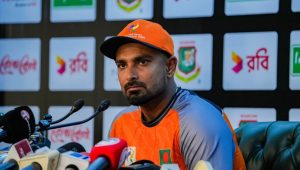
He was once the youngest man to stand in a Test match, later won five consecutive ICC Umpire of the Year awards, and is regarded as one of the finest officials in cricket history. Now Simon Taufel has embarked on a fresh challenge in Bangladesh.
In an exclusive interview with Times of Bangladesh, the Australian speaks about his two-year contract with the Bangladesh Cricket Board (BCB), his vision for improving umpiring structures, and his belief that officiating is “more art than science.” From his accidental start in the game after a career-ending back injury to mentoring the next generation of referees and umpires, Taufel explains why consistency, calmness and communication will be the keys to raising standards.
You have come all the way from Australia to Bangladesh. What brings you here?
The Bangladesh Cricket Board (BCB) has made a strategic investment decision to improve its umpiring and officiating system, and to support the development of umpires and referees. It is a very courageous and important decision. Over the next two years, my aim is to help enhance the system of development, talent identification, assessment, feedback, and support. I will also be working closely with umpires and referees to help them explore their potential.
You are here on a two-year contract. What is the scope of your work and how are you approaching it?
There are around eight areas I will be focusing on. These include assessment, accreditation, and setting minimum standards for umpires. I will be educating referees on how to assess better and what to look for, as well as improving our data management systems. We want a clear pathway and a transparent selection and appointments policy.
I will also work with umpires to help them progress through that pathway, looking at panel sizes, who we are selecting, why we are selecting them, and improving overall domestic standards. That will, in turn, allow the right umpires and referees to make it to the international level.
Your cricket career ended quite early because of a back injury. Tell us about that journey.

I started playing cricket relatively late, around age 12, and was fortunate to represent New South Wales at Under-19 level with players like Michael Slater and Adam Gilchrist. But at 20, a back injury forced me to stop playing.
An opening bowler I played with, Dave Budge, suggested we both take an umpiring course. We sat the exam, he did not pass, I did. So, while at university, I began umpiring to earn some extra pocket money. I had no intention of becoming an umpire, I was an accidental one. But here I am.
From an accidental umpire to a five-time ICC Umpire of the Year. How did that journey change you mentally?
When I started, I thought umpiring was easy and that I would not make mistakes. But in my first few games, I realised that was not true. Every level you go up, you get new information, and when you start watching your own decisions on TV, it is quite confronting.
You learn to cope with mistakes, to spend long periods away from home, missing birthdays and holidays. It teaches you about life and perspective. At the end of the day, it is just a game of cricket, but sometimes we take sport and fandom too seriously.
What is the secret to being a top umpire? How did you stay consistent and motivated year after year?




My coach played a big role in keeping me grounded. Even after awards, he would always ask, “What are we doing to train like we are number two?” Because the standard in 2025 will not be the same in 2026, you always have to evolve.
The key comes down to what I call the three Ps: preparation, process, and practice. Prepare the right way by anticipating the ‘what ifs’ and high-risk situations. Stick to your process, be specific, and be strong. And practise the right things, not the wrong ones. Practise to get better, not just to repeat habits.
You have been watching the umpires in the NCL T20. What are your impressions of Bangladesh’s umpiring standards?
I am really impressed by their thirst for knowledge and their positive mindset. They ask for feedback and take it well. Their strengths are in the hard skills, knowledge of the laws, playing conditions, and decision-making.
The growth areas are in the soft skills, managing people, handling conflict, dealing with pressure, and bouncing back from setbacks. The best umpires in the world are great communicators, calm, composed, and effective under pressure.
These days, umpires face intense scrutiny due to social media and technology. How should they mentally prepare for that reality?
That is a big issue. Personally, I stay away from social media, no Twitter, no Instagram. It is not a source of good feedback; it is distracting and counterproductive. If you want real feedback, talk to your coach, your colleagues, or the match referee.
Yes, there is scrutiny with 30-plus cameras and commentary analysis, but umpires need to block out the noise, focus on their process, and stay rational, not emotional.
How has technology helped umpires improve their decision-making beyond DRS?
I believe umpiring is more of an art than a science. We have gone too far trying to turn cricket into data and percentages. While technology is useful, the best officials excel in soft skills, communication, judgment, and discretion.
For example, knowing when to apply a penalty, when to give a warning, or when to let something go, that is art. I am working with the BCB and referees to capture the right data and use it for trend and error analysis, but we cannot lose sight of the human side.
Who were the best umpires you worked with, and what made them special?
Darrel Hair was incredibly strong and decisive. David Shepherd, on the other hand, could build relationships with everyone, regardless of culture. He taught me that to be a good umpire, you first have to be a good person.
Rudi Koertzen was another great, strong, funny, and human. We spent so much time together as a team, and that bond is crucial. We do not have to love each other, but we do need to understand, respect, and support one another.
Sharfuddoula Saikat has recently joined the ICC Elite Panel. What do you make of his rise?
Saikat is a testament to perseverance. He has been umpiring internationally for about a decade and has been patient and hardworking. Like players, umpires cannot control when they are selected; they just have to keep improving.
Now that he has made the elite panel, the real work starts. It is like making the national team, that is not the end goal. You have to perform, contribute, and keep getting better. You never know how good you can be until you try.
It has been a pleasure speaking with you, Simon. Hopefully, we will talk again about the lighter side of your life someday.
Absolutely, mate. It has been a pleasure. Bhalo bhalo bhalo!
You have even learned some Bangla, very impressive!
As Bangladesh cricket looks to strengthen its foundations beyond the playing field, Simon Taufel’s presence represents both ambition and investment in the country’s future. With his reputation for discipline, perspective and innovation, the Australian is now tasked with helping Bangladesh’s officials bridge the gap from promising domestic umpires to world-class international figures. If his philosophy of preparation, process and practice takes root, the BCB’s bold move could set new standards for years to come.
– Shahnoor Rabbani