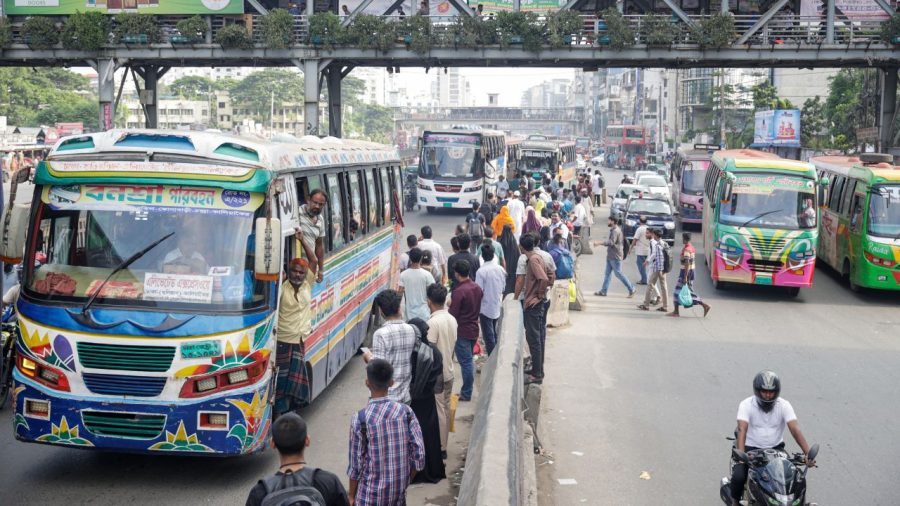



The distance from Moghbazar to Gabtoli is 9.4 kilometres. The government-fixed fare should be Tk25, but MM Lovely and Labbaik Paribahan charge Tk40 – the fare for a 15-kilometre journey.
The distance from Shahbagh to Merul Badda is 9.2 kilometres, and the fare should be Tk24. Ramzan Paribahan, however, charges Tk30, prompting a heated argument between passenger Jarif Hossain and a bus worker.
When Jarif asked to see the fare chart, he found that none was displayed. The driver’s assistant told him that everyone paid the same rate and that he had to do so too.
Overcharging on city and long-distance bus routes is nothing new. But transport companies have been exploiting the recent fuel price increase to collect even higher fares.
Bangladesh Road Transport Authority (BRTA) has previously launched enforcement drives following fuel price adjustments. This time, however, it has only prepared a revised fare chart and distributed it to transport companies.
BRTA fixes fares per kilometre, but transport companies charge fixed amounts for journeys between designated points using a chart known as a waybill. Once passengers pass a designated point, they must pay the full fare for the next section, regardless of where they get off.

A passenger travelling on Lovely Paribahan from Moghbazar to Asad Gate should pay Tk15 but was charged Tk25. Under the waybill system, two signatures are required along the route, with fares of Tk10 and Tk15 for the two sections.
Section 34(3) of the Road Transport Act 2018 prohibits carrying passengers on buses and minibuses unless a fare chart is displayed in a clearly visible place. Yet transport companies often leave the charts off their buses because displaying them limits opportunities to collect extra fares. Even when put up, they are removed. The same applies to buses operated by the state-owned Bangladesh Road Transport Corporation (BRTC).
Asadul Islam, a passenger on Bihanga Paribahan’s Mirpur 12–Sadarghat route, said, “They demand an extra Tk10 to Tk15 without any calculation. When we ask to see the chart, they make excuses or start arguing.”
Asked why Azmeri Glory Paribahan had no fare chart, fare collector Mohammad Sumon Mia claimed, “Passengers themselves pull down and tear up the fare lists. Even when new lists are put up repeatedly, they do not last.”




Mohammad Rubel, a conductor of Dishari Paribahan, offered a different explanation. He said, “We collect fares according to the rates set by the owners’ association.”
Saidur Rahman, executive director of the Road Safety Foundation, said, “If the government’s fare list, including the name and registration number of each passenger bus, is displayed in a visible place inside the vehicle, ordinary passengers will be able to lodge specific complaints with law enforcement agencies.”
Mohammad Saiful Alam, secretary-general of the Bangladesh Road Transport Owners Association, said passengers already knew the fares, so displaying the chart prominently was unnecessary. However, he acknowledged that buses were required to display the fare list.
Passengers have few avenues for lodging complaints. Without BRTA mobile courts, no action can be taken against operators collecting excessive fares, while police cannot act independently. Although BRTA has a helpline and a website for complaints, few passengers use these channels. Even when they do, there is often no evidence because tickets are not issued for the fares collected.
On the Savar Paribahan route from Raysaheb Bazar in Old Dhaka to Savar, a distance of around 28 kilometres, the fare rose from Tk75 to Tk90 following the fuel price increase. At the prescribed rate of Tk2.60 per kilometre, however, the fare for a minibus should be Tk73. Passengers were already paying more than the prescribed rate before the latest increase and are now being charged another Tk15.
Driver Md Rafiqul Islam said, “We have nothing to do. We collect fares according to the owners’ instructions.”
Junaed Sheikh, a student of Jagannath University, said, “Previously, students were charged Tk25 to Tk30 on the Savar route. Now they are being asked to pay Tk40 to Tk45.”
BRTA Chairman Mohammad Habibur Rahman repeated an assurance made previously. He said that if the government-fixed fares were not followed on the ground, necessary action through mobile courts would be taken.

Same arbitrary fare collection on long routes
Tungipara Express charges Tk740 for a non-AC bus from Gulistan to Khulna Zero Point, a distance of around 200 kilometres. According to BRTA sources, the fare should be Tk612. Even after adding Tk70 in expressway and Padma Bridge tolls, the total should be Tk685.
The prescribed long-distance fare for a 51-seat non-AC bus is Tk2.40 per kilometre. Companies may charge proportionately more if they reduce the number of seats to provide passengers with greater comfort. However, operators calculate fares on the basis of 40 seats, although their buses have between 44 and 47 seats.
Even on a 40-seat basis, the fare should be Tk3.06 per kilometre. For 44 seats, it should not exceed Tk2.80, while for 47 seats, the maximum should be Tk2.60 per kilometre.
Golden Line Paribahan charges Tk850 for a non-AC bus from Gulistan in Dhaka to the Kaliganj bus terminal in Jhenaidah, a distance of around 196 kilometres. Even including tolls, the fare for a 40-seat bus should be no more than Tk670.
Another tactic is to inflate journey distances. Although the distance from Mohakhali in Dhaka to Kapasia in Kishoreganj is 106 kilometres, passengers are charged fares calculated on the basis of 135 kilometres. Operators add 10 to 30 kilometres to the stated distance on almost every long-distance route to collect extra money.
Bus fares were adjusted on 24 September following a fuel price increase. The revised rates were Tk2.60 per kilometre for minibuses and Tk2.70 for large buses on city routes, and Tk2.40 for 51-seat buses on long-distance routes. Fares rose by around 17 per cent from the previous rates, but actual increases have been twice as high or more.
Before the adjustment, Road Transport Minister Shaikh Rabiul Alam warned on 21 and 22 September that route permits could be cancelled if operators charged excessive fares. The government has issued similar warnings in the past.