


The February general election raised hopes that businesses would resume investing after months of political uncertainty had weighed on economic activity and job creation.
Eight months later, the picture is even grimmer. Hopes for growth and investment revival are fading.
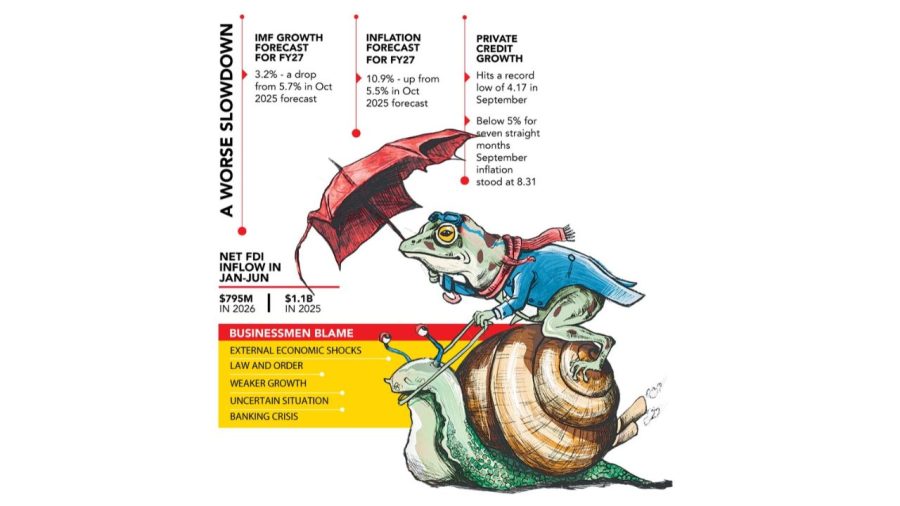
Growth and inflation outlook worsened further, and entrepreneurs’ caution dragged the private-sector credit growth to the lowest level in records.
It hit a record low of 4.17 per cent in September, against inflation of 8.31 percent, reflecting growing reluctance among businesses to borrow and expand.
Private-sector credit growth has been below 5 per cent for a seventh consecutive month, despite Bangladesh Bank’s target of 6.8 per cent private-sector credit growth for the first half of the 2026–27 financial year.
“This is a worrying reflection of declining business confidence, subdued investment and mounting economic uncertainty,” said Asif Ibrahim, a former president of Dhaka Chamber of Commerce and Industry (DCCI).
Meanwhile, the International Monetary Fund cut its growth forecast to a 38-year low of 3.2 per cent this fiscal year amid external shocks and structural issues, which is half of what the country achieved in 2021-22.
Behind the figures lies a combination of high borrowing costs, weak growth and domestic demand, banking-sector vulnerabilities, energy shortages and persistent concerns over law and order.
“Together, these are making businesses question whether new investment can deliver adequate returns,” said Rizwan Rahman, former president of the Dhaka Chamber of Commerce and Industry (DCCI).
The change in government has yet to produce the business confidence many had expected.

Domestic investors remain cautious, while foreign investment has also weakened.
Net foreign direct investment inflows fell 28 per cent year on year in the first half of 2026, dropping to around $795 million between January and June from more than $1.1 billion in the same period a year earlier, according to the Bangladesh Bank.
The decline came despite a recovery in overall FDI during 2025.
Rahman said the deterioration in law and order during the interim government had discouraged foreign investors from committing fresh capital under an unelected administration.
Although an elected government has since taken office, he said, the situation has not improved significantly. Limited government management capacity and the failure to restore investor confidence continue to weigh on business decisions.
Recent developments in the garment sector have also sent a deeply negative signal to international investors, he said. Stronger intelligence surveillance and timely preventive measures could have helped avert some of the incidents.




Domestic businesses, meanwhile, are also holding back.
“Ensuring the rule of law and providing adequate support to the private sector are essential to restoring investor confidence. If the government cannot ensure these basic conditions, what is the point of taking bank loans and investing in new ventures?” Rahman said.
High borrowing costs make expansion harder
The cost of financing remains another major deterrent. Bangladesh Bank cut its policy rate from 10 per cent to 9.5 per cent on July 31, but commercial lending rates have remained at 13-15 per cent.
For businesses already facing weak sales and rising operating costs, borrowing at such rates makes new factories and expansion projects financially risky.
Persistent inflation has eroded consumers’ purchasing power, leaving companies uncertain about whether additional production would translate into higher sales.
Fahmida Khatun, distinguished fellow at the Centre for Policy Dialogue (CPD), said the continued decline in private-sector credit growth was worrying.
High borrowing costs, subdued domestic demand, uncertainty over the economic outlook and energy supplies, and declining confidence in future returns are making businesses cautious, she said. Many companies are prioritising existing operations and debt obligations instead of committing funds to new projects.
“The availability of liquidity in the banking system will not automatically translate into productive investment unless businesses see sufficient market demand and predictable economic conditions to justify expansion,” she said.
Restoring investment will require consistent policies, better infrastructure and reliable energy supplies, Khatun said. The government must reduce the cost and uncertainty of doing business while strengthening domestic consumption and export demand.
Banks, too, need to assess viable proposals carefully so that financially sound businesses can obtain the financing they need.
“Without investment, there will be no employment generation. This could adversely affect the economic welfare of a large section of the population,” she said.
Even businesses willing to invest face a banking sector struggling with the legacy of past irregularities and a mounting burden of bad loans.
Classified loans reached Tk 6,06,555 crore at the end of June 2026, accounting for 32.78 per cent of total outstanding loans, according to Bangladesh Bank data.
The burden weakens banks’ balance sheets, raises provisioning requirements and reduces their capacity to extend fresh credit. Banks facing capital shortages and deteriorating asset quality have become more cautious about lending, further restricting financing for productive investment.

Syed Mahbubur Rahman, managing director and CEO of Mutual Trust Bank, said several major industrial groups were struggling and had reduced production, weakening demand for financing.
Irregularities during the previous government had severely weakened the banking sector and constrained productive economic activity, he said.
The result is a difficult cycle. Businesses are reluctant to expand, while banks weakened by bad loans have less room to finance those that are prepared to invest.
Energy shortages and government borrowing add pressure
Uncertainty over gas and electricity supplies is adding to the risks facing investors. Interruptions can disrupt production and raise operating costs, making it harder for businesses to calculate the likely returns from new projects.
Md Fazlul Hoque, administrator of the Federation of Bangladesh Chambers of Commerce and Industry and former president of the Bangladesh Knitwear Manufacturers and Exporters Association, said the global economic slowdown and energy shortages had discouraged the establishment of new factories, weakening investment demand.
Government borrowing is another pressure on the credit market. Net government borrowing from banks reached Tk 47,800 crore in the first four months of the 2026–27 financial year, nearly 43 per cent of the annual target, according to Bangladesh Bank sources.
As public borrowing increases, competition for available bank credit could intensify, potentially leaving less financing for private businesses.
Investment remains hostage to uncertainty
The record-low credit growth reflects more than a shortage of bank liquidity. It exposes a deeper crisis of business confidence. Weak demand limits the incentive to expand, high borrowing costs make investment expensive, and uncertainty over law and order, energy supplies and policy direction raises the risks.
Banking-sector weakness compounds the problem by restricting the flow of credit to productive businesses. Meanwhile, rising government borrowing could intensify competition for available funds.
The consequences extend beyond investment figures. When businesses defer expansion, job creation and income growth suffer. Weaker economic activity then further dampens demand for credit, reinforcing the cycle.
Breaking it requires more than a change in political leadership.
The government must restore law and order, ensure reliable energy supplies, contain inflation, reduce regulatory uncertainty and strengthen banking discipline, said Bangladesh Chamber of Industries President Anwar Ul-Alam Chowdhury.
Businesses need not only access to finance but also confidence that investment will be viable, he said, adding, “The election changed the political landscape. It has yet to change the economic calculations keeping investors on the sidelines.”