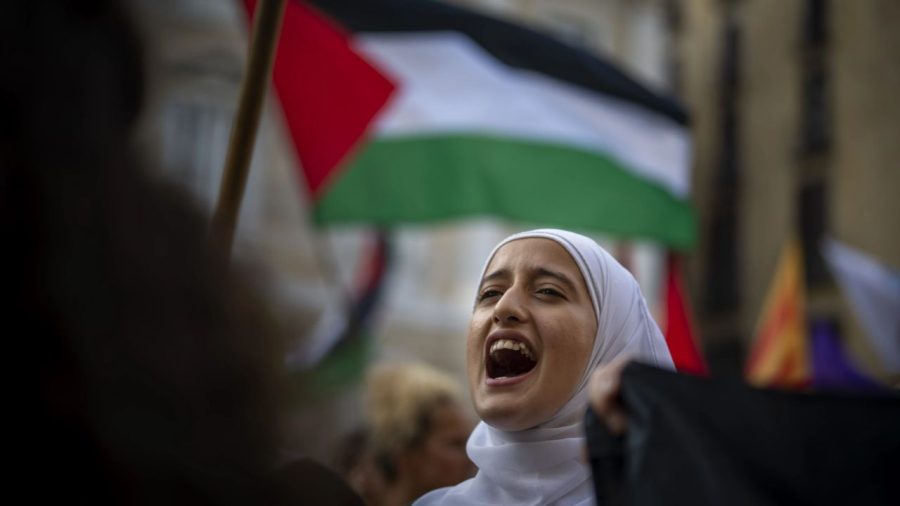



The Palestinian flag and the traditional keffiyeh scarf have increasingly emerged as prominent symbols across European mass demonstrations, appearing at student strikes in France, housing rallies in Spain, anti-corruption protests in Albania, and civil standoffs in Northern Ireland.
However, their growing presence in domestic European movements has sparked a debate among activists, politicians, and Palestinian observers over whether these emblems represent a unified anti-colonial fight or risk diluting Palestine’s national struggle.
In Belgium, Kenny Pierre Agboton of the Free University of Brussels for Palestine platform stated that carrying the flag signals a stance against colonialism and repression, framing the Palestinian cause as a central crossroad for social and climate movements in Western Europe.

His platform coordinates with student groups across Belgian universities to distribute flags during nationwide rallies, reports Al Jazeera.
In France, high school and university students supported by trade unions and political groups have organised blockades to demand better school conditions, smaller class sizes, and affordable education while waving Palestinian flags.




Alice Cohen-Morzadec, spokesperson for the French Student Union, described the flag as a symbol linking local demands to broader resistance against global inequality, capitalism, and colonialism.
Political figures have also defended the practice. Mario Furore, an Italian Member of the European Parliament representing the Five Star Movement, questioned criticisms of citizens displaying the flag during protests, pointing to the tens of thousands of casualties reported in Gaza and the West Bank since October 2023.
The political framing of Palestinian symbols varies across Europe due to local historical contexts.
In Muslim-majority Albania, activist and former political prisoner Fatos Lubonja noted that he is among the very few wearing the keffiyeh or carrying the flag at domestic anti-corruption demonstrations.

Lubonja explained that Albanian national identity historically associated Islam with the Ottoman occupation.
As a result, post-communist national narratives heavily emphasize Western integration, NATO alignment, and pro-American stances, which in turn fosters strong pro-Israel sentiments among the general public.