India wants to maintain a “positive, constructive and forward-looking” relationship with Bangladesh, and is committed to working together despite recent political shifts, anti-India slogans, and garment sector unrest, the country’s Ministry of External Affairs said.
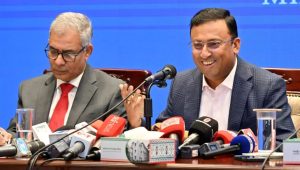
Randhir Jaiswal, official spokesperson of the Ministry of External Affairs, presented New Delhi’s position on Tuesday while responding to several queries regarding Bangladesh during a regular bilateral media briefing.
Addressing questions on the normalisation of bilateral ties and geopolitical balance following the formation of a new government in Bangladesh, the spokesperson said India has always desired a positive, constructive, and forward-looking partnership.

Jaiswal added that this remains India’s expectation and that New Delhi is committed to working towards this goal.
Asked about anti-India slogans raised at political rallies in Dhaka and concerns over garment worker protests impacting regional trade and supply chains, Jaiswal informed that India is keeping a close watch on the overall situation and recent developments in Dhaka, though he refrained from making detailed comments.


Regarding the upcoming expiry of the Ganges Water Sharing Treaty and demands within Bangladeshi political circles for fair water distribution, the spokesperson explained that the Joint Rivers Commission (JRC) serves as the institutional framework for discussions on all transboundary common rivers, including the Ganges.
He added that there is currently no new update or progress on the matter.
On a potential visit by top Bangladeshi leadership, the spokesperson explained that a formal invitation has been extended to the prime minister of Bangladesh to visit India, with schedule details to be shared through appropriate diplomatic channels in due course.

Meanwhile, he declined to comment directly on political allegations made by a political assistant in Dhaka.
According to analysts, despite political debates and ground-level discontent in Dhaka, Delhi is attempting to avoid public tension and project a message of diplomatic stability and positive engagement.