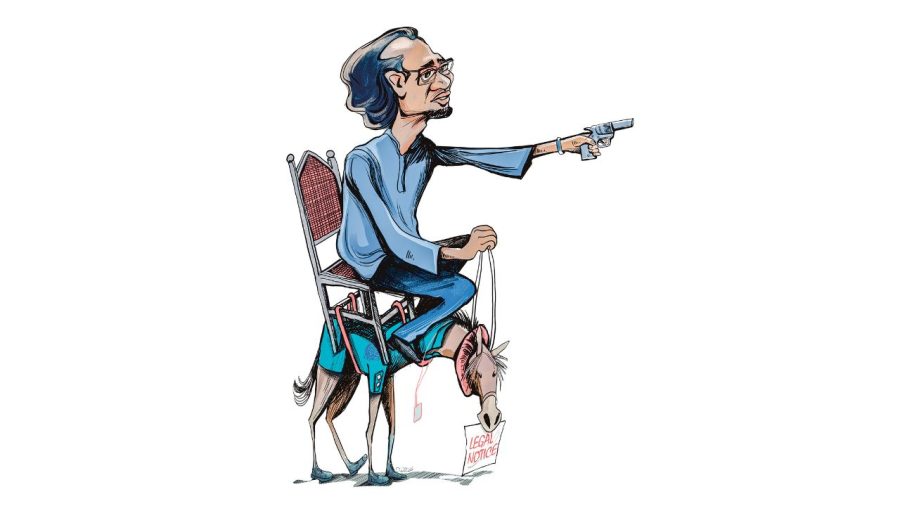



A remark by Prime Minister’s Adviser Zahed Ur Rahman that police have the “right to kill” someone if circumstances warrant it has raised questions about its legality.
A former inspector general of police (IGP), a senior Supreme Court lawyer and a member of the Human Rights Commission have said that although police are legally entitled to use force in self-defence, this cannot be interpreted as a general right to kill.
“The main point is that the purpose of using force must be to maintain public order and save lives, not to kill anyone,” former IGP Baharul Alam told TIMES.
Senior Supreme Court lawyer Manzill Murshid warned that such statements could create uncertainty within the police force.
“The police force is still traumatised following the mass uprising. In this situation, if such statements come from responsible levels of the government, they could create instability within the force. Officers may develop the impression that the authorities themselves have authorised them to use force in this manner.”
Zahed Ur Rahman was a vocal critic of the ousted Awami League government, regularly challenging it on social media and at various programmes when the opposition accused it of intolerance towards criticism.
After the national election in February, the BNP government appointed him adviser to the prime minister on policy and strategy, with the status of a minister. He is also in charge of the Ministry of Information and Broadcasting and the Ministry of Cultural Affairs.

Zahed briefs the media on government activities at the Secretariat every Tuesday. His remarks frequently trigger public debate and criticism, with some arguing that his attempts to manage the government’s public relations have instead made him a liability.
At this week’s briefing, he faced questions mainly about garment workers’ protests and the latest LPG price increase, which raised the price of a 12kg cylinder to Tk2,060.
Asked about police use of force during the workers’ protests, he said, “Police have the legal right to use force. Within the right of self-defence, police have the right to kill someone if such circumstances arise, within the bounds of the law.”
He also said, “We do not want this government to suppress these protests in the way they were suppressed before. … We want to handle the situation in such a way that there is minimal damage and the least possible hardship for the public.”




Asked whether the adviser’s statement was legally correct, Baharul said, “Police have the right to defend themselves. However, ‘the right to kill someone’ is not the language of the law. If a person’s life is under threat, police may take countermeasures in self-defence. Even if someone dies as a result, that must be considered in the context of self-defence; it cannot be described directly as a right to kill.”
Sections 96 to 102 of the Penal Code 1860, recognise the right to private defence. Under Section 100, a person facing an attack that reasonably creates a fear of death or grievous hurt may use force that could cause the attacker’s death in self-defence.
However, Section 99 prohibits causing more harm than necessary in exercising that right. Sections 127 and 128 of the Code of Criminal Procedure, 1898, empower authorities to order the dispersal of unlawful assemblies and use force if those orders are disobeyed.
These provisions allow necessary and lawful force depending on the circumstances, but do not give police a general right to kill to suppress protests, maintain public order or enforce the law.
Baharul said police must follow a graduated approach when dispersing an unlawful assembly. “To disperse an unlawful assembly in the interest of maintaining public order, police must first use loudspeakers to order people to leave.”
“Depending on the situation, they may then gradually resort to measures such as tear gas, water cannon and baton charges. However, if a crowd attacks the police and their lives are at risk, the question of using firearms may arise under the law,” he added.
Manzill Murshid said firearms could be used only as a last resort. “Police can fire only in self-defence and when there is a threat to life. Even then, they must follow the law and prescribed procedures. The first options are less severe forms of force, including tear gas and baton charges. Firing is the last resort. And even when firing, shots must be aimed at the legs, not the chest.”
Ilira Dewan, a member of the Human Rights Commission formed during the interim government, said excessive police force had already cost the previous government its power. “The previous government had to leave power because of the excessive use of force by police. If force is again used as a tool to suppress movements in the same way, the very objective of the change will be undermined.”
Trials are under way at the International Crimes Tribunal over incidents of excessive police force and killings through indiscriminate firing during the 2024 mass uprising, which are being treated as crimes against humanity.

The accused include the ousted Awami League government’s prime minister, cabinet members, senior party leaders and leaders of affiliated organisations, as well as senior police officials. Verdicts have already been delivered in several cases.
Ilira also questioned whether the latest remarks reflected a broader government position. “A few days ago, the IGP spoke about crossfire, and today a government adviser has made a similar statement. This also raises the question of whether any such decision has been taken at the highest levels of the government.”
She said the labour movement should not be treated solely as a law-and-order issue, arguing that workers’ wages, living costs and the value of their labour must also be considered.
“Workers have the right to live and responsibilities towards their families. The government may have limitations, but even within those limitations, it is possible to assure workers about their legitimate demands and create a path towards compromise. In the past, firing on protesters did not bring a lasting solution to movements. Therefore, taking the same path again is in no way acceptable,” she said.
Mohammad Saiful Alam Chowdhury, associate professor of mass communication and journalism at Dhaka University, said government officials in important positions should be more careful with their wording and legal interpretations.
“As an information adviser, Zahed Ur Rahman’s remarks could affect the government’s image. Amid labour protests and public discontent, such comments on police use of force could create confusion among the public. If the government cannot clearly communicate its position, it will also have a negative impact on public relations,” he said.
The same briefing also drew attention to Zahed’s remarks on LPG prices. The previous day, the Energy Regulatory Commission had raised the price of a 12kg cylinder by Tk223 to Tk2,060. Zahed said the decision had been taken in the public’s long-term interests, but his comments triggered widespread trolling on social media.
Asked whether Zahed was fulfilling his public relations responsibilities or becoming a liability for the government, Saiful Alam Chowdhury said, “He needs to explain himself more clearly so that the intended meaning of his statements is properly understood.”