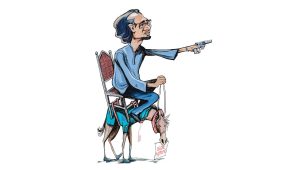
Salman F Rahman, adviser to now deposed prime minister Sheikh Hasina, and Anisul Huq, former law minister, were the masterminds behind imposing curfew during July uprising, a coordinator of Anti-Discrimination Student Movement told International Crimes Tribunal-1 on Tuesday.
SM Sayem, testifying as the 13th prosecution witness while Anisul Huq and Salman F Rahman were present in the dock, alleged that the imposition of curfew was one of the main reasons for the mass killings.
He believed that so many casualties might not have occurred had the curfew not been imposed.
Sayem, a student of the marketing department at Dhaka University, told the tribunal that according to United Nations data, more than 1,400 people were killed in attacks by various government forces during the movement.

However, to their knowledge, the death toll exceeded 2,000, while over 25,000 people were injured, with around 4,000 permanently disabled after losing hands, legs, or eyes.
Recounting his experience of taking injured protesters to hospital, Sayem said several died later.




He described horrific injuries, including one victim whose intestines came out after being shot in the stomach, another whose brain hung out after a gunshot to the head, and a third who lost an eye to a bullet.
He also alleged that protesters were killed using helicopters on the orders of Sheikh Hasina.
Sayem further alleged that while Salman F Rahman and then law minister Anisul Huq were the primary planners of the curfew, Zunaid Ahmed Palak, former state minister for information and communication technology, planned the internet shutdown.

He claimed in his testimony that Salman F Rahman encouraged Palak in carrying out the internet shutdown.
Describing personal attacks against him, Sayem told the tribunal that several raids were conducted on his house during the movement to arrest him, leaving a residential wall riddled with bullets.
He added that he received death threats warning he would be killed wherever found, telling the tribunal that those memories continue to haunt him.