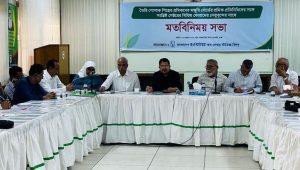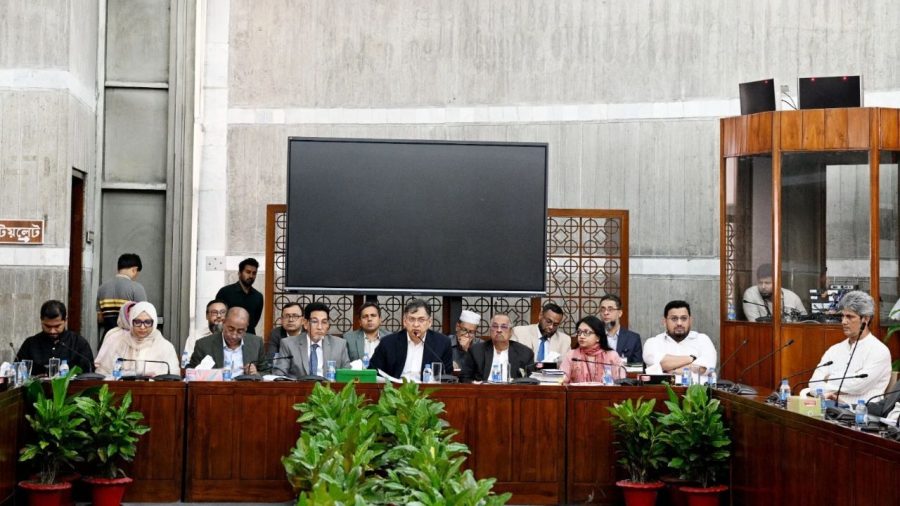



Special Committee on Constitutional Amendment held a view-exchange with representatives of student organisations on Tuesday to discuss various constitutional amendment issues, including the implementation of July National Charter, powers of prime minister, and recognising education and healthcare as fundamental rights.
However, invited leaders from several organisations, including National Citizen Party (NCP), Islami Chhatra Shibir, and Islami Chhatra Andolan Bangladesh, boycotted the session, claiming that the government’s constitutional amendment initiative contradicts aspirations of July mass uprising and the verdict of the referendum.
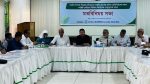
The meeting took place in the Cabinet Room of Jatiya Sangsad Bhaban, presided over by Salahuddin Ahmad, home minister and chairman of the committee.
This session was attended by committee members including Nurul Islam Moni, chief whip; Md Asaduzzaman, law minister; Zainul Abedin; Md Zonayed Abdur Rahim Saki, minister of state for planning; Md Nurul Huq, minister of state for expatriates’ welfare; Mir Mohammad Helal Uddin; and Farjana Sharmin, minister of state for social welfare.
Broad agenda covering key reforms
According to a press release issued by the Parliament Secretariat, discussions with student representatives, including Anti-Discrimination Student Movement, covered the inclusion of education and healthcare as fundamental rights, legal protection for July fighters, implementation of mass uprising demands, sustainable implementation of the July Charter, powers of the prime minister, protection of women and children, emergency provisions, independence of constitutional bodies, and the referendum.

The meeting also recalled the contributions of students during the July mass uprising and discussed drafting a user-friendly, modern constitution for youth welfare.
The press release noted that the July Charter explicitly specifies “reforms subject to constitutional amendment” and that the government remains sincere about its full execution, urging youth not to be misled by opposition propaganda.
Chhatra Dal opposes curbing PM powers
Speaking to reporters after the meeting, Rakibul Islam Rakib, central president of Jatiyatabadi Chhatra Dal, urged resolving differences through dialogue rather than opposing for the sake of opposition to achieve the goals of the July-August uprising.


He pointed out that elected representatives in parliament are offering views, warning that any student group stepping away from discussions must take responsibility for disrupting the aspirations of the mass uprising.
Nasir Uddin Nasir, central general secretary of Jatiyatabadi Chhatra Dal, explained that his organisation opposed the proposal in the July National Charter to reduce the powers of the prime minister, arguing that the public gave a mandate for parliamentary democracy and thus prime ministerial powers should not be curtailed.
On reinstating the caretaker government system, the organisation suggested avoiding complex formulas and pursuing an acceptable mechanism through discussions with all stakeholders.
To establish a balance among the three organs of the state, Chhatra Dal proposed ensuring judicial independence alongside accountability, while also suggesting the re-establishment of “full trust and faith in Almighty Allah” as a fundamental principle of the constitution.
Nasir added that as the BNP secured over 50 per cent of votes in the national election, Chhatra Dal proposed implementing the July National Charter with a Note of Dissent, taking into account the party’s “No” vote stance in the referendum.
Expressing concern that amending the constitution through a Constitutional Reform Council could trigger a constitutional crisis and lead to future invalidation by the Supreme Court, the organisation urged passing amendments as a bill through parliamentary procedure, promising to submit remaining views in writing within seven days.
Boycotting leaders cite ‘betrayal of mandate’
Meanwhile, announcing his decision to boycott the meeting in a Facebook post, Asif Mahmud, former coordinator of Anti-Discrimination Student Movement, said there was no question of becoming part of the “deception” being carried out against the public mandate delivered in the referendum under the guise of the Constitution Amendment Committee.

Sadique Kayem, vice president of Dhaka University Central Students’ Union (Ducsu) and former Dhaka University president of Chhatra Shibir, also announced a boycott via Facebook, explaining that the July mass uprising aimed at radical structural reform rather than amending a few articles. He argued that parliament cannot establish a new constitutional arrangement outside the basic structure using amendment powers under Article 142, citing the invalidation of the 5th, 8th, and 13th amendments by courts to warn of legal risks if July Charter proposals are implemented solely through parliamentary amendments.
Calls for independent reform council
Sadique Kayem noted that the July Charter includes proposals for changing state principles, creating a bicameral parliament, limiting the prime minister’s power and tenure, expanding presidential authority, and restructuring the judiciary and state bodies.
Highlighting that 68.59 per cent of voters backed state reform by voting “Yes” in the referendum, he demanded the formation of an independent Constitutional Reform Council to execute the verdict.
In a separate press release, Islami Chhatra Andolan Bangladesh expressed that it refrained from attending due to the government’s lack of effective measures to implement the July Charter and reform the constitution.
The organisation claimed that despite the public voting “Yes” for state reform in the referendum, the government ignored the verdict, describing such view-exchange meetings as a mockery that fails to meet public expectations.