


An escalating water crisis, prolonged droughts, and extreme temperatures are severely threatening agriculture, livelihoods, and public health across the Barind Tract, prompting urgent calls for government intervention and robust protections for communities vulnerable to climate change.
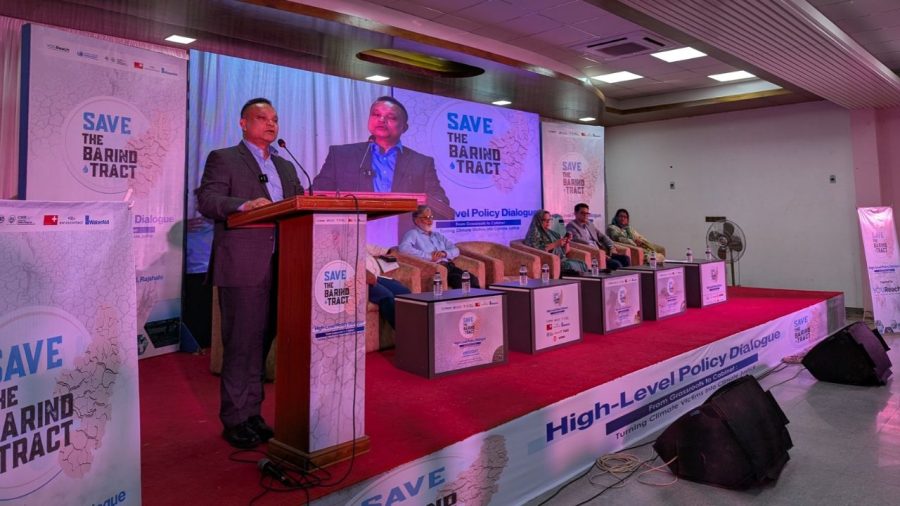
At a high-level policy dialogue held in Rajshahi, lawmakers, policymakers, researchers, and development experts urged stricter controls on groundwater extraction, the equitable distribution of irrigation water, and the meaningful participation of indigenous and marginalised communities in water management decisions. Delegates emphasised the necessity of harmonising government policies, academic research, and development projects to deliver climate justice to affected populations.
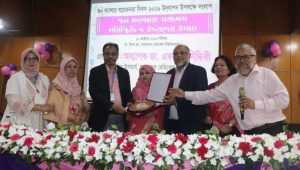
Titled “Save the Barind Tract,” the dialogue was organised by YOUReach under the theme “From Grassroots to Cabinet: Advancing Climate Justice for Climate-Affected Communities” at the Victoria Convention Hall in the city’s Terokhadia.
Supported by the Embassy of Switzerland in Bangladesh, the event was delivered in partnership with the Office of the United Nations High Commissioner for Human Rights (OHCHR) and the Centre for Climate Change and Environmental Research (C3ER) at BRAC University, alongside assistance from the GO4IMPACT programme, implemented by WaterAid Bangladesh and Swisscontact Bangladesh.
Groundwater depletion and unequal access
Following the opening session, Professor Md Golam Mostafa, director of the Institute of Environmental Science at the University of Rajshahi, delivered the keynote address. A primary focus of the subsequent panel was the accelerating depletion of groundwater and systemic discrimination in irrigation access.

Rajkumar Shah, executive director of Anagrasar Samaj Unnayan Sangstha, highlighted that historical land deprivation has left many indigenous families in the Barind tract landless. He noted that deep-tube-well operators and wealthy landowners maintain close alliances, leaving sharecroppers and marginalised farmers struggling to obtain water for crops, and occasionally for basic drinking needs. “Indigenous men and women must be included in decisions on water distribution and management,” Shah asserted, demanding equal access to irrigation.
Kazi Rabiul Alam, chairman and associate professor at the Anthropology Department at the University of Rajshahi, urged the creation of alternative livelihood options alongside agricultural reforms. He stressed that ponds and natural water bodies must remain under community ownership to safeguard local access, arguing that regional development plans must reflect local realities rather than top-down models.



Policy gaps and environmental adaptation
Roufa Khanam, deputy director of C3ER at BRAC University, pointed out that gaps in understanding macro-level frameworks, such as the National Adaptation Plan (NAP) and the Delta Plan, hinder effective local implementation. Noting that the Barind region encompasses three of the eleven stress zones identified in the NAP, she urged tighter alignment between research and field projects.
Khanam also emphasised educating farmers on water-saving techniques, including alternate wetting and drying (AWD) for rice cultivation and targeted drip irrigation. She remarked that while existing policies assign distinct institutional responsibilities, inter-agency coordination remains critically weak.
The event subsequently divided into seven thematic roundtables covering water scarcity, drought, heatwaves, economic livelihoods, agriculture, public health, and the rights of indigenous peoples and persons with disabilities.
Heatwaves, health risks, and district-level planning
During the concluding executive session, SM Ziauddin Haider, special assistant to the prime minister, warned that rising temperatures, erratic rainfall, falling water tables, and depleted soil moisture are jeopardising public health alongside crop yields. He warned that extreme climate stress is driving higher incidences of heatstroke, kidney disease, cardiovascular illness, and dehydration, while severely impacting maternal and child nutrition.
To combat these threats, Haider advocated for planned afforestation, the establishment of green belts, and the restoration of degraded canals, wetlands, and rivers. Referencing the national initiative to plant 250 million trees over the next five years, he insisted the Barind region receive priority allocation.
Reserved-seat MP Mahmuda Habiba observed that transboundary river barrages and unplanned groundwater extraction have exacerbated regional water deficits. She called for rigorous, research-driven assessments across every upazila in Rajshahi, Naogaon, and Chapainawabganj to tailor solutions to specific local vulnerabilities.

Delegates collectively advocated for transitioning towards low-water crops, restoring natural surface reservoirs, and establishing enforceable legal frameworks to halt uncoordinated groundwater pumping.
Eight-point action plan proposed
Concluding the symposium, YOUReach Adviser Parvez Azharul Haque presented an eight-point action plan. Key recommendations included enforcing immediate limits on groundwater depletion, guaranteeing transparent and non-discriminatory water distribution, reclaiming public ponds, promoting drought-resistant crops, safeguarding minority rights, and securing dedicated long-term budgetary allocations.
The dialogue featured contributions from lawmakers Nazrul Islam and Md Mostafizur Rahman, alongside Barind Multipurpose Development Authority Executive Director Md Jahangir Alam Khan and Bangladesh Forest Industries Development Corporation Chairman Mohammad Mosaddeque Hossain Bulbul.
Academics and civil society representatives concluded the conference with a unified call to transition from fragmented initiatives to a fully funded, community-led response.