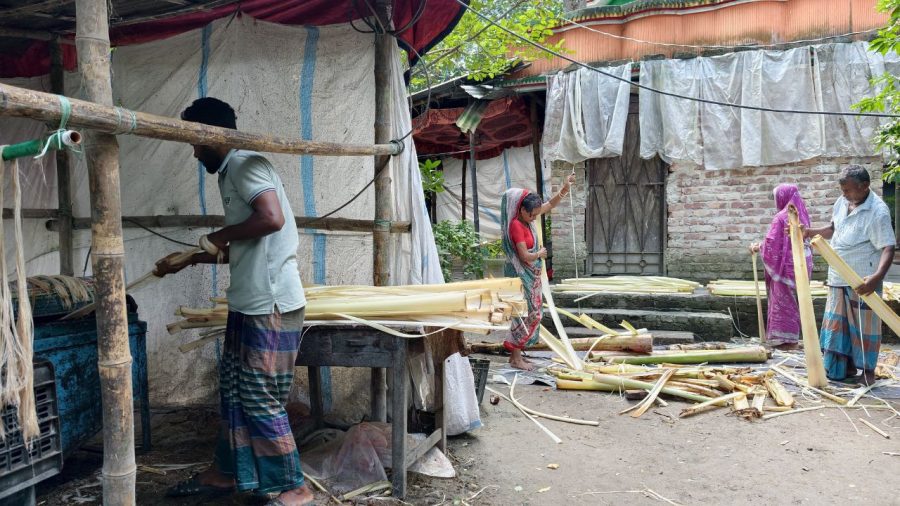



What was once discarded as waste is now generating income, creating jobs and attracting overseas buyers in a remote coastal village of Noakhali.
In Subarnachar upazila, Shankar Majumdar, once unemployed, has built a small enterprise that turns discarded banana plants and water hyacinths into environmentally friendly natural fibre. His products are reaching overseas markets, but growing demand has created a challenge he cannot yet overcome.
Shankar started the venture after watching fibre-making videos on YouTube. With an initial investment of just Tk1.20 lakh, he bought a fibre-extraction machine and began processing locally available materials that were previously thrown away.
Today, his enterprise in Char Amanullah union employs 10 to 15 workers and generates monthly revenue of several lakh taka.
Shankar said buyers from different countries had approached him seeking around 100 tonnes of fibre a month. However, limited machinery and insufficient capital have prevented him from meeting that demand.

According to the entrepreneur, banana fibre produced at his facility is exported to China, while fibre extracted from water hyacinths reaches different European countries.
Banana fibre currently sells for Tk500 to Tk600 per kilogramme, while water hyacinth fibre fetches Tk700 to Tk800 per kilogramme.
The production process begins with workers collecting banana plants and water hyacinths, which are processed by a machine to extract natural fibre. The fibre is then washed, dried in the sun and packaged for distribution.



Mithun, a worker at the facility, said the finished products were sent to different destinations, including Kazipur.
“Once the fibre is properly dried and packaged, we send it to Kazipur,” he said.
Even the leftover material has commercial value. Waste generated during fibre extraction is sold for Tk40 per kilogramme, while there are plans to use the residue in nursery growing materials and as cattle feed.
The initiative has also changed local perceptions of discarded vegetation. Residents initially found it difficult to believe that banana plants and water hyacinths could become marketable products.
Now, people from distant areas visit the facility to observe the production process, while some unemployed young people are considering similar ventures.
Residents believe greater financial and government support could help expand the enterprise and create more employment opportunities.
Subarnachar Youth Development Officer Mohammad Khurshid Alam said Shankar was commercially marketing his products in Noakhali, Bogura and Dinajpur.

He said the Department of Youth Development remained committed to supporting such entrepreneurs.
“We have already discussed how financial assistance could be arranged for him through institutions such as Grameen Bank and Karmasangsthan Bank,” he said, encouraging Shankar to contact the department.
Subarnachar Upazila Nirbahi Officer Aqib Osman welcomed the initiative, describing it as a promising example of using technology to transform readily available natural resources into commercially valuable products.
He said the administration would help connect entrepreneurs seeking investment with financial institutions and government banks willing to provide loans.
For Shankar, the immediate challenge is expanding production to meet rising demand. His enterprise has already created jobs and opened new commercial opportunities for materials once considered worthless. Further investment and machinery could help him reach more buyers at home and abroad.