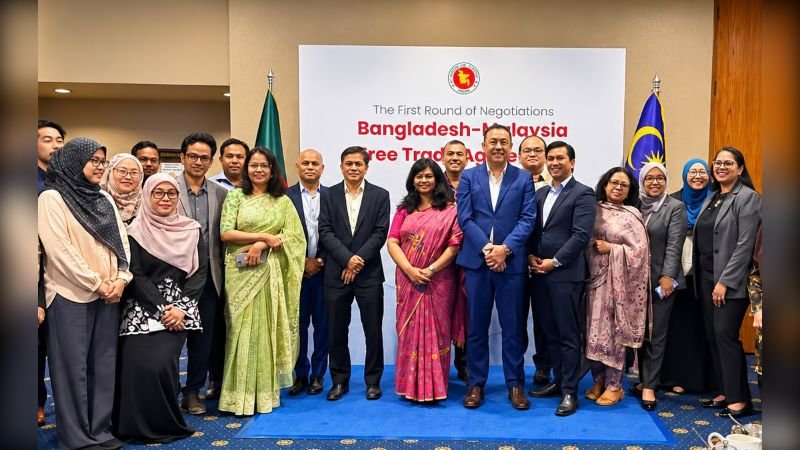



Bangladesh and Malaysia concluded their first round of free trade agreement negotiations on Thursday, setting a preliminary target of January 2027 for further talks as the two countries seek to expand market access, investment and technology cooperation.
The three-day negotiations, which began on Tuesday at the Pan Pacific Sonargaon Dhaka, examined draft provisions and the proposed structure of a free trade agreement (FTA), according to a Commerce Ministry statement.
Thirteen working groups reviewed proposed chapters covering trade in goods and services, rules of origin, customs procedures, digital trade, intellectual property, sanitary and phytosanitary measures, technical barriers to trade and the interests of small and medium-sized enterprises.
The discussions focused on identifying areas of cooperation, examining each country’s negotiating positions and developing a mutually acceptable framework.

Bangladesh’s chief negotiator, Commerce Ministry Additional Secretary Khadija Nazneen, said the proposed agreement could deepen economic ties and create opportunities for investment and industrial cooperation.
She highlighted Malaysia’s strengths in electronics, semiconductors and digital technology, identifying potential benefits for Bangladesh through technology transfer and investment.
Malaysia’s delegation was led by chief negotiator Rashidi Said.




Both sides expressed their intention to reach a balanced agreement within the targeted timeframe, with subsequent negotiations expected to address differences over individual provisions.
The talks are particularly important for Bangladesh as it prepares for graduation from least developed country (LDC) status, which could reduce preferential access to international markets.
A trade agreement with Malaysia, a major economy in the Association of Southeast Asian Nations, could help Bangladesh diversify export markets, attract investment and strengthen participation in regional supply chains.
It could also improve market access for goods and services while supporting industrial upgrading through closer technology cooperation.
However, the commercial benefits will depend on the final terms, including tariff concessions, protection of domestic industries and implementation arrangements.

Negotiators will therefore need to balance wider market access against the interests of businesses in both countries.
The first round ended with a framework for continued discussions, but no final agreement or specific tariff concessions were announced.
The proposed January meeting remains a preliminary target as the two sides work towards resolving outstanding issues and developing the agreement’s final structure.