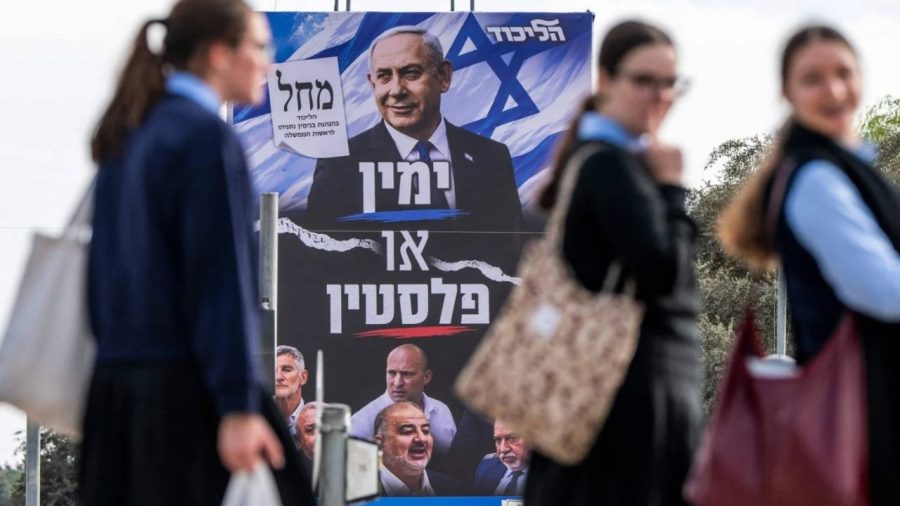



Israel’s general election has produced an uncertain political outcome, with exit polls indicating that neither Prime Minister Benjamin Netanyahu’s right-wing coalition nor the opposition alliance led by former military chief Gadi Eisenkot has secured enough seats to form a government independently.
Projections released by three major Israeli broadcasters initially suggested that Eisenkot’s Yashar party and three other Jewish opposition parties in his Change Bloc could secure between 52 and 53 seats in the 120-member Knesset. Netanyahu’s Likud-led coalition was projected to win approximately 50 seats.
However, updated projections later showed a tighter contest. Kan and Channel 13 placed the two rival blocs on 51 seats each, while Channel 12 gave Netanyahu’s camp 52 seats against 49 for Eisenkot’s alliance. The differing estimates have left the outcome unresolved, with both sides still short of the 61 seats required for a parliamentary majority, BBC reports.
The final balance of power could depend heavily on two Arab political parties, the United Arab List and the Joint List, which exit polls projected would collectively win between 18 and 19 seats. Their anticipated gains could give them considerable influence over negotiations to establish Israel’s next government.
The projections remain preliminary, and the final distribution of parliamentary seats will depend on the official vote count.
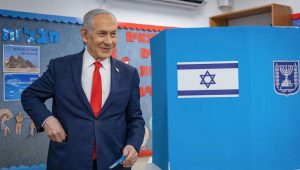
Voter participation reached 77.7 per cent by the time polling stations closed at 10 p.m. local time on Tuesday, according to Israel’s Central Elections Committee. The figure represented the highest turnout recorded by that hour since 1999, highlighting the intensity of public engagement in a closely contested election.
Official results were expected to begin emerging overnight. However, approximately 600,000 absentee ballots, largely cast by military personnel and accounting for around 10% of the total vote, were not expected to be fully counted until Thursday.
Even after the results are finalised, the formation of a government could take several weeks. Israel’s president must consult political factions before inviting the party leader considered most capable of assembling a governing coalition to attempt to form an administration.

If the designated candidate fails to secure sufficient support, the country could ultimately face another election.
At the Tel Aviv headquarters of Eisenkot’s Yashar party, supporters responded enthusiastically to the initial exit polls, celebrating the possibility that the opposition could emerge as the largest political bloc in parliament. Chants calling for Netanyahu to leave office echoed through the gathering.
Eisenkot described the projected outcome as a historic achievement and pledged to turn the voters’ decision into what he called a stable, constructive Zionist government serving all Israeli citizens.
Former prime minister Yair Lapid, an ally of Eisenkot whose Beyachad party is part of the opposition camp, also declared that Netanyahu’s bloc had suffered a major electoral setback.
Despite the celebrations, Netanyahu’s Likud party remained projected to be the largest individual party in the Knesset, even if its wider coalition lacked a clear parliamentary majority.
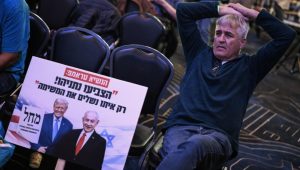
At Likud’s Jerusalem headquarters, supporters expressed concern but remained hopeful that the final count could improve the party’s position. One supporter, identified as Itzik, said the contest was not finished while acknowledging his nervousness about the outcome.



Senior figures in Netanyahu’s camp also pushed back against the opposition’s claims of victory. Foreign Minister Gideon Saar described the celebrations on the left as premature, while National Security Minister Itamar Ben-Gvir urged supporters of his far-right Jewish Power party to pray for a result that would allow a firmly right-wing government to take shape.
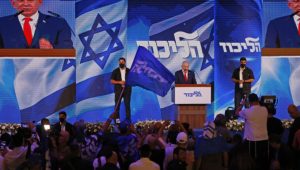
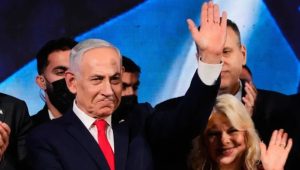
Netanyahu later addressed supporters at Likud headquarters, asserting that his right-wing bloc retained a strong majority and calling for the establishment of a powerful national government led by right-wing parties.
His remarks underscored the continuing divide between the two camps over how the preliminary results should be interpreted.
The projected gains by the United Arab List and the Joint List have emerged as one of the election’s most significant developments.
The two parties were forecast to win a combined 18 or 19 seats, potentially marking a record parliamentary representation for Arab political parties. Their performance followed reports of strong participation among Arab Israeli voters, who make up roughly one-fifth of Israel’s population and frequently identify as Palestinian citizens of Israel.
Their anticipated parliamentary strength could become decisive if neither major political bloc can secure the support needed to govern.
However, the prospect of cooperation remains politically complicated. Only one party among the main political groupings has openly supported working with the Arab parties in government, limiting the available options for coalition negotiations.
United Arab List leader Mansour Abbas expressed hope that his party could work with Eisenkot’s Change Bloc to reach the 61-seat threshold required to form a government. Abbas’s party previously participated in a governing coalition following the 2021 election. That administration, led by Naftali Bennett and Yair Lapid, remained in power for approximately one year before collapsing.
Meanwhile, Joint List chairman Yousef Jabareen argued that his political grouping’s projected strength meant it could not be excluded from consideration under any potential governing arrangement.
The Arab parties’ eventual role will depend on the official results and whether the major political factions are willing to negotiate with them.
Security, military service and judicial reform dominate debate
The election was Israel’s first national parliamentary contest since the Hamas-led attacks of October 7, 2023, and the subsequent wars involving Gaza, Lebanon and Iran.
The vote was widely regarded as one of the most consequential in the country’s recent history because it could determine not only who leads the government but also whether Israel continues along its existing religious-nationalist and hard-line political course.
Security failures surrounding the October 7 attacks became a central issue during the campaign, alongside questions about political accountability and the government’s handling of the conflicts that followed.
The growing burden of military service was another major point of contention, particularly the question of how service obligations should be distributed across Israeli society.
Judicial reforms, the balance of power between political institutions, and Israel’s standing in the international community also featured prominently in the campaign.
These issues have deepened divisions over the country’s future direction and contributed to the high stakes surrounding the election.
Coalition negotiations could prolong uncertainty
The preliminary results leave Israel facing the possibility of extended negotiations before a new government can take office.
Although Likud appears positioned to remain the largest individual party, that distinction alone does not guarantee Netanyahu another term. The decisive factor will be whether either political camp can assemble a coalition with sufficient support in the Knesset.
Eisenkot’s opposition alliance could have an advantage if its seat projections hold, but its path to power is complicated by the need to secure additional parliamentary backing and the political sensitivities surrounding cooperation with Arab parties.
Netanyahu, meanwhile, could seek to retain power through negotiations with his existing allies and other potential partners. If neither side can establish a viable coalition, the country could be forced into another round of voting.
For now, the election has delivered a clear message of political uncertainty rather than a decisive mandate. With official results still pending and the Arab parties potentially holding the balance of power, the coming days are likely to be crucial in determining Israel’s next government and its political direction.