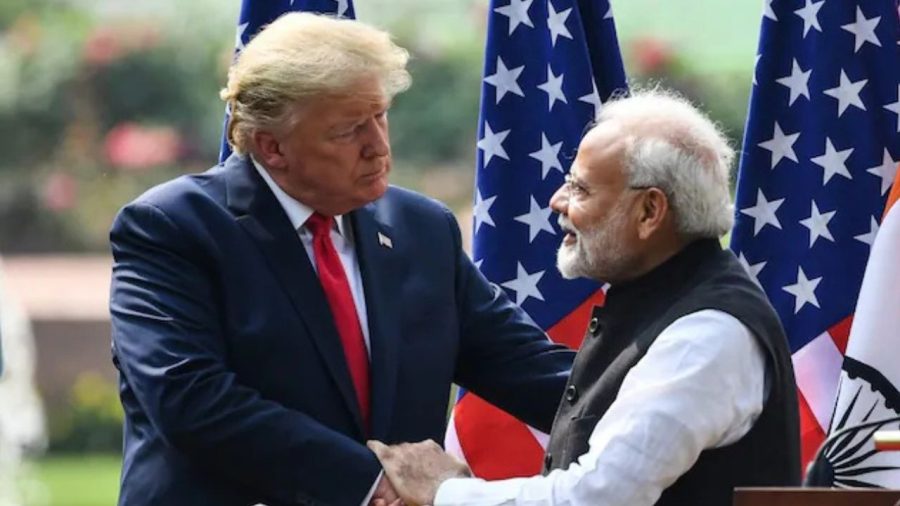



Seven years after Indian Prime Minister Narendra Modi endorsed US President Donald Trump with the slogan “Abki baar, Trump sarkaar!”, relations between New Delhi and Washington have deteriorated ahead of US midterm elections.
Departing from its traditional practice of quiet diplomacy, Indian leadership has adopted an unusually direct tone in criticising White House.
Speaking in New York, External Affairs Minister S Jaishankar described Trump administration as “insensitive” to India’s security concerns, overly accommodating towards arch-rival Pakistan, and pursuer of “self-centred” trade policies.
Consequently, analysts observe New Delhi now openly anticipates a Trump administration humbled by midterm losses, hoping a Democrat-led Congress might restore stability to the bilateral partnership.
Economic strain over tariffs and stalled negotiations
Trade friction forms a central cause of New Delhi’s disillusionment with Washington. India faces a 25 per cent baseline duty that was doubled to a 50 per cent tariff, the highest applied to any major US partner, including a 25 per cent penalty targeting its Russian crude oil purchases.

Bilateral trade negotiations have stalled, with Corporate Affairs Minister Nirmala Sitharaman adding discussions reached a “plateau beyond which giving or taking might be very difficult”.
Although Trump signed legislation allowing 100 per cent tariffs on Russian energy buyers, he temporarily paused enforcement before the midterms to prevent domestic fuel price spikes.
US Secretary of State Marco Rubio maintained in Mumbai that tariffs were not intended to punish India, yet refrained from ruling out future re-imposition.
Diplomatic strains over Pakistan overtures and broken trust
Diplomatic trust was severely damaged following a four-day military clash between India and Pakistan in May 2025.




Although both neighbours negotiated a bilateral ceasefire directly, Trump repeatedly claimed credit for brokering the truce as part of his Nobel Peace Prize bid, claims rejected by New Delhi.
Friction intensified when Trump hosted Pakistan’s Prime Minister Shehbaz Sharif and Army Chief Field Marshal Asim Munir at the Oval Office after Islamabad nominated Trump for the Nobel prize.
Tensions worsened when White House trade advisor Peter Navarro publicly labelled India an “oil money laundromat for the Kremlin” and accused Modi of “getting into bed” with Beijing and Moscow.
Indian lawmaker Shashi Tharoor remarked that such behaviour placed relations on shaky ground.
Immigration restrictions and diaspora political realignment
The strain in state-level relations is reflected in a political shift within the South Asian diaspora ahead of the November 3 midterms.
Trump’s aggressive immigration agenda, including proposed restrictions on H-1B visas, where Indian professionals receive over 70 per cent of approved visas annually, has created widespread anxiety. A White House proposal replacing the 60-day grace period for laid-off visa holders with a 24-hour departure requirement threatens sudden deportations.
Coupled with rising anti-Indian rhetoric, community support for Republicans has eroded. HIT Strategies polling reveals 25 per cent of South Asian Americans who supported Trump in 2024 plan to vote Democratic in the midterms, with 60 per cent supporting Democratic congressional candidates overall.
Strategic autonomy and global diversification
In response to erratic governance from Washington, New Delhi is actively reinforcing its core doctrine of strategic autonomy.
Rather than relying on personal chemistry between leaders, Modi has accelerated efforts to diversify India’s global partnerships.
India concluded a free-trade agreement with the European Union, formalised a trade deal with the United Kingdom, and implemented an economic pact with the European Free Trade Association.
Moreover, Modi attended the Shanghai Cooperation Organisation summit in Beijing, conferring with Chinese President Xi Jinping and Russian President Vladimir Putin to demonstrate multi-aligned strategic options.
While core Indo-Pacific security collaboration continues, Indian planners are focused on building domestic capabilities and alternative alliances to hedge against political volatility in Washington.