
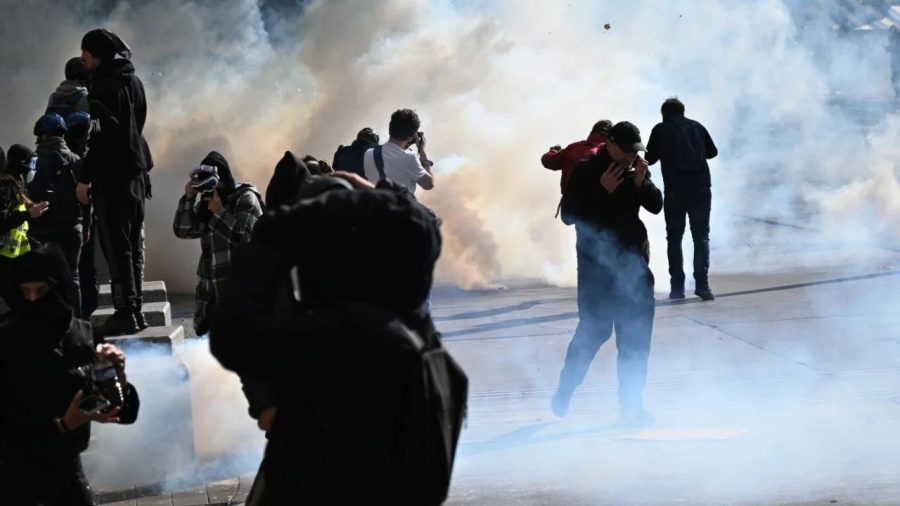



Protesters set fire to a tourist office in Lyon and 272 people were arrested across France by mid-afternoon on Saturday as tens of thousands marched over the rising cost of living and declining public services, in some of the country’s most violent demonstrations in years, according to multiples agencies.
Police and demonstrators clashed in Paris, Marseille, Lille, Rennes, Toulouse and Angers, with riot police firing tear gas in several cities. The interior ministry spoke of an “escalation in violence” and blamed what it called the “ultra-left”. The unrest began last month at high schools in Paris’s poor northern suburbs, over teacher shortages and shabby facilities, and has since widened to draw in trade unions and the yellow vests.

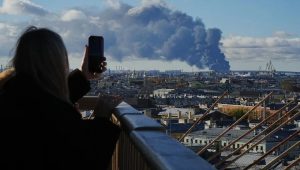
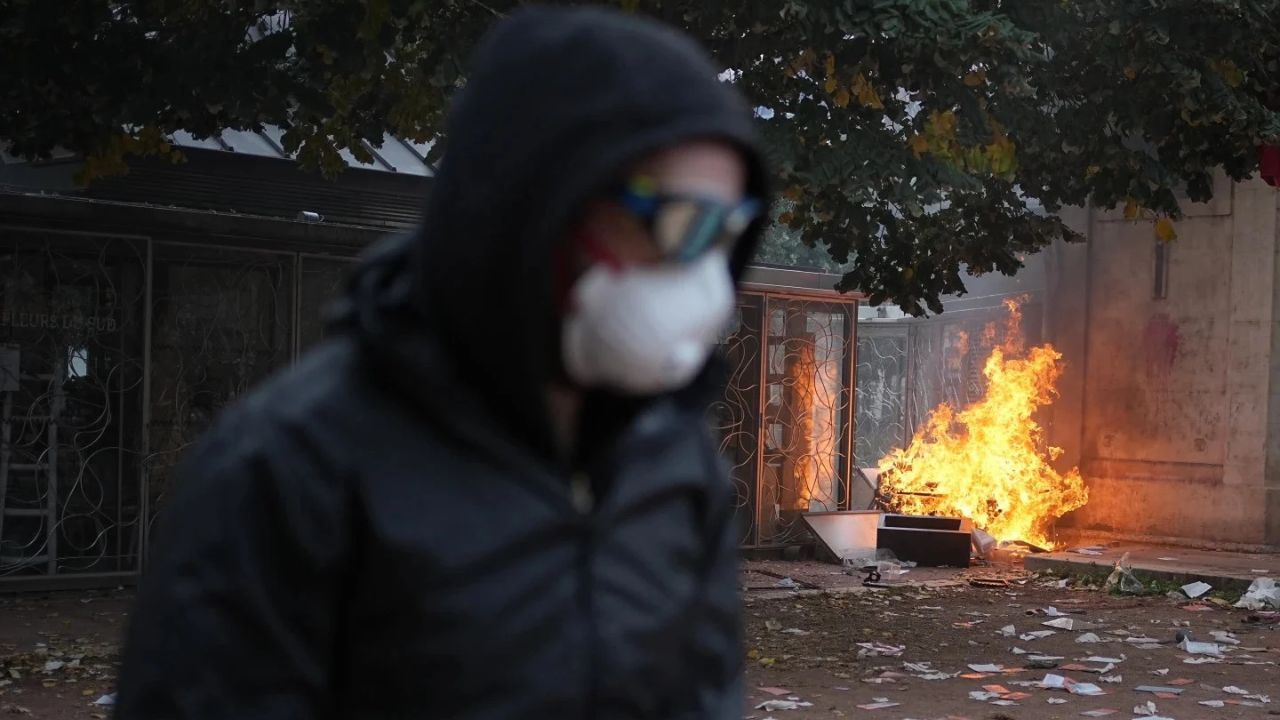
In Lyon, demonstrators set fire to the tourist office, smashing windows as flames burned inside and out, AFP and local media reported. Local police said “hostile individuals” were preventing firefighters from tackling the blaze safely. By midday, around 32,800 people had taken part in 140 protests nationwide and 166 had been arrested, people close to Interior Minister Laurent Nuñez said. The ministry also put the crowd in Lyon at 20,000, with similar numbers in Nantes and 10,000 in Rennes.
In Marseille, masked protesters rammed the door of the 17th-century city hall with security barriers and briefly forced their way in, an AFP journalist reported. One person threw a chair and another spray-painted an anarchist symbol on a wall before police intervened. “We’re taking the Bastille,” one demonstrator shouted, a reference to the 1789 storming of the state prison during the French Revolution. Mayor Benoît Payan described the damage as “limited”, according to BFMTV, and said extra police were being sent after talks with the prime minister and interior minister.

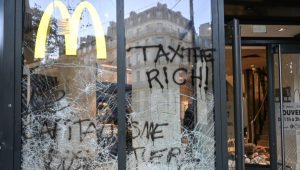
In Lille, AFP and local media reported that some protesters managed to get inside the town hall before fleeing. Grenoble’s town hall was damaged, authorities said, and individuals entered the courtyard of the Vaucluse prefecture in Avignon. Businesses were vandalised in Pau, Montpellier, Toulouse and Valence.
The interior ministry said “black bloc” groups had formed within the marches, centred on far-left elements. Officers had been targeted, businesses looted or subjected to attempted looting, and public buildings attacked and damaged, it said, adding that security forces remained heavily deployed. In Paris, several unsanctioned groups were trying to converge on seats of power, and law enforcement was “intervening systematically” to block them.


In the early hours, about 100 protesters blockaded the western Paris offices of the right-wing CNews network, which shares a building with Europe 1, and police detained 21 people. Protesters reportedly threw projectiles and broke several windows. After demonstrations were banned across swathes of the capital, the city’s police prefecture said 40 people had been arrested by 9.30am following stop-and-searches, largely for carrying “prohibited protective gear or weapons”.
Police fired tear gas at the crowd in Place de la République an hour and a half before the authorised march was due to begin, scattering protesters, according to FRANCE 24. Footage posted online by the CLPRESS agency showed armoured riot police chasing demonstrators through Paris’s streets and striking several people after they were knocked to the pavement.
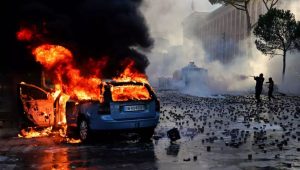
The authorised march from Place de la République to Place de Clichy appeared peaceful, but small groups roamed the rest of the capital, some clearly bent on causing trouble. One built a barricade of bicycles and crash barriers on Rue Beaubourg; another gathered on Rue du Faubourg Saint-Honoré, where the Élysée palace stands. A correspondent in Paris likened it to the early days of the yellow vest movement eight years ago, when the violence of such small wildcat groups proved too much for police. By evening, a water cannon was turned on protesters, and reporters sheltering in a café said the atmosphere had turned hostile as fires burned around them.
Politicians were quick to react. Marine Le Pen, the hard-right National Rally’s presidential candidate, accused “rioters” of “poisoning” the protests, saying the demands had been “hijacked by the far left” and that groups legitimising violence “seek to plunge the country into chaos”. Jean-Luc Mélenchon, leader of the left-wing La France Insoumise, said on X that “everything is unfolding in calm” while news channels flooded viewers with images of violence. “Two worlds, two realities,” he wrote. President Emmanuel Macron, who urged calm on Friday, appealed to demonstrators to show “respect for people and property”.
Those on the streets spoke of exhaustion and anger. “We are fighting because the cost of living is too harsh, because the price of fuel is too high,” said Lola, a 19-year-old protester in Paris, adding that pupils were “being violently attacked and hurt all over the country just for trying to protest”. A group of young people in Paris, who called themselves “pacifists”, said they were “just trying to make things change, but nothing is moving”. Midway through the interview, they covered their mouths as more tear gas was fired nearby.
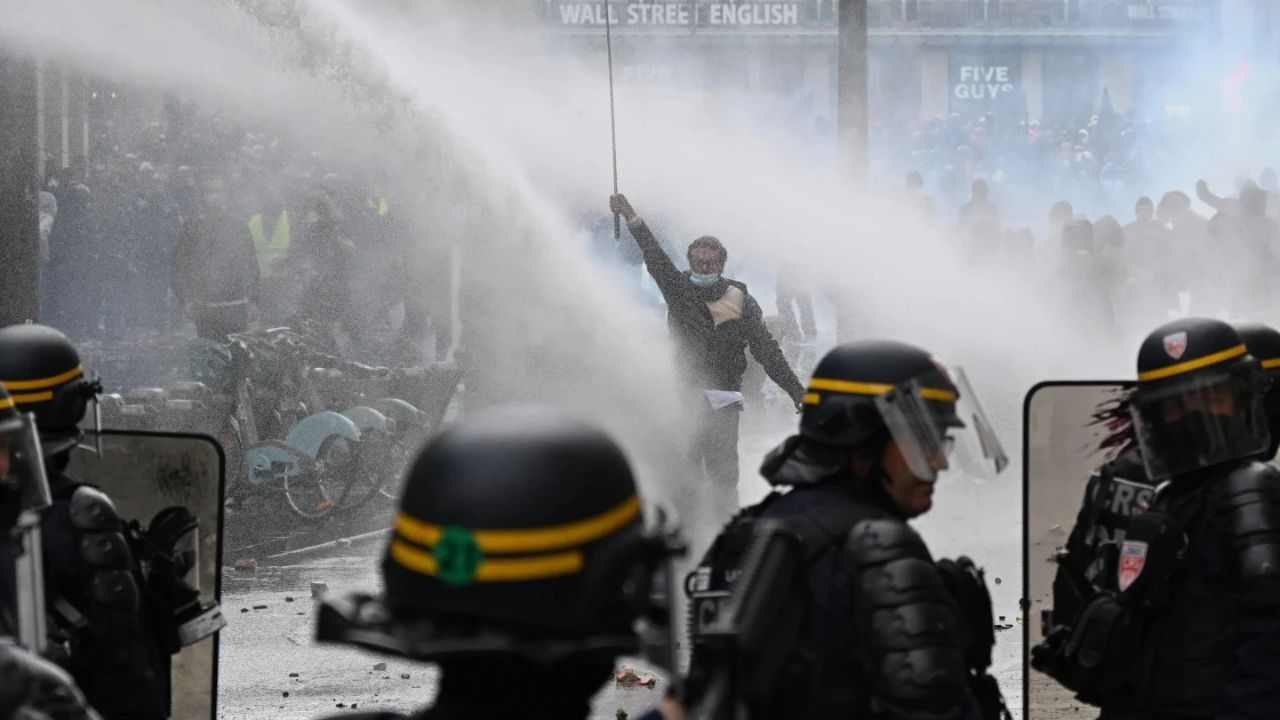
Police tactics are under scrutiny after a series of injuries among demonstrators, including a teenager who lost a hand after picking up a stun grenade. Prime Minister Sébastien Lecornu said more than 900 officers had also been injured in earlier protests. The police watchdog is investigating at least two dozen allegations of police violence. France suspended the use of stun grenades during the student demonstrations, but Nuñez said they could be used on Saturday.
Demonstrators in high-visibility vests blocked streets, recalling the Yellow Vest movement that marked Macron’s previous term. That movement emerged in 2018 against diesel taxes before widening into a protest over living costs and inequality, and subsided after Macron announced billions of euros in tax cuts. Macron now enters the final stretch of his presidency amid a fragmented political landscape and growing economic pressure. Efforts to reduce public debt have failed to reassure investors, pushing government borrowing costs to their highest in more than two decades.
One analysis asked whether the unrest is simply another turn in France’s habit of street action, a cycle of cause, march, wrecking, tear gas, arrests and cries of police brutality seen almost every autumn, or something deeper. Could it turn 2026-2027 into an epoch-defining moment like May 1968, the Paris Commune or the social revolutions of 1848, when protests did usher in change? The arguments for that view are real, it said: a centrist government incapable of acting, the failed experiment of 10 years of radical Macronism, widespread disillusionment, a debt crisis that serious people say could lead to a French default, inflation-induced impoverishment, the rise of the extremes, war in Europe, Trump, and presidential elections in April and May. The world, it concluded, is very unstable and things are shifting.