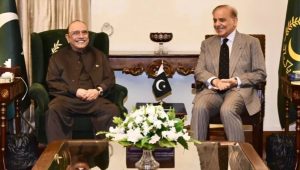



Federal government of Pakistan on Sunday imposed an emergency and governor’s rule in the north-western province of Khyber Pakhtunkhwa after Asif Ali Zardari, president of Pakistan, approved recommendations submitted by cabinet.
The decisions were taken under Articles 232 and 234 of Pakistan’s Constitution following an emergency cabinet meeting chaired by Shehbaz Sharif, prime minister of Pakistan, to address the deteriorating security situation in the province, reports Dawn.
Security breakdown and economic concerns
The cabinet recommended measures citing the provincial government’s deliberate disengagement from the fight against terrorism.
Shehbaz Sharif, prime minister of Pakistan, told the cabinet that the government led by Pakistan Tehreek-i-Insaf (PTI) would not be permitted to destabilise the national economy or derail fiscal progress.
Highlighting the loss of lives amongst citizens, police, and security personnel in Khyber Pakhtunkhwa and Balochistan, he noted that neighbouring Afghanistan had failed to rein in terrorist elements despite repeated appeals from Islamabad.

Addressing broader economic and diplomatic matters, the prime minister expressed confidence in unlocking a $1.2 billion International Monetary Fund (IMF) tranche this year, recalling discussions with Kristalina Georgieva, managing director of the IMF, at the UN General Assembly.
He commended civil leadership alongside Asim Munir, chief of defence forces and chief of the army staff field marshal, for maintaining fiscal discipline, while also noting his meetings with financial executives in London, Pakistan’s Middle East mediation efforts, and reiterating firm solidarity with Saudi Arabia following a deadly Houthi attack on Riyadh airport.
Administrative changes, security measures
Following the proclamation, Islamabad appointed Dr Muhammad Fakhr Alam Irfan, a Grade 22 officer of the Pakistan Administrative Service (PAS) from Mardan previously serving as secretary of the Power Division in the federal Ministry of Energy, as chief secretary of Khyber Pakhtunkhwa.



In a separate notification, Muhammad Yahya Akhunzada, a Grade 20 PAS officer from Charsadda who served as additional secretary at the Prime Minister’s Office, was placed at the disposal of the provincial government.
Meanwhile, telecom sources reported localised slowing and shutdowns of mobile data services in selected urban areas, including Peshawar, where heavy police deployments and container barricades were erected.
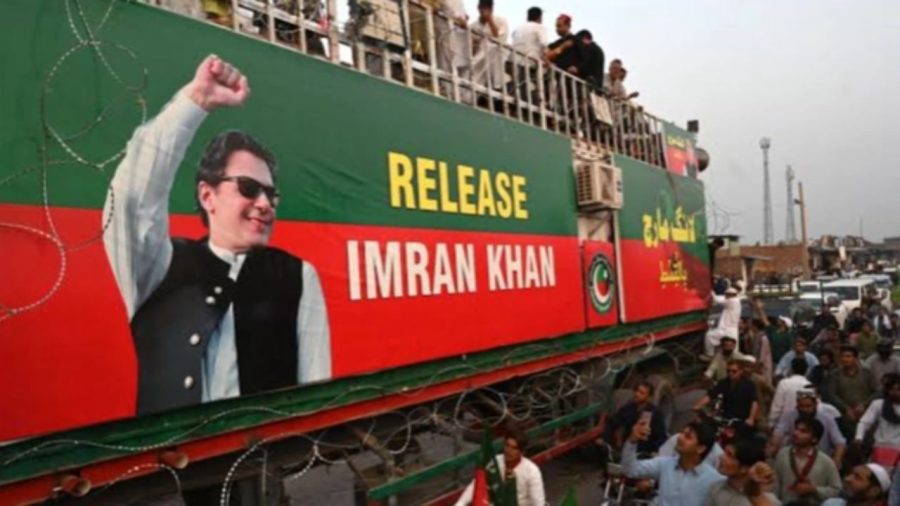
Shafi Jan, information minister of Khyber Pakhtunkhwa, claimed that Sohail Afridi, chief minister of Khyber Pakhtunkhwa, was taken into custody while participating in a PTI march.
Opposition condemnation and legal framework
Gohar Ali Khan, chairman of the Pakistan Tehreek-i-Insaf (PTI), strongly condemned the imposition, describing it as an undemocratic measure and a grave political mistake that weakens provincial autonomy.
Sheikh Waqas Akram, central information secretary of the PTI, stated that the party’s parliamentary committee was considering challenging the decision in court, boycotting parliamentary proceedings, and organising peaceful nationwide protests.
Additionally, the Tehreek-i-Tahafuz-i-Ayin-i-Pakistan opposition alliance rejected the move as unconstitutional, while Maulana Fazlur Rehman, chief of Jamiat Ulema-i-Islam-Fazl (JUI-F), convened an emergency core committee meeting to formulate a response.
Conversely, Faisal Karim Kundi, governor of Khyber Pakhtunkhwa, urged public unity and expressed support for the decision, calling it essential to restore peace, protect citizen rights, and begin a new development chapter.
The emergency order follows months of escalating political deadlock between the PML-N-led federal administration and the PTI provincial government over counterterrorism strategy and Afghan policy, including the collapse of talks on 3 October.
When Ali Amin Gandapur, former chief minister, led the provincial government, and later under Afridi, the provincial assembly passed resolutions demanding central consultation before launching military operations and calling for direct negotiations with Kabul.
Under the constitutional framework, Article 232 allows an emergency proclamation when national or regional security is threatened, requiring provincial assembly backing or parliamentary approval within 10 days if the president acts independently.
Article 234 permits governor’s rule for up to six months upon a request by the governor and approval by a joint parliamentary sitting. Article 233, which provides powers to suspend certain fundamental rights, was not invoked.