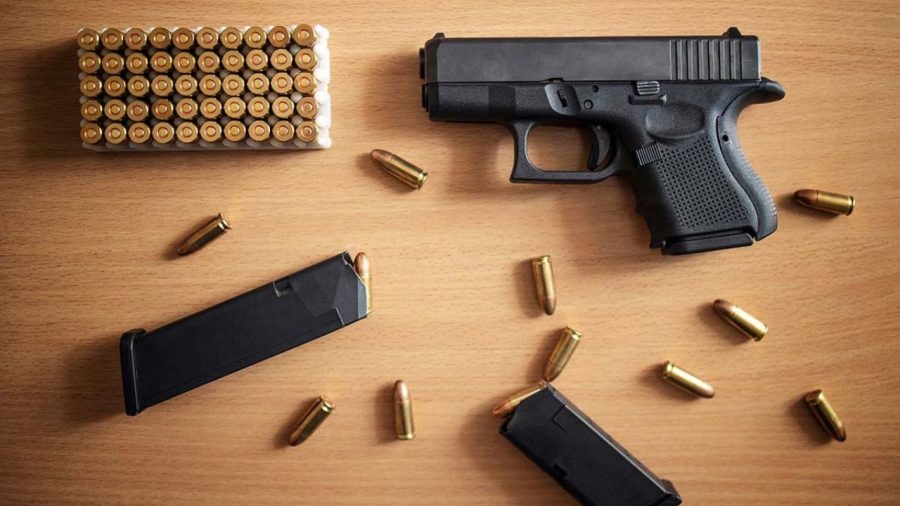



More than 20,000 licensed firearms remain unsurrendered despite government orders, while many weapons looted during the mass uprising are still missing. Against that backdrop, the BNP government has resumed issuing firearm licences to individuals.
Security analysts have urged the authorities to assess applicants on the basis of genuine need rather than political considerations, citing past instances of licences being issued for political reasons and licensed weapons being misused.
Lobbying by Bangladesh Arms Dealers Association, representing firearm importers and dealers, also played a role in the decision. The association held several meetings with the home secretary, seeking easier scrutiny of applications and lower licence fees, although the fees have instead been raised substantially.
Tanvir Ahmed, joint secretary of the association, told TIMES, “After several meetings, the government understood the importance of issuing firearm licences, taking the overall situation into consideration. The government then decided to issue new licences and sent letters to all deputy commissioners.”
He said business had contracted after more than two years without new licences, forcing some gun shops to close.
Tanvir said his company, Ahmed Hossain & Company, survived because it works with banks, the police, the army and Ansar, but most firearm shops were struggling because of weak sales.
Mokarram Hossain Khan, owner of Ripon Arms Company in Purana Paltan, said, “There are shops that have not sold a single firearm in the past nine months.”
On 16 September, the home ministry instructed deputy commissioners across the country to scrutinise new applications. Abeda Afsari, deputy secretary of the ministry’s Political-4 Branch, confirmed the move to TIMES.
Several hundred applications for small and large firearms are already pending with the firearms branches of districts including Dhaka, Narayanganj, Mymensingh, Jashore, Khulna, Narsingdi and Gazipur. Scrutiny and interviews began after the ministry’s letter arrived.
Security analyst Air Commodore (retd) Ishfaq Ilahi Choudhury said strict oversight must accompany licensing.

“Those who misuse legal firearms must certainly face legal action and prosecution. It is not enough only to issue licences. The use of firearms must also be strictly controlled and regularly monitored. After issuing a licence, it is the responsibility of the state to ensure that no one can misuse that firearm,” he told TIMES.
New licences remained suspended since the Awami League government was ousted in the mass uprising on 5 August 2024. The interim government also announced scrutiny of licences issued during AL rule.
Police stations, the Special Branch of police (SB) and the National Security Intelligence (NSI) are collecting information on licence holders. Officials said political affiliation is also being considered during the review.
Conditions for obtaining a licence
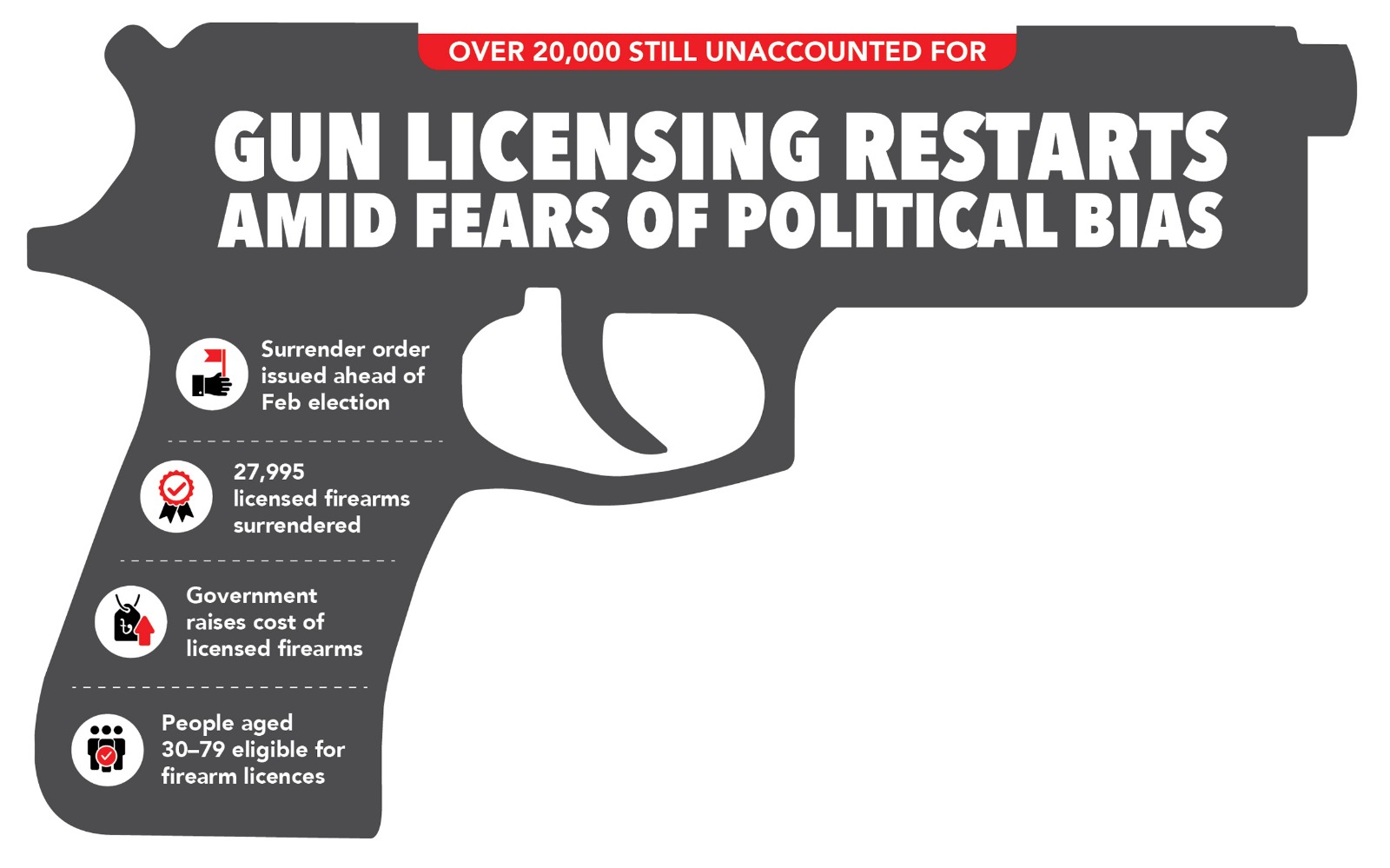
Under government policy, people aged 30 to 79 may apply for a firearm licence against their permanent address.
Anyone named in the charge sheet of a criminal case is ineligible. A convicted person cannot apply until five years have passed since completing the sentence.
Large firearms require approval from the deputy commissioner, while small firearms require home ministry approval.
Home ministry officials and firearm dealers said applicants for large firearms must have paid at least Tk2 lakh in income tax annually for three consecutive years, or Tk6 lakh in total. For small firearms, the requirement is Tk5 lakh a year for three years, or Tk15 lakh in total.




Applicants are considered after submitting income tax documents, receiving positive reports from the police and SB and completing an interview.
The government has also sharply raised the cost of keeping licensed firearms.
Annual income tax, previously Tk1,000 for shotguns and guns and Tk5,000 for pistols, revolvers and rifles, have been increased to Tk50,000 and Tk1 lakh respectively.
Annual renewal fees are now Tk10,000 for shotguns and guns and Tk20,000 for pistols, revolvers and rifles.
Bangladesh Arms Dealers Association President Nasir Ahmed said six companies import firearms into Bangladesh, while 88 shops are licensed to sell firearms and ammunition.
Dealers in Dhaka’s Bijoynagar and Paltan areas said shotguns, single-barrel and double-barrel guns and Sikander guns are in greater demand, alongside revolvers and pistols.
They said firearms from Italy, the United States, Brazil, Türkiye, Germany, Austria, France and Slovakia are popular in Bangladesh.
Pistols and revolvers sell for Tk2 lakh to Tk5 lakh, while shotguns and guns cost Tk1 lakh to Tk3 lakh, depending on international market prices.
Not all licensed firearms accounted for
Police Headquarters data show that 53,702 licensed firearms are registered to individuals, institutions and financial organisations across the country.
Of them, 48,283 are individually licensed, 4,854 belong to financial institutions and 565 to other organisations and institutions.
Ahead of the February parliamentary election, licence holders were ordered to surrender their firearms by 31 January.
By the deadline, 27,995 individually licensed firearms were deposited at police stations, while 20,288 were not.
In the Dhaka metropolitan area, 740 of the 3,991 firearms registered to individuals, institutions and financial organisations were not surrendered.
Home Minister Salahuddin Ahmed said relevant authorities were instructed to recover firearms which were not deposited and to file cases against the licence holders concerned.
A home ministry notification said those defying the order would face legal action under the Arms Act of 1878.
Police Headquarters data show that 116 firearm licences have been cancelled since the interim government period, with more cancellations under way.
20,016 licences under AL rule
Police Headquarters statistics show that 20,016 firearm licences were issued during the 15 and a half years between AL’s return to power in 2009 and 5 August 2024.
Of those granted licences, 1,306 did not buy firearms.
A further 2,153 firearms are registered to banks and other institutions, 933 to serving military officers and 777 to serving government officials.
The home minister said many licences issued between 6 January 2009 and 5 August 2024 were granted on political and party considerations. Deputy commissioners have been instructed to scrutinise them.
Concern over missing firearms
Many police stations were looted during the July uprising. Along with police weapons, privately licensed firearms deposited at police stations were also lost, although the exact number was not disclosed.
Since the interim government took office, 521 looted firearms were surrendered through various channels.
Law enforcement agencies have recovered 33 licensed firearms, while 214 privately owned firearms remain unsurrendered.
Former inspector general of police Baharul Alam said licensed firearms had also been misused in the past.
“After issuing a licence, the use of the firearm must also be strictly monitored so that it is not used for coercion, extortion, terrorism or intimidation,” he said.
He said political considerations should not determine licensing. The key questions, he added, are whether an applicant genuinely needs a firearm for personal security and whether the applicant meets the prescribed criteria.