

Artificial intelligence is usually introduced to Bangladesh as a threat — a technology that will take jobs. For an economy like ours, that is the wrong place to begin. The sharper question is where AI makes people more productive, where it removes waste in how we use human effort, and where its economics actually make sense.
The World Bank’s World Development Report 2026, released in August, settles part of the argument. It finds that only 4.5 per cent of jobs in low- and middle-income countries are exposed to automation by generative AI, against 14.2 per cent in wealthy countries.
Yet the productivity upside is almost even: around 16.2 per cent of jobs in developing economies stand to be meaningfully enhanced, close to the 18.7 per cent in advanced economies. The Bank’s conclusion is blunt and correct — for countries like ours, the promise is not replacing workers but amplifying what they can do. Used well, it argues, AI could let a developing country achieve in a decade what once took a century.
That matters now. Bangladesh is projected to grow around 4.8 per cent this fiscal year and recover further next year. We are also approaching graduation from least-developed-country status and the eventual close of our demographic dividend. Productivity is no longer a nice-to-have; it is the growth engine we must switch on.
Here is where the national conversation goes wrong. Loading company information into a cloud service and receiving an impressive presentation is not the same as building useful AI. A generic model can produce an answer instantly. Whether that answer is relevant to your business is an entirely different problem.
The evidence is striking. McKinsey estimates generative AI could add between $2.6 trillion and $4.4 trillion to the global economy every year. But by the same firm’s reckoning, while virtually every executive knows about the technology and most plan to spend more on it, only about one per cent of organisations have reached mature deployment. The gap between the demo and the profit line is the whole game.
The reason is simple. A general model does not know your operating context, your internal rules or why your best people made the decisions they did. It optimises from the world’s information. A business needs decisions grounded in its own reality.
So, the first technology investment is not AI. It is data. Most organisations have information scattered across SAP, legacy systems, customer databases and external research, all sitting in silos. The first job is to bring it together — often in a data lake — and make it clean, connected and usable, under proper data and AI governance.
The second, less glamorous job is to capture how experienced people actually decide: how they read a situation and arrive at a judgement. That human logic becomes a decision-rules library.

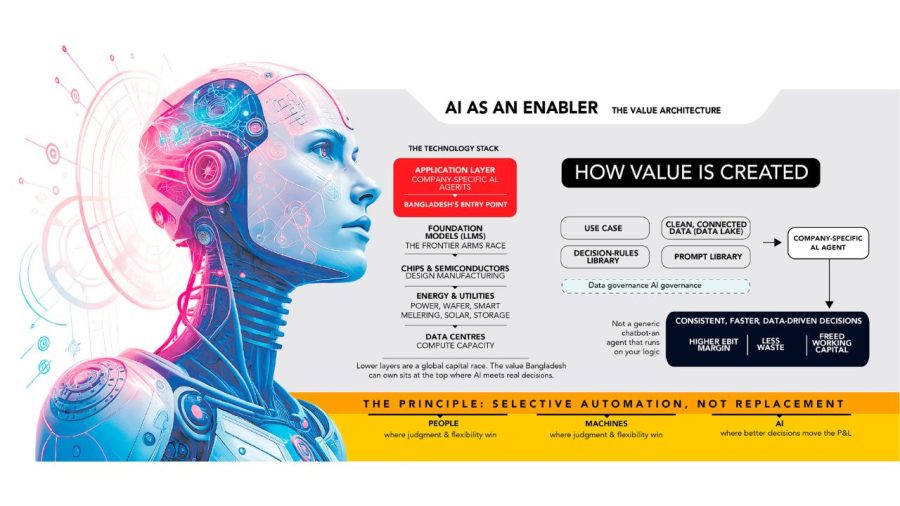
Connect the use case, the clean data, the decision-rules library and a prompt library, and build an agent around them. The result is not a generic chatbot. It is a company-specific AI agent that makes decisions according to an organisation’s context and logic.
For a retailer, that can mean reducing variations in how different store managers order stock — moving from individual judgement to a consistent, faster and data-driven process without removing the employee. Applied across forecasting and operations, the payoff eventually appears where it should: in operating, or EBIT, margin.
Figure: AI creates value not from the model itself, but from proprietary data and codified human judgement, assembled into a company-specific agent — sitting atop a physical stack where Bangladesh should compete at the top.
Where Bangladesh should compete
AI sits far higher up the technology stack than the headlines suggest. Beneath it are foundation models; beneath those, chips and semiconductors; beneath those, data centres; and at the very bottom, energy and water.
Bangladesh has made progress in chip design, but the lower layers are a global capital race. The United States, China and India are pouring in fortunes, and as of mid-2025, high-income countries held roughly 77 per cent of the world’s data-centre capacity, while low-income countries held less than a tenth of one per cent.
We will not win that race head-on, and we do not need to. The value Bangladesh can own sits at the top of the stack: the application layer, where AI is put to work inside real businesses and public services.




Building our own frontier language model makes a fine slogan and a poor strategy. Applying AI to what we already do is the immediate prize.
Consider the numbers globally. McKinsey puts the annual operating-profit opportunity for retail and consumer goods at $400 billion to $660 billion, and for banking at $200 billion to $340 billion. Three-quarters of generative AI’s value, it finds, lands in just four areas: customer operations, marketing and sales, software engineering, and research.
Translate that to Bangladesh. In retail, demand-forecasting and replenishment agents trained on a chain’s own point-of-sale history attack the exact costs that erode margins — overstock, waste and locked-up working capital.
In banking and fintech, some have already built the rails. AI credit scoring using alternative data can open lending to small businesses that banks currently cannot assess.
Agriculture — still our largest employer — can use image-based disease detection and Bangla-language advisory tools to lift yields.
Garments, where the debate is loudest, show the pattern. Sewing itself resists automation, so the opportunity lies in the thousands of decisions around production — sampling, planning, defect detection, quality control and order allocation — where AI makes a factory faster, more accurate and more traceable.
That is exactly what buyers now reward, and it wins better orders at better prices. Used this way, AI lifts competitiveness rather than simply cutting payroll. A factory that competes on value holds a position Bangladesh can actually defend — which competing on cost alone never will.
This is where national ambition should focus, because the returns are civic as well as commercial.
The right strategy is not to build a sovereign model from zero, but to adapt open models to our own language and data — a sovereign-lite approach.
India is the template. Its Bhashini platform runs more than 350 language models across more than seventeen Indian languages, chosen for reach rather than benchmark supremacy; its national AI mission has pooled tens of thousands of GPUs and offers them cheaply to startups and researchers; and at the 2025 Mahakumbh, a Bhashini-based assistant helped manage one of the largest human gatherings on earth.
India did not wait to build the world’s best model. It built the world’s most useful public AI.
Bangladesh can do the same: Bangla-language citizen services for a population where written English is a barrier; AI triage and diagnostic support to stretch a thin doctor-to-patient ratio; predictive analytics to reduce tax leakage and target subsidies more accurately.
Each is a productivity gain that lands directly on the public balance sheet.
None of this is free. Energy has a cost, data centres and land have costs, capital has financing costs, and models charge for every query. So, the real question is never simply whether we can replace a worker. It is whether a task is better done by a person, a machine or AI.
Robots consume electricity; AI consumes compute; people bring judgement and flexibility. In a low-wage economy, indiscriminate automation often makes no economic sense at all.
The disciplined model is selective automation: people where people win, machines where machines are efficient, and AI where it sharpens the decisions in between.
History is on this side. The calculator did not end calculation; the spreadsheet did not empty offices. The workforce adapted and became more valuable. AI belongs in that lineage — as an enabler that changes how work is done.
The winners of this decade will not be whoever spends most on AI. They will be those who fix their data first, build reliable energy and connectivity underneath, buy the models rather than trying to invent them, and pair all of it with operators who understand how technology connects to real decisions.
That is as true for the state as it is for the firm.
Bangladesh should be deliberate and open: welcome the partners who can actually build these systems, but keep ownership of the data, the context and the decision logic that make them ours.
Do that, and AI stops being a threat to workers and becomes the productivity engine — and the strategic asset — this moment demands.
Sovereignty in this era is not won at the silicon layer. It is won at the layer where data meets decisions.
That is a race Bangladesh can lead.
Author is the Managing Director, Shwapno. The views expressed in this article are solely those of the author