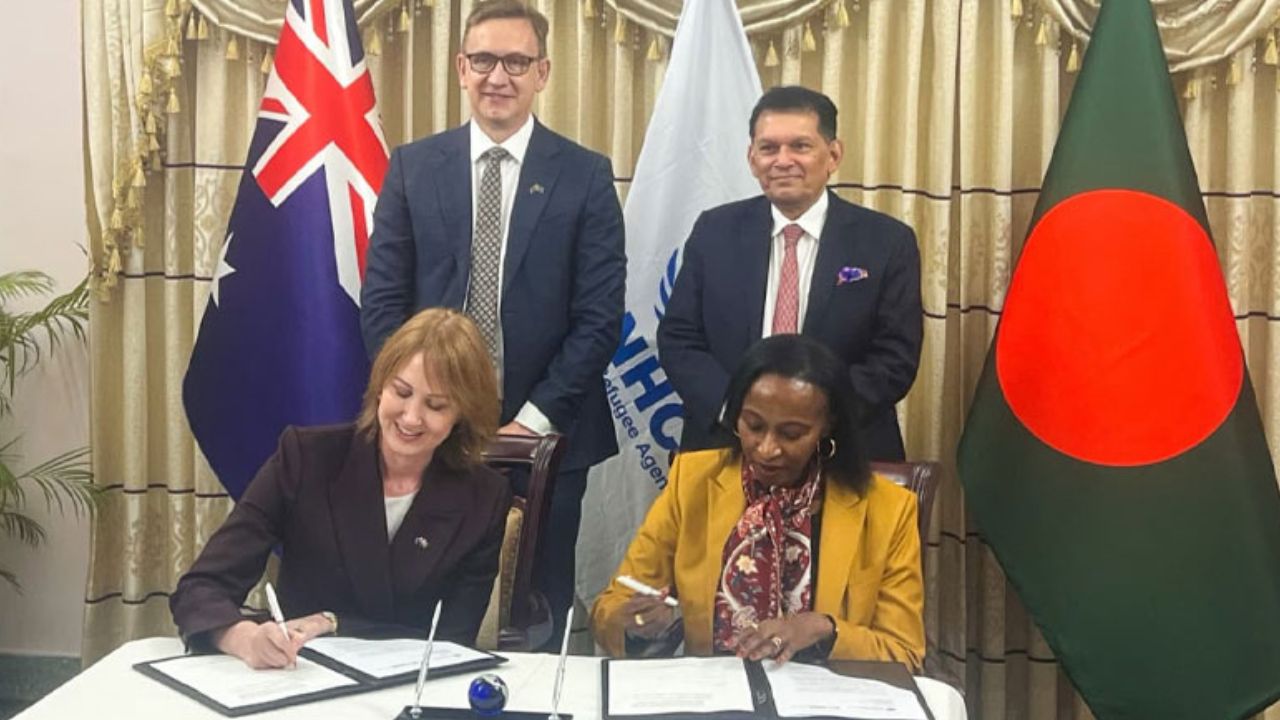



The Australian government has announced a grant of AUD25.25 million to continue humanitarian assistance for Rohingya refugees in Bangladesh and the local host communities.
From 2026 to 2028, this funding will be spent through the United Nations High Commissioner for Refugees (UNHCR) under humanitarian assistance programmes.
The announcement was made on Monday in the presence of Khalilur Rahman, Foreign Affairs Adviser to the Government of Bangladesh, and Julian Hill, Australia’s Assistant Minister for Citizenship, Customs and Multicultural Affairs, and Assistant Minister for International Education.
UNHCR stated that despite global financial constraints and uncertainty in humanitarian aid, Australia’s contribution will play a vital role in sustaining essential services for Rohingya refugees and host communities.

The funds will support protection activities, skills development, disaster risk reduction, and other necessary services in the Rohingya camps.
Australian Assistant Minister Julian Hill said, “Australia continues to assist in addressing the region’s largest humanitarian crises, making it safer, more stable, and more resilient. We remain committed to meeting the humanitarian needs of the Rohingya in Myanmar and Bangladesh.”




He further added, “The Rohingya want to return to their homeland. However, for their voluntary, safe, and dignified repatriation, the necessary environment must be ensured in Myanmar. Without addressing the root causes of the crisis, this will not be possible.”
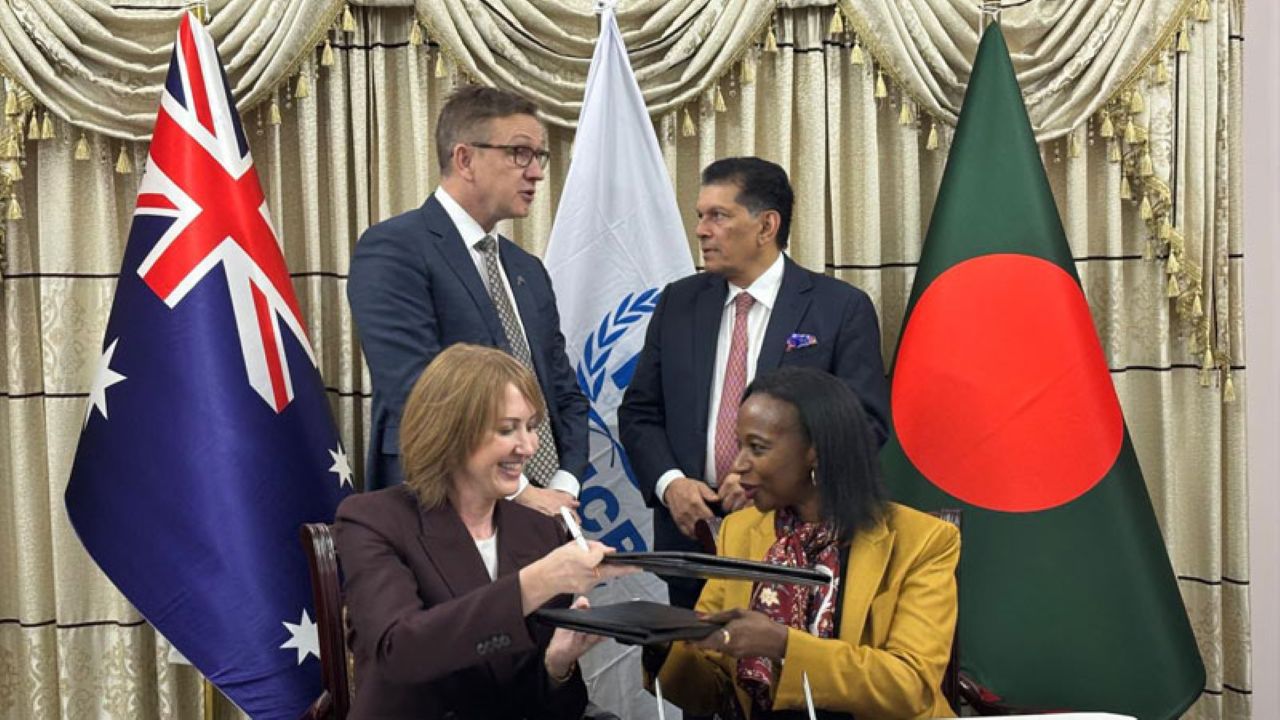
Juliette Murekeyisoni, Deputy Representative, UNHCR in Bangladesh, said, “Nearly nine years on, with new humanitarian crises emerging, the Rohingya crisis is struggling to attract global attention. In this situation, Australia’s continued support sends a strong message that ‘the world has not forgotten the Rohingya.’”
She added, “Every refugee I speak to expresses hope of returning safely to their homeland. Until a conducive environment is created in Myanmar for voluntary, safe, and dignified repatriation with full citizenship guarantees, the international community must continue to stand by them.”
Susan Ryle, Australia’s High Commissioner to Bangladesh, said, “Australia is committed to supporting the Rohingya in Bangladesh and the host communities. This grant will help ensure essential services for women, girls, persons with disabilities, and the most vulnerable.”
According to UNHCR, the number of Rohingya who fled to Bangladesh in 2017 amid widespread violence and persecution in Myanmar now stands at nearly 1.2 million. Most live in refugee camps in Cox’s Bazar and remain almost entirely dependent on humanitarian assistance for daily survival.
The agency further said that prolonged funding shortages have disproportionately affected women, girls, persons with disabilities, and the elderly. Since 2024, more than 150,000 additional Rohingya have sought refuge in Bangladesh, many still lacking adequate shelter, clean cooking fuel, and basic services.
Recent reports also indicate that in 2025, nearly 900 Rohingya went missing or died while attempting perilous sea journeys across the Andaman Sea and Bay of Bengal in search of a better life.
UNHCR emphasised that alongside immediate humanitarian aid, expanding access to education and skills development is critical. Until long‑term and sustainable solutions are achieved, continued solidarity and support from the international community will remain essential to ensuring the safety, dignity, and vital services for Rohingya refugees.