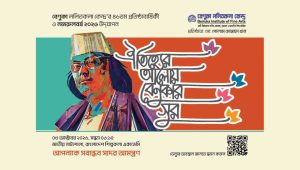



Some poets leave behind books; others leave behind an enduring voice that continues to echo across generations. As Bangladesh marks the 90th birth anniversary of Al Mahmud on 11 July, readers, poets and literary enthusiasts once again turn to the timeless verses of a writer whose poetry captured the landscapes, language and soul of Bengal.
Born as Mir Abdus Shukur Al Mahmud on 11 July 1936, in Maurail village of Brahmanbaria, he emerged as one of the defining literary voices of the post-Tagore era. His poetry blended romance, rural life, history, folklore and spirituality with a distinctly Bengali sensibility.
His early collections, including Lok Lokantor (1963) and Kaler Kalosh (1966), established his poetic identity. However, it was Sonali Kabin (1973) that cemented his reputation as one of Bangladesh’s foremost poets, earning widespread acclaim for its lyrical richness and evocative imagery.

Beyond poetry, Al Mahmud was also a journalist, novelist, short story writer, essayist and memoirist. His literary works drew deeply from the rhythms of rural Bangladesh, bringing village life, indigenous traditions and everyday experiences into the heart of modern Bangla literature.




His life and career, however, were not without controversy. Political developments and ideological positions in different phases of his life often sparked debate, making him one of the country’s most discussed literary figures.
Even so, his literary contribution has remained a subject of sustained academic interest and public appreciation. His words still continue to be revisited and rediscovered, reaffirming his place among the most significant poets in modern Bangla literature.
Recipient of the Bangla Academy Literary Award in 1968, Al Mahmud passed away in Dhaka on 15 February, 2019. His poems continued to find new readers, while literary organisations and cultural institutions regularly commemorate his birth anniversary through discussions, recitations and remembrance programmes.
On his 90th birth anniversary, Al Mahmud’s legacy remains both enduring and multifaceted. The enduring power of his poetry ensures that his voice continues to occupy a distinguished place in the rich tradition of Bangla literature.