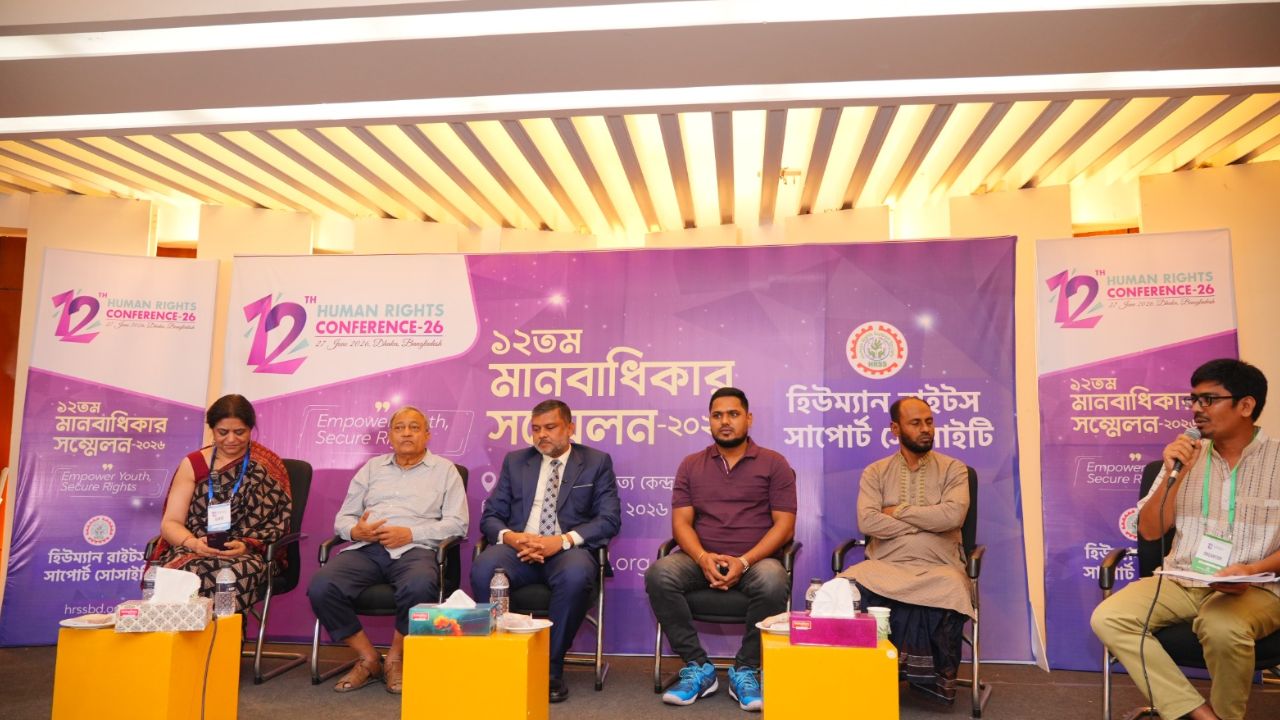



The Human Rights Support Society (HRSS) on Saturday called for greater accountability to address state repression and strengthen the protection of fundamental rights during its 12th National Human Rights Conference 2026 held in Dhaka.
Held under the theme “Empower Youth, Secure Rights”, the day-long conference took place at the Isfandyar Jahan Hasan Chowdhury Auditorium of Bishwo Shahitto Kendro, bringing together human rights defenders, lawyers, judges, researchers, journalists, academics, students and victims of alleged state repression alongside their families, according to press release.
The programme began with the national anthem, followed by a welcome address from HRSS Executive Director Ejajul Islam. HRSS Programme Officer Md Saiful Islam presented a review of the organisation’s activities in 2025, while Documentation Officer Abdul Kader unveiled the Annual Human Rights Situation of Bangladesh 2025 report. Programme Officer Sani Kudrat Saki also presented a monitoring report on the 13th National Parliamentary Election and Plebiscite 2026.

Speakers at the inaugural session said protecting the life, liberty and dignity of citizens was both a constitutional obligation and an international commitment of the state. They expressed concern over issues including enforced disappearances, extrajudicial killings, custodial torture, political violence, restrictions on freedom of expression and border killings, arguing that the absence of effective investigations and accountability had fostered a culture of impunity.
A panel discussion titled “State Repression: Victim Experience, Justice, and Accountability” featured Barrister Sara Hossain, Md Nur Khan, Sanjida Islam and Advocate Mohammad Shishir Monir. Victims and family members, including Imtiaz Hossain Roki, brother of the late Ishtiaq Hossain Jony, and Ruhul Amin of Satkhira, who was injured in a police shooting, shared their experiences and said the lack of justice had caused long-term social, economic and psychological hardship. They called for truth-seeking, independent investigations and reparations for victims.




Another session focused on border security and human rights, with presentations by human rights activist Sajjad Hossain and Professor Saifuddin Ahmed of the Department of Peace and Conflict Studies at Dhaka University. Nur Islam, father of the late Felani Khatun, and Yeasin Mia, elder brother of the late Mursalin, also spoke about their experiences. Participants urged the government to ensure that border management complies with international human rights standards and to pursue bilateral initiatives to prevent border killings.
Addressing the conference as chief guest, Justice Moyeenul Islam Chowdhury, former judge of the High Court Division and former chairman of the Commission of Inquiry on Enforced Disappearances, said human rights were fundamental rights rather than political issues. He called for a national framework to ensure security, legal assistance and mental health support for victims.
Among the special guests were Md Jahid Hossain, Human Rights Officer at the Office of the UN High Commissioner for Human Rights in Bangladesh; Advocate Mohammad Tajul Islam, former chief prosecutor of the International Crimes Tribunal; and Barrister Md Khalilur Rahman Khan, Director (Joint Secretary) of the NGO Affairs Bureau.
The conference concluded with the prize-giving ceremony for the 2nd National Human Rights Olympiad 2026. In his closing remarks, HRSS Chairman Barrister Shahzada Al Amin Kabir thanked participants and speakers for their commitment to promoting an accountable and humane state.