Bangladesh has set an ambitious target of generating 5,000 megawatts (MW) of solar power by 2030 as part of its broader strategy to strengthen energy security, reduce import dependence, and support the growing global demand for clean energy in export-driven industries.
Power, Energy and Mineral Resources Minister Iqbal Hassan Mahmood announced the target while speaking to journalists at a post-budget press conference for FY2026-27 held at the Osmani Memorial Auditorium in Dhaka on Friday afternoon.
“We have set a target to generate 5,000 megawatts of solar power for the national grid by 2030. I believe actual capacity could exceed this,” he said.
Rejecting the argument that solar energy is unnecessary, the minister said renewable energy has become an economic necessity rather than a policy choice.
“Some people say solar power is not needed. I disagree. There are practical reasons why it is essential,” he said.
He noted that Bangladesh’s export competitiveness is increasingly tied to clean energy adoption, particularly in European markets.
“European countries are clearly moving toward renewable energy. To remain competitive in export-oriented industries, we must expand clean energy use,” he added.

Mahmood said the solar expansion plan would be supported by battery storage systems to ensure stability and round-the-clock electricity supply.
“We are moving toward battery-based solar systems. Energy generated at specific times must be stored and supplied when required. Storage will be key to making solar power reliable,” he said.
The minister said the latest budget includes fiscal incentives to attract investment in renewable energy, including reductions or waivers in duties and taxes on solar batteries and related equipment.
He also acknowledged structural challenges in the energy sector, saying it has become heavily import-dependent over the past 17 years.


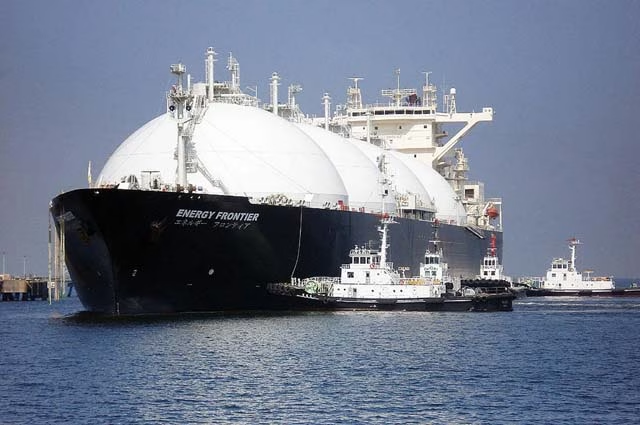

“Despite securing maritime boundaries and having onshore exploration potential, sufficient efforts were not made to explore new gas reserves,” he said.
Mahmood said the government has decided to strengthen the state-run Bangladesh Petroleum Exploration and Production Company Limited (BAPEX) by equipping it with additional drilling rigs to boost onshore exploration.
“BAPEX has a successful track record but was largely sidelined. We are reactivating it and procuring five new drilling rigs,” he said.
On offshore exploration, he said international oil companies have been invited due to Bangladesh’s limited technical experience in deep-sea operations.
“Tenders have already been floated. After completion, we will negotiate with successful bidders and allocate blocks,” he added.
The minister acknowledged that Bangladesh will continue to rely on imported fuel in the near term but said supply stability has been maintained despite global disruptions, including tensions around the Strait of Hormuz.
“Following the Hormuz crisis, some suppliers invoked force majeure. We quickly secured alternative sources, and fuel supply remained stable,” he said.
He said Bangladesh has already spent around $2.5 billion on fuel imports to ensure energy security. However, he noted continued financial pressure in the power sector due to subsidies and inherited liabilities.
“We buy electricity from private producers at higher rates and sell it at lower prices. The gap is covered by government subsidies,” he said.
Mahmood further stated that the government inherited unpaid liabilities of around Tk56,000 crore in the power sector.
“These arrears had to be cleared alongside current bills, creating significant fiscal pressure,” he said.
On capacity payments to independent power producers, the minister said the issue is legally complex and tied to existing contracts.
“If capacity payments are abruptly stopped, lenders may demand repayment and some plants could become non-operational,” he warned.
He added that the government has sought legal opinion from the Law Ministry and will consider action based on its advice. “We are carrying the burden of past decisions,” he said.
The minister expressed optimism that ongoing reforms, including expanded gas exploration and renewable energy initiatives, would begin yielding results in the coming years.
Finance Minister Amir Khosru Mahmud Chowdhury, Information and Broadcasting Minister Zahir Uddin Swapon, and other cabinet members were also present at the briefing.