






Bangladesh’s ready-made garment (RMG) exports declined 3.73 per cent to $25.80 billion during July–February of FY2025–26 as weaker demand in the European Union (EU) and non-traditional markets weighed on shipments, according to the Export Promotion Bureau (EPB).
The figure compares with $26.80 billion in the same period a year earlier.

Both major product segments recorded declines during the eight-month period.

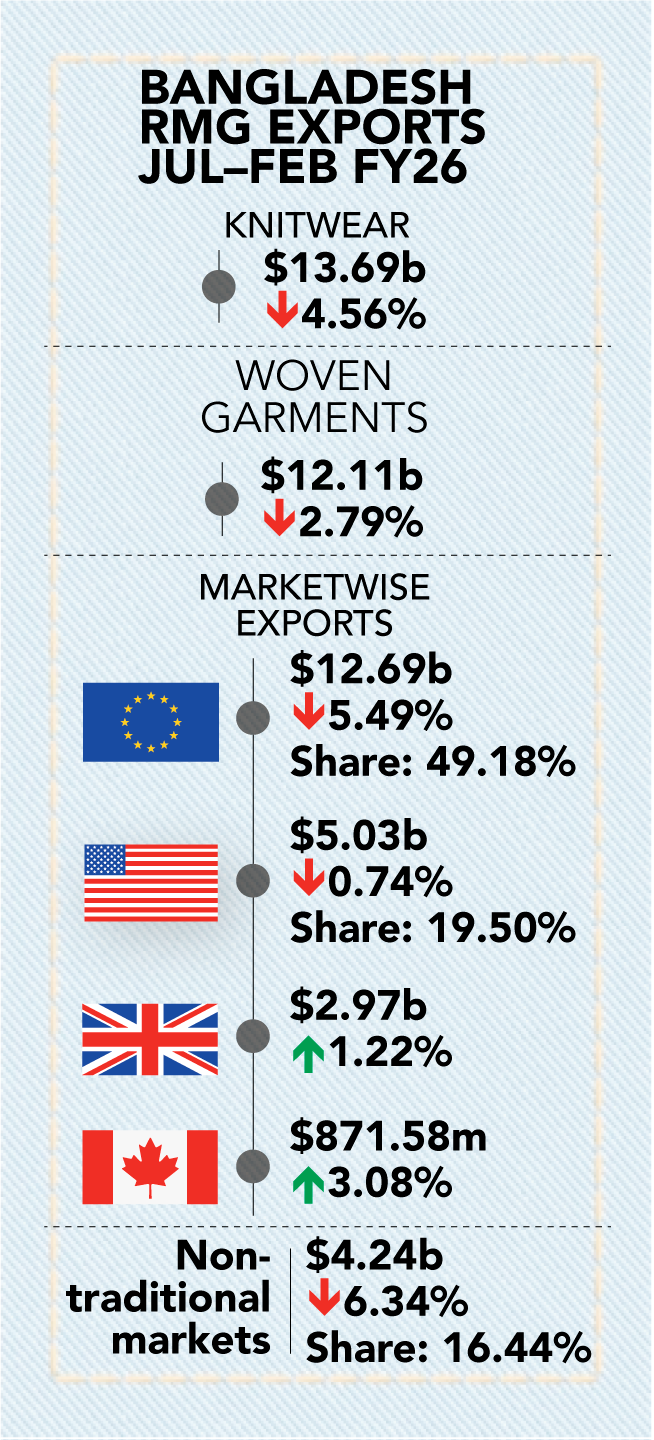
Knitwear exports fell 4.56 per cent to $13.69 billion, while woven garment shipments declined 2.79 per cent to $12.11 billion.
Sparrow Group Managing Director Shovon Islam told TIMES of Bangladesh that exports slowed partly due to tariffs imposed by the United States (US) on some competitors and domestic political uncertainty.
Orders had shifted to Bangladesh after the US imposed a 50 per cent tariff on India, but some buyers are now moving orders back, he said.
Rising inflation in major markets including the EU and the US, partly linked to global geopolitical tensions, may further dampen apparel demand, he added.
“These factors indicate that difficult days may lie ahead for the country’s garment industry,” he said.
The EU, Bangladesh’s largest apparel market, recorded a sharp decline in imports.
Exports to the bloc dropped 5.49 per cent year-on-year to $12.69 billion from $13.42 billion in the same period of the previous fiscal year.
Shipments to Germany, the largest EU destination for Bangladeshi garments, fell 12.20 per cent to $2.97 billion.
Exports to France declined 11.30 per cent to $1.27 billion, while shipments to Italy dropped 8.06 per cent to $969.95 million.
Some EU markets recorded modest growth.
Exports to the Netherlands rose 0.24 per cent to $1.43 billion, shipments to Spain increased 3.03 per cent to $2.42 billion and exports to Poland grew 7.03 per cent to $1.21 billion.
Overall, the EU accounted for 49.18 per cent of Bangladesh’s apparel exports during the period, down from 50.10 per cent a year earlier.
The US, Bangladesh’s single largest country market, remained relatively stable.
Exports to the US stood at $5.03 billion during July–February, representing 19.50 per cent of total garment exports, although shipments were 0.74 per cent lower than a year earlier.
Exports to Canada increased 3.08 per cent to $871.58 million, while shipments to the United Kingdom (UK) rose 1.22 per cent to $2.97 billion.
However, exports to non-traditional markets declined 6.34 per cent to $4.24 billion from $4.53 billion a year earlier.
Among major destinations, exports to Australia fell 12.68 per cent, shipments to Japan declined 5.38 per cent and exports to South Korea dropped 12.76 per cent.
Shipments to India decreased 9.74 per cent to $431.60 million, while exports to Mexico fell 16.82 per cent.
Some markets posted strong growth despite the broader slowdown.
Exports to China increased 21.51 per cent, shipments to Saudi Arabia rose 21.46 per cent, exports to the United Arab Emirates (UAE) grew 15.68 per cent and shipments to Malaysia climbed 16.40 per cent.
Former Bangladesh Garment Manufacturers and Exporters Association (BGMEA) Director Mohiuddin Rubel said the export performance reflects global economic uncertainty and weaker consumer demand in key markets.
“Slower consumer demand in Europe and cautious purchasing by international retailers have affected apparel orders,” he said.
Bangladesh remains heavily dependent on the EU and US markets, highlighting the need for faster expansion into emerging destinations, he added.
“To sustain long-term growth, the industry must accelerate market diversification, strengthen product variety and improve competitiveness,” he said.


