The reported death of Iran’s Supreme Leader, Ali Khamenei, has sent shockwaves across the Middle East. Iran’s state broadcaster, Islamic Republic of Iran Broadcasting, confirmed the news in the early hours, following a claim by former U.S. President Donald Trump that Khamenei had been killed in a joint U.S.–Israeli military operation. Whether viewed as a targeted killing, a wartime casualty, or a strategic turning point, the event marks far more than a change of leadership. It signals the possible conclusion of a four-decade geopolitical doctrine that shaped Iran’s posture at home and abroad.
Khamenei assumed the position of Supreme Leader in 1989 after the death of the Islamic Republic’s founding figure, Ruhollah Khomeini. Prior to that, he had served as president during the brutal Iran–Iraq War of the 1980s – a conflict that deeply influenced his worldview. The war, coupled with sweeping international sanctions and Western backing of Saddam Hussein, reinforced in Khamenei a profound distrust of the United States and its regional allies. Under his stewardship, Iran portrayed itself as a besieged fortress, surrounded by hostile powers and therefore compelled to prioritise ideological steadfastness and strategic self-reliance. Over time, that defensive posture evolved into a broader regional strategy.
During Khamenei’s tenure, the Islamic Revolutionary Guard Corps (IRGC) expanded far beyond its original revolutionary mandate. It became not only a formidable military institution but also a key political and economic actor within Iran.
Simultaneously, Tehran consolidated what became known as the ‘Axis of Resistance,’ an informal network that included Lebanon’s Hezbollah, the Palestinian group Hamas, Yemen’s Houthis, and several Shiite militias in Iraq. This constellation of allies allowed Iran to project influence across the Levant and the Gulf without direct conventional confrontation. A central architect of this regional strategy was General Qasem Soleimani, commander of the Quds Force, who was killed in a U.S. drone strike in Baghdad in 2020. Soleimani’s death intensified tensions across the region. Khamenei’s reported killing raises even larger questions: Can the architecture of deterrence he helped construct endure without him?

Iran’s nuclear file remains another defining element of Khamenei’s legacy. In 2015, under President Hassan Rouhani, Tehran signed a landmark nuclear agreement with world powers. The International Atomic Energy Agency (IAEA) was tasked with monitoring Iran’s compliance.
However, in 2018, President Trump withdrew the United States from the accord and reinstated sweeping sanctions under a ‘maximum pressure’ campaign. Iran subsequently scaled back its commitments and expanded uranium enrichment, heightening regional security anxieties.
In the years that followed, cycles of Israeli strikes, proxy confrontations, and retaliatory threats further complicated the diplomatic landscape. Khamenei remained steadfast in framing resistance as both a strategic necessity and a moral imperative.
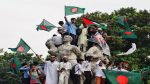


While projecting power abroad, Khamenei faced repeated waves of domestic unrest. The 2009 Green Movement challenged the legitimacy of presidential election results. Economic grievances fueled nationwide protests in 2019. In 2022, the death of Mahsa Amini while in police custody ignited widespread demonstrations demanding social and political reform. International human rights organisations criticised the state’s forceful responses. Yet the leadership consistently prioritised stability and ideological continuity over political liberalisation.
In this context, Khamenei’s passing could open space for recalibration – or it could reinforce a security-first approach, particularly if hardline factions consolidate power.
Iran’s constitution outlines a formal process for selecting a new Supreme Leader. The Assembly of Experts is responsible for appointing a successor. In the interim, executive authority is coordinated among the president, the head of the judiciary, and a clerical member of the Guardian Council. Behind the formal mechanisms, however, power dynamics are complex. The IRGC’s influence, factional rivalries within the clerical establishment, and broader public sentiment will all shape the transition. Stability in the short term may depend less on procedure and more on elite consensus. The IRGC has vowed retaliation, describing Khamenei as a martyr and warning adversaries of consequences. Such rhetoric raises the risk of escalatory cycles, particularly amid ongoing tensions linked to Israel–Gaza hostilities, cross-border clashes in Lebanon, and maritime confrontations in the Red Sea.
For Washington and Tel Aviv, strategic objectives have long centered on constraining Iran’s nuclear ambitions, weakening its missile capabilities, and curbing its regional reach. Yet leadership decapitation does not automatically translate into strategic transformation. In some cases, it can entrench existing doctrines rather than dismantle them.
The departure of Ali Khamenei marks the end of a defining chapter in the Islamic Republic’s history. For more than three decades, he embodied the ideological continuity of the 1979 Revolution while adapting its strategy to shifting regional realities. The crucial question now is whether Iran will double down on confrontation or cautiously explore diplomatic recalibration. Leadership transitions in the Middle East rarely produce immediate ideological reversals. Still, they can create openings – moments when entrenched narratives are reassessed and strategic priorities reconsidered.
Khamenei’s legacy will be debated for years to come. Whether it ultimately symbolises enduring resistance or the threshold of transformation will depend on the choices made in Tehran in the days ahead.
The views expressed in this article are solely those of the author
The writer is an author, journalist and language instructor. E-mail: [email protected]