The phrase ‘High North, Low Tension’ became the unofficial Arctic mantra in the decades. It denoted the region where, notwithstanding the harsh winds of the Cold War, the world powers managed to maintain a fragile frozen alliance. But the ice is melting not just due to a warming climate, as in January 2026, but also under the pressure of an unprecedented geopolitical craze. President Donald Trump has threatened to impose new tariffs on US allies who do not support his claim to Greenland against the will of the Greenlandic people, and this threat has put NATO in what may be its worst crisis ever. What began as the absurdity of his first term has, under his second term, turned into an Art of the Deal expansionist policy, which is in danger of shredding the most successful military alliance in world history.
On the Atlantic, Saturday came as a shock, with the President escalating his aggressive claims against the world’s largest island. Trump has instituted a 10 per cent tariff on all goods of Denmark, Norway, Sweden, France, Germany, the United Kingdom, the Netherlands, and Finland, which will go into effect on February 1, 2026. Such tariffs will skyrocket to 25 when no agreement is attained by June 1 on the ceding of Greenland. Not only a trade war, but also a ransom for the Western security architecture. The President is acting as a protection racket by bypassing the countries that are the backbone of NATO. His argument has an element of history since these countries have emptied their military and cowered under the security of the US shield, and this has made allies spend more on defense. But by that complaint, as a springboard to a military force, he has, in its place, the unity of defense through repressive expansionism.
The most frightening thing about this crisis is that even the President did not rule out the use of military force. It is mind-boggling both legally and ethically. It is unlimited to any military access by the president, as Rep. Michael McCaul just indicated, to protect us against any threat. Military invasion on his part would mean to reverse Article 5 of NATO upon itself, and in a literal sense would take us to war with NATO itself. The premise of the alliance is Article 5, which states that an attack on one is an attack on all. If American boots set foot on Greenland without the consent of Copenhagen and Nuuk, the mutual defense clause of NATO will technically obligate the United Kingdom, France, and Germany to protect Denmark against the United States. It is too surreal to be in a real techno-thriller, but on a Sunday last, EU ambassadors held an emergency consultation in Brussels to be prepared for such an eventuality.

The relationship’s unstable future lies with the president, who feels that the US military’s might is his to do with as he pleases and is not subject to any legal or constitutional restrictions. The concept of Greenland’s acquisition by Trump does not concern the so-called Golden Dome missile defense system, which he is proud of; it concerns a footnote in the history books. He would prefer to be remembered as an expansionist of the American map, alongside Thomas Jefferson and William McKinley. Nonetheless, the Louisiana Purchase of Jefferson and the acquisition of Hawaii by McKinley occurred in a pre-modern era. The 56,000 inhabitants of Greenland, mostly Inuit, are not on a real estate balance sheet. They are a country that has a constitutional right to sovereignty under the Self-Government Act of 2009. Their Hands off Greenland protests should not be overlooked since they will turn out to be a betrayal of the same democratic ideals that NATO was formed to promote.



The disintegration of this alliance will partly rest on the Republicans’ ability to exercise uncharacteristic decisiveness, even if it means jeopardizing the relative tranquility in the world. Nevertheless, Trump is feared by several GOP lawmakers even though he has lost some of his power base in other areas, like the recent Jeffrey Epstein files. As long as Congress does not make use of its power of the purse to prevent the imposition of these tariffs, or to bar more precisely the expenditure of money in a Greenlandic intervention, it will be cooperating in the destruction of the alliance. European leaders have so far responded with steely unity. But they face a grim calculus. The European Union represents a massive trading bloc, and a response would bring down US stock markets. Trump is so proud of it as a measure of economic well-being. However, blocking trade or reducing military assistance may prove as damaging to the allies as to their benefactor, America. The global economy, already in a nosedive due to the so-called Arctic Crisis, was to be drawn into a full-scale trade war.
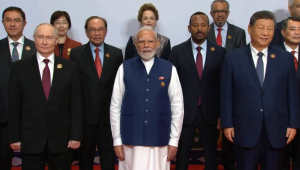
The faceless winners of the ‘Crack in the Ice,’ as the West bickers over property, are Russia and China. Even the deputy chairman of the Security Council of Russia, Dmitry Medvedev, has already mocked the West, saying that the people of Greenland would be enabled to vote to become part of Russia when Trump mounts excessive pressure on the people. In the meantime, China is emerging as a Near-Arctic State and is ready to invest in and provide the stability that Washington currently lacks. NATO without the United States would be just a mere shell; the United States without NATO would be an isolated superpower in a world of rising competitors. If the alliance collapses because of the desire to place a Trump insignia on a glacier, it would be the most disruptive this century has ever seen.
Ice in the Arctic is melting faster than before, and so is the post-war order. Unless we manage to get on one side of the crack in the ice or the other, we may find out that the “High North” is where the West has at last lost its road.
The writer is a Professor, International Relations, University of Chittagong, and Deputy Director, Hong Kong Research Centre for Asian Studies (RCAS)