




National Board of Revenue (NBR) is effectively abandoning its much-touted electronic fiscal device (EFD) system after years of failed implementation, shifting instead to an app-based VAT collection model—without settling questions of accountability for the collapse of the original project.
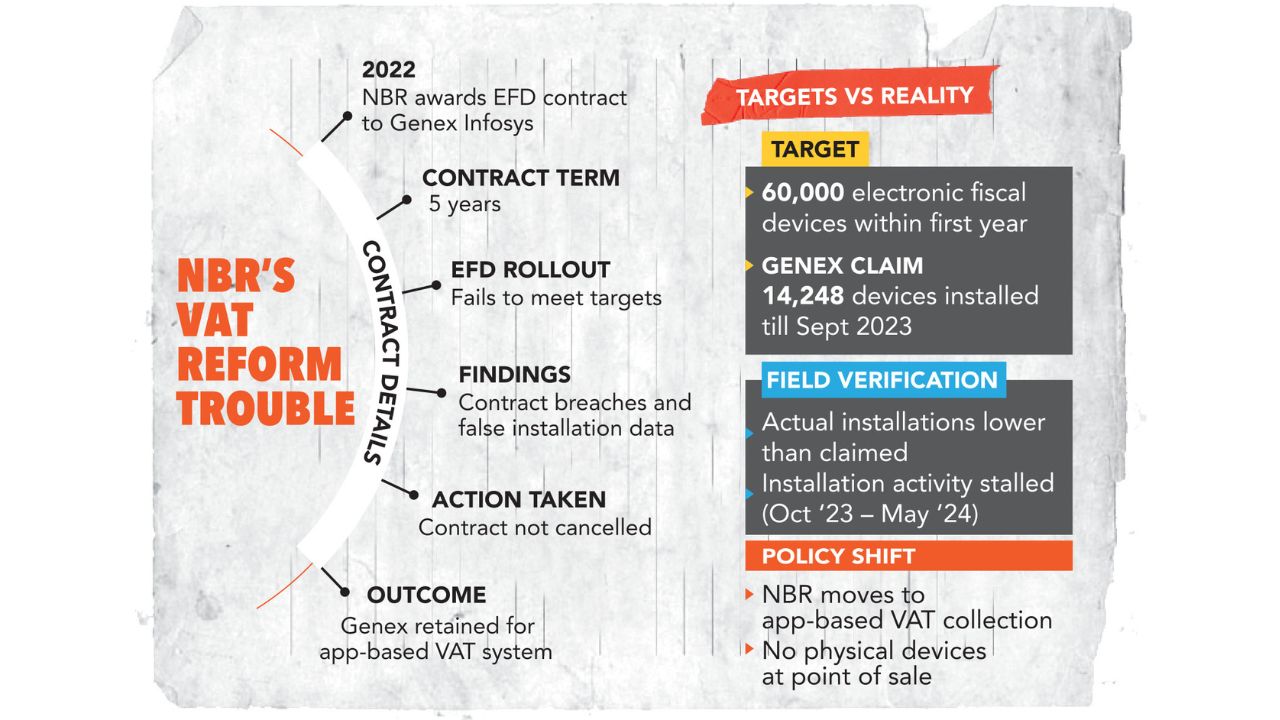
The change follows the poor performance of Genex Infosys Limited, the contractor appointed to implement the EFD system, according to NBR officials. Despite clear evidence of repeated failures and irregularities, NBR has neither terminated the five-year contract signed in November 2022 nor removed Genex from the centre of the new system.
The EFD model was introduced to prevent VAT evasion at the point of sale. Each device was meant to automatically record every transaction, generate VAT invoices and transmit data in real time to NBR servers, allowing remote monitoring of sales and tax collection. But more than three years on, NBR’s own reports show that implementation remains below 20 percent, depriving the state of expected revenue.
Under the contract, Genex was required to install 60,000 devices in Dhaka and Chattogram within the first year. By September 2023, the company claimed it had installed 14,248 devices. Field-level verification later found the actual number to be significantly lower. The deadline was extended to June 30, 2024, with the same target. By then, although NBR had supplied 42,235 business identification numbers, Genex installed only 11,313 new devices. Of the 195 sales data controllers it claimed to have installed for small businesses, inspections found only 97.
An eight-member NBR committee, led by then director general of the Research and Statistics Wing Muhammad Rashedul Alam, found that the project had reached only 19 percent completion even long after all deadlines had passed. The report cited discrepancies between the number of devices shown on the system and those physically installed. Installation activities were effectively stalled between October 2023 and May 2024. Many devices failed to transmit data in real time, dashboards were not user-friendly, and technical limitations made effective monitoring impossible.
The committee also found that no meaningful training had been provided to VAT-paying businesses, despite contractual obligations. Scattered briefings in a few markets could not be considered proper training, the report said. Businesses struggled to use the system, and no realistic plan for expansion was in place.

Human resource management was described as deeply inadequate. Although Genex reported having recruited144 staff, only 44 were overseeing 11,410 establishments—meaning each officer was responsible for more than 79 businesses on average. After office hours, technical support was effectively unavailable. Broken devices often went unrepaired for days, allowing businesses to continue sales without recording transactions.
After the fall of the Awami League government in August 2024, allegations against Genex intensified. These included failure to meet installation targets, importing devices in violation of specifications, providing false installation data and using NBR officials’ names to mislead businesses. At one point, NBR Chairman Md Abdur Rahman Khan instructed that the contract be cancelled and alternatives explored. In practice, no such decision was implemented.
Genex officials declined to comment on the allegations. Written questions sent by TIMES of Bangladesh remained unanswered for over a month.



NBR sources say rising dollar exchange rates significantly increased device import costs. Genex then demanded a higher commission than the contractually agreed 0.52–0.54 percent of collected VAT—a proposal NBR rejected. The dispute further stalled the project.
Explaining why the contract was not cancelled, NBR member Azizur Rahman said sudden termination could lead to legal complications, and that the presence of some operational devices was another reason for continuing.
This deadlock prompted a fundamental policy shift. Instead of fixing or overhauling the EFD model, NBR decided to introduce an app-based VAT system. Under the new arrangement, businesses will register sales through mobile or web-based applications, generate digital VAT invoices and send transaction data directly to NBR servers. No physical device will be required, and VAT payments are meant to go straight to the government treasury.
The shift has triggered an uncomfortable question within NBR itself: if an app-based model can work, why did the authority spend years pursuing a device-based system and sharing VAT revenue with a private firm?
Bangladesh currently has about 775,000 BIN-registered businesses. Registration is mandatory for firms with annual sales exceeding Tk 50 lakh. The app-based system has been approved for five VAT commissionerates in Dhaka and Chattogram, the newly formed Cox’s Bazar commissionerate, and major highways nationwide.
Yet Genex remains central to the rollout. Without cancelling the existing contract, NBR has assigned the company responsibility for deploying the VAT app among registered businesses in Dhaka and Chattogram. Technical implementation will be handled by Germany’s state-owned Veridos, alongside local IT firm Relive Validation Limited.
Veridos director Md Saidur Rahman said the approved areas contain between 150,000 and 200,000 registered businesses, which could be brought under the new system within six to seven months. He said the absence of physical devices and direct transfer of VAT to the treasury would reduce evasion. He added that direct contracts with NBR typically take one to one-and-a-half years, and Genex’s existing contract has not yet expired.
Field-level officials, however, remain sceptical. They warn that without a dedicated monitoring cell, strict enforcement mechanisms and real penalties, the app-based system could become another cosmetic reform. They argue that success will depend on ensuring accurate back-end purchase and sales data, as well as consumer verification of VAT invoices.
In Dhaka alone, more than 50,000 registered businesses are overseen by roughly 1,200 officials. Conducting daily oversight of such a large number of establishments is already difficult, they say, and no clear strategy has been outlined to address this.
Frequent policy changes have also frustrated businesses, who fear that weak enforcement will ultimately place disproportionate pressure on a limited group of compliant firms.
VAT law expert Bindu Saha told TIMES that repeated shifts in NBR’s approach have created confusion and mistrust among businesses. He said the infrastructure required to implement the app-based model properly does not yet exist, raising the risk of another failure.
To boost transparency and speed, NBR made EFDs, sales data controllers, POS machines and smart VAT invoicing mandatory from June 2019. Revenue from domestic trade has fluctuated sharply in recent years. According to NBR data, VAT collection stood at Tk 5,037 crore in FY 2021–22, rising to Tk 8,917 crore in FY 2022–23 and peaking at Tk 10,008 crore in FY 2023–24. But in FY 2024–25, it fell dramatically to Tk 5,417 crore. In the current fiscal year, up to November, VAT collection from domestic trade stands at Tk 1,875 crore.
Former NBR officials say the failure of the EFD project was not technological but institutional. Without accountability for past failures and clearly defined enforcement responsibilities, they warn, the shift to an app-based system risks becoming yet another failed reform.
NBR’s Second Secretary (VAT Policy), Badruzzaman Munshi, said no system can be effective without full automation. He said a new project aims to introduce digital invoicing across all registered businesses and supply the necessary tools. He expressed hope that the project could be implemented within two years, tripling VAT revenue from the sector.