


A frightened child clings to an adult amid endless floodwaters. Elsewhere, a son carries his 80-year-old father to safety, while another family cannot find dry ground to bury a two-year-old child.
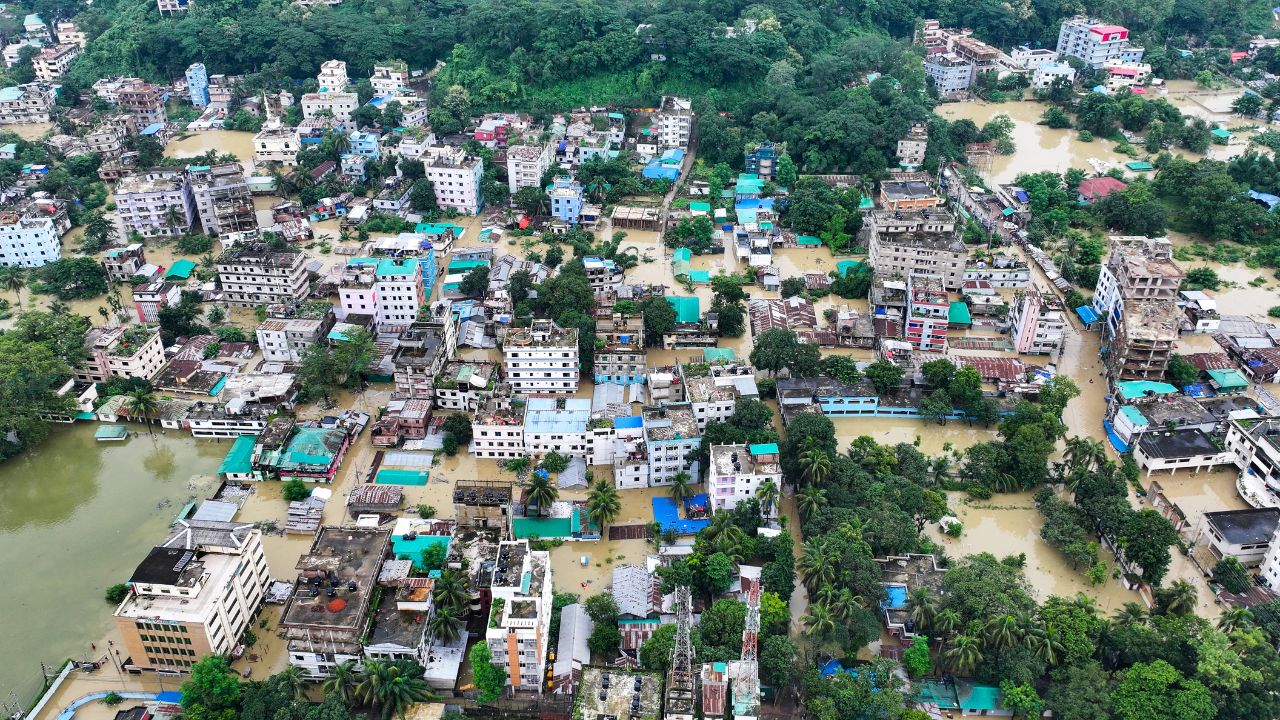
Relentless rain, landslides and upstream water have created a humanitarian disaster across south-eastern and north-eastern Bangladesh, bringing much of Chattogram Division close to a standstill and leaving millions at the mercy of rising water.
The Ministry of Disaster Management and Relief put the death toll across seven flood-hit districts at 39. Cox’s Bazar recorded 23 deaths, including 13 Rohingyas, while eight people died in Chattogram, six in Bandarban and two in Rangamati. About 9,28,000 people have suffered.
In Chattogram district alone, nearly 4,50,000 people are waterlogged. Large areas have become isolated islands without electricity or mobile networks as families plead for food, safe water, medicine and shelter.
After the Dolu Canal embankment in southern Chattogram broke, water from the hills surged into neighbourhoods. Around 70 to 80 per cent of 17 unions and one municipality remain submerged, trapping more than 2,00,000 people. Thousands of homes, shops, farms and rural roads have gone under water.
Flooded kitchens have left many families unable to cook for days. Some moved to relatives’ homes or shelters; others remain on tin roofs or high ground.
“So far no one has come to give relief or see the situation,” said Rahmatullah, a Satkania resident. Children are surviving on dwindling dry food and water beneath plastic sheets.
Safura, who reached a shelter with her three-year-old child, said, “There is no one to take care of us here. I would feel peace if I could eat some rice. No more dry food. Houses have gone under water, God saves them.”

Chattogram Deputy Commissioner Mohammad Zahidul Islam Mia said a cash allocation had been made, although the amount was incomplete in the supplied information, alongside 200 tonnes of rice. He said fresh allocations would be delivered quickly.
The floods are also denying families dignified burials. Two-year-old Ismail Hossain slipped out of his home in South Rupkania, Satkania municipality, on Friday night without his family noticing. His father, Zainal Abedin, said they later found his body in floodwater near the house.
That day, two children drowned outside their home in Baharchhara Union of Banshkhali. “There was no dry place to bury the body,” resident Helal Uddin said. A burial was eventually carried out beside a pond on slightly higher ground.
In Bajalia Union of Satkania, floodwater from the Sangu damaged a graveyard near Altab Ali Chowdhury Jame Masjid. Three bodies were washed from their graves and caught in bushes. Residents recovered and reburied them in a safer graveyard.
Survivors are struggling to preserve what remains. In Banshkhali, Baset Ali cleared the ruins of his mud-walled home with a spade while his wife, Mariam Begum, stood beside him in tears.


“The mud house was our property. Suddenly the flood came. The house collapsed instantly. The earthen walls began to crumble. I ran out to save my life with small children. Now where will I live, what will I eat, I don’t know anything,” she said.
Baset said the walls softened as water rose and collapsed before the tin roof was torn apart in the storm. The family has been left homeless.
Water has fallen slightly in some hilly parts of Banshkhali but remains high in coastal communities. Women and children have moved to shelters or relatives’ homes, while many men remain in flooded houses guarding lifelong possessions.
Lohagara and Chandnaish face similar misery. Water has receded slightly in Lohagara, but large areas of Satkania remain flooded. The upazila administration estimated around 4,00,000 people were still trapped. The Sangu was flowing 19 centimetres above danger level, while traffic on the Keranihat-Bandarban road had not normalised. Lohagara Sadar, Adhunagar, Barahatia and parts of Amirabad Union remained waterlogged.
Water Development Board Chattogram Divisional Engineer Prashanta Talukder warned of further heavy to very heavy rain in the south-east over the next 24 to 48 hours.
In Chandnaish, homes, courtyards, rural roads, farmland and ponds remained under knee-deep water, leaving about 20,000 people stranded. Water covered roads and yards for roughly three kilometres around Bhagbanhat, Baruapara, Jatarkul, Muchibhita and Nazirhat in Satbaria Union. Residents said many families had received no relief after three days. Private aid reaching Rayjowara and Khillapara in Dohazari municipality was far below need.
Upazila Nirbahi Officer Abdur Rahman said each union had received four and a half tonnes of rice and dry food, with efforts continuing to reach others.
Across Cox’s Bazar, 69 of 71 unions have been affected and more than 2,00,000 people are trapped. Around 15,000 families in Pekua, 10,000 in Matamuhuri and 18,000 in Chakaria remain surrounded by water.
Low-lying areas of Bandarban have flooded following hill runoff.
More than 125 landslides in Rangamati have severely disrupted roads. In Khagrachari, thousands in Dighinala have been stranded for four days, with about 30 villages in Kabakhali and Merung unions flooded. The Dighinala-Longadu road remains closed, although traffic has resumed on the Dighinala-Sajek and Khagrachhari-Rangamati roads.
About 7,000 families are in 20 shelters, where authorities are trying to provide food and safe water. Although the Chengi has receded from most of Khagrachari town, low-lying areas remain waterlogged, damaging farmland, vegetable plots and pond fish.
As thousands flee flooded towns for temporary schools and cyclone centres, women and children face a harrowing new crisis: a total lack of safety. Mixed-gender spaces, zero privacy, and toothless security have turned these sanctuaries into hotbeds for sexual harassment, abuse, and trauma.
A damning Police Staff College study revealed a shocking reality, with 75.5% of respondents reporting bitter experiences while displaced. Instead of offering a safe haven from natural disasters, these final refuges have transformed into spaces of profound fear, leaving the most vulnerable entirely unprotected at their absolute time of need.
Fresh danger is emerging in the north-east. Rivers have risen in Moulvibazar and Habiganj, inundating low-lying areas. The Flood Forecasting and Warning Centre warned Sylhet and Sunamganj could flood within 24 to 72 hours because of heavy rain, upstream runoff, low pressure and active monsoon winds.
The Khowai, Manu and Kushiyara have crossed danger level at several points. The Kushiyara was above danger level at Markuli in Sunamganj and Fenchuganj in Sylhet. The Surma, Kushiyara and Manu may rise further, while the Sarigowain, Someshwari, Jadukata and Bhugai-Kangsha could also cross danger level.
Eight more districts may be at risk within 24 hours. Flash floods have hit Habiganj and Moulvibazar, while Sylhet and Sunamganj are high-risk. Submerged roads along the Surma and Kushiyara have affected Pailgaon and Raniganj unions in Jagannathpur, Markuli in Dirai, and low-lying Korbannagar, Mollapara and Lakshmanshree unions in Sunamganj Sadar.
Sunamganj Water Development Board Executive Engineer Mamun Hawlader said 45 millimetres of rain had fallen in 24 hours and could continue for two days, increasing short-term flood risks.
Transport links have collapsed in many areas, leaving boats as the only route to safety. More than six kilometres around Janalihat station on the Sholashahar section of the Chattogram-Cox’s Bazar railway are under water, with engineers placing stones to repair the track. The Patenga Meteorological Office said moderate rain had continued in Chattogram for two days and could persist.
Danger has also reached the south-west. Khulna recorded 184 millimetres of rain in 51 hours up to Saturday afternoon, flooding roads, lanes and low-lying neighbourhoods. Mujgunni, Royal More, Tutpara, Jinnah Nagar, Daulatpur, Atra, Giltala, Dilkhola, Banargati and Sheikhpara were among the worst affected.
Times of Bangladesh correspondents in districts also contributed to this report.