An era of Khaleda Zia has come to an end. Millions of people attended her funeral, and heartfelt tributes continue to pour in at her gravesite. The depth of public emotion reflects the enormous attachment people felt toward her leadership. Praises have flooded social media, highlighting her uncompromising stance for democracy and her indomitable political will. In recognition of her contribution to the nation, the government announced a three-day state mourning.
Across political affiliations, people have shared reflections and allegories on Facebook and other platforms, portraying Khaleda Zia as a towering personality in national politics who played a decisive role in shaping Bangladesh’s democratic journey. For many, she symbolised the spirit of independence and the enduring essence of Bangladesh.
Resonating from history, Khaleda Zia established her authority through mass movements against the Ershad regime in the 1980s and 1990s, while maintaining strict party discipline and organisational coherence. Notably, she did not immediately assume the top position in the Bangladesh Nationalist Party (BNP). She rose gradually – first as vice-chairperson, then acting chairperson, and finally as party chairperson – earning legitimacy through struggle rather than entitlement.
Over a political career spanning 43 years, Khaleda Zia led the country’s largest opposition party as its top leader for 41 years. Throughout this period, she consistently advanced the political ideology of her husband, Major General Ziaur Rahman – an ideology rooted in economic liberalisation, Bangladeshi nationalism (emphasising territory over ethnicity or language), restoration of multi-party democracy, and a decisive shift from socialism toward a market-oriented economy. Under this vision, Bangladesh moved closer to capitalism while strengthening regional cooperation through initiatives such as SAFTA and engagement with the ASEAN Free Trade Area.

The personal glory and charisma of Khaleda Zia may have reached their conclusion, but her legacy will continue anchored in discipline, institutional strength, and an unwavering commitment to democratic values, carried forward by her political successors.
Khaleda Zia earned the love and respect of millions. Now, with the weight of that public affection and historical legacy, Tarique Rahman has taken up the baton of party leadership. His political ascendancy marks the beginning of what many perceive as a new era in Bangladesh’s political landscape. In recent public engagements and deliberations, Tarique Rahman has demonstrated increasing maturity and composure. Many see in him the possibility of a renewed Bangladesh; reflected through the clarity of his presence and the evolving depth of his political vision.



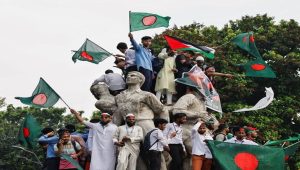
The country’s political landscape has undergone a profound transformation following the July mass uprising that ousted an autocratic regime. This historic movement demonstrated that entrenched authoritarianism can be challenged through collective sacrifice and civic courage. The anti-discrimination movement now stands as a golden chapter in Bangladesh’s history, opening an unprecedented opportunity to build a “New Bangladesh” through state reform and a reimagined political and social order.
At the heart of this movement was a shared aspiration – particularly among students and ordinary citizens – to establish a non-discriminatory, inclusive, and rights-based state. The core demand was for radical reforms in political representation, governance, and administration, ensuring that state power is exercised through the people’s mandate, delegated authority, and genuine accountability.
In this context, political leadership must play a decisive role amid multidimensional challenges and risks. The nation now looks to Tarique Rahman for pragmatic and inclusive leadership capable of navigating this complex transition.
Freedom of expression and access to information remain under strain. While the environment may appear open to collaboration and criticism, there is a growing concern about certain groups accumulating excessive power and abusing it to impose rigid ideologies. Such tendencies undermine the goal of building a non-discriminatory, equal-rights-based, and inclusive “New Bangladesh.”
Above all, the selection of competent and principled teammates poses an excruciating challenge. Party nominations for the national election will be the first critical step in addressing these risks. The second, and equally vital phase, will be the selection of leadership teams who genuinely believe in the party’s stated ideology and are committed to serving the people in line with their aspirations.
The road to fulfilling these expectations is undoubtedly long and complex, but it is attainable. With vision, restraint, and inclusive leadership, Tarique Rahman has the opportunity to rise to this historic moment and to help shape the foundations of a truly democratic and just New Bangladesh.
The writer is a journalist and columnist