Amid the shifting political landscape that followed the July Uprising, Bangladesh is set for a democratic transition as the 13th national election and the referendum on implementing the July Charter will be held on 12 February next year, clearing all remaining uncertainty.
Chief Election Commissioner (CEC) AMM Nasir Uddin announced the schedule in a recorded address to the nation broadcast on Thursday evening.
For the first time in the country’s history, the national election and a referendum will take place on the same day.
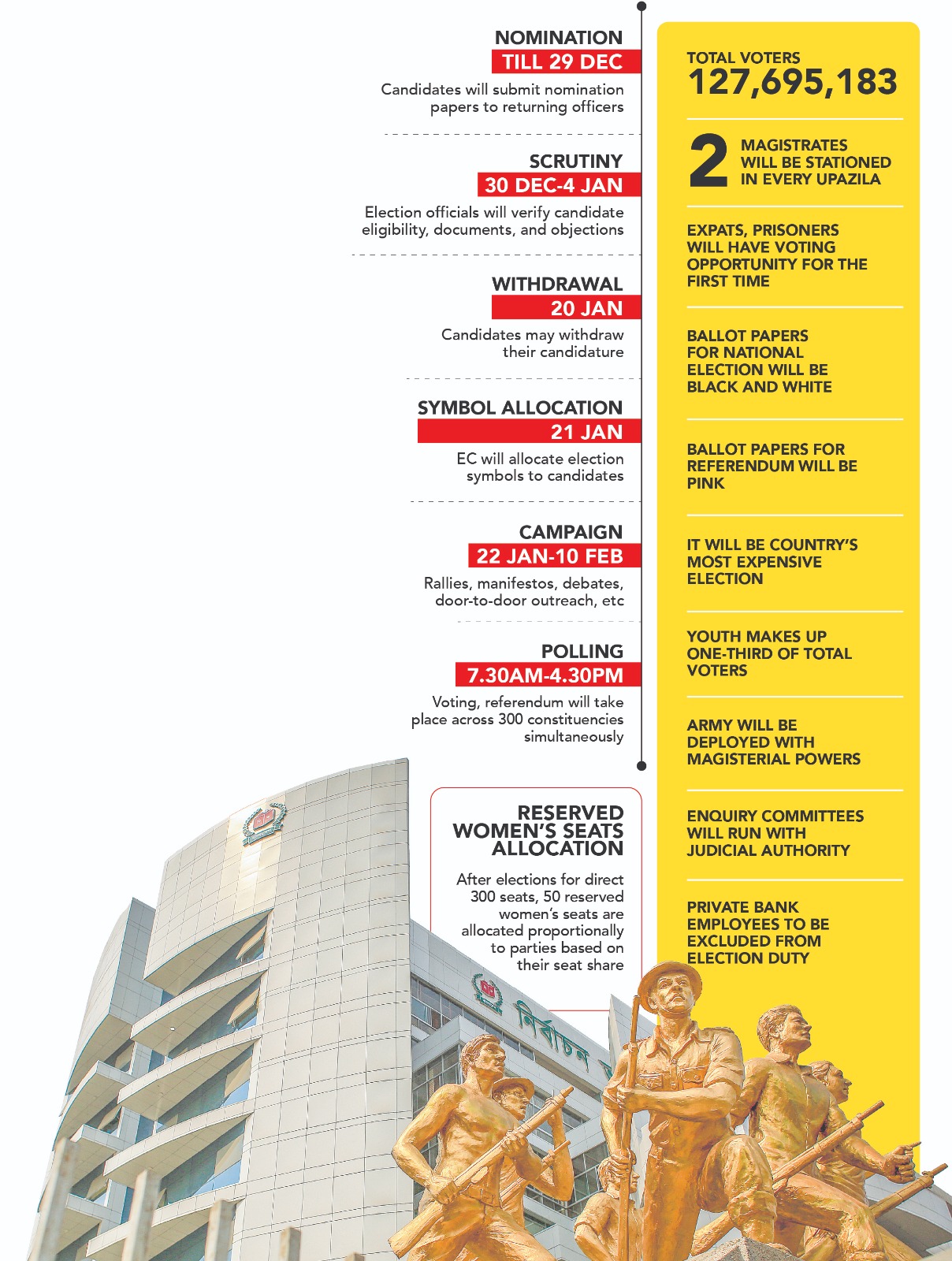
In his speech, the CEC said ballot papers for the parliamentary election will be black and white, while referendum ballots will be pink. Expatriates, inmates and polling officials will, for the first time, be able to cast their votes through postal ballots. Voting will run uninterrupted from 7:30am to 4:30pm – one hour longer than the usual polling duration.
The CEC described elections as the only path to ensuring the people’s representative ownership and pledged a free, fair and orderly process. He urged everyone to play their part in advancing the country’s democratic journey by contributing to the successful conduct of both the parliamentary election and the referendum.
“Standing on the sacrifices of our brothers, sisters and children, our commitment is to hold a free, fair and orderly election that will fulfil the nation’s expectations and enhance our image before the world,” the CEC said in his address.
“I believe you share the same expectations and stand with the same commitment,” he added.
The 13th parliamentary election is to be held just two years after the 12th. Ahead of the upcoming polls, Election Commission has introduced major amendments to electoral laws and the code of conduct as part of its preparations.

The commission has also carried out a series of reforms, including political party registration, replacing previous observer organisations with newly accredited ones, updating the voter roll three times, altering parliamentary constituency boundaries, and ensuring voting rights for expatriates.
Among these initiatives, political party registration and constituency delimitation became key challenges for EC.
Since taking office, the Nasir Uddin-led commission has updated the voter list in three phases, adding approximately 85 lakh new voters compared with the 12th parliamentary election. According to EC data, 12.77 crore citizens will be eligible to vote this time, more than one-third of whom – over 4 crore – are young voters.
The 13th national election is also expected to be the most expensive in the country’s history. EC officials estimate costs may reach nearly Tk3,000 crore, driven largely by the referendum and the arrangements required to ensure expatriate voting rights.
Meanwhile, strong emphasis is being placed on maintaining law and order during the polls. The army will be deployed with magistracy powers, and a higher-than-usual number of law enforcement personnel will be stationed at polling centres. Security forces will also be present at every centre to ensure the safety of polling officials.
In addition, electoral inquiry committees will be active on the ground from the moment the schedule is announced, tasked with enforcing the election code of conduct and, for the first time, empowered with judicial authority.


For this election, EC has also decided to exclude officers and employees of private banks from the pool of polling officials while forming its panel of presiding and assistant presiding officers.
The commission will appoint 69 returning officers for the elections. Of these, 64 will be deputy commissioners, along with the two divisional commissioners from Dhaka and Chattogram divisions, and three officials from the EC itself. This will be the first time that officials from the EC will take on the role of returning officers in a national parliamentary election.
What CEC said in his speech
In announcing the schedule, CEC Nasir Uddin said nomination papers for the parliamentary election may be submitted until 29 December, while scrutiny will be conducted from 30 December 2025 to 4 January 2026.
Appeals against returning officers’ decisions may be filed with the Commission until 11 January, and the commission will dispose of them between 12 and 18 January. The final date for withdrawal of candidature is 20 January. Returning officers will publish the final list of candidates and allocate symbols on 21 January.
Election campaigning will run from 2 January until 48 hours before polling begins, he added.
Highlighting the commission’s work over the past year to ensure a free and credible election, the CEC said a transparent election requires a complete, accurate and clean voter roll. “We began our work at that very point,” he said.
He noted that in the past year, alongside enlisting new voters, around 45 lakh previously missing or inactive voters were added to the roll, while more than 21 lakh deceased voters were removed.
Nasir Uddin said the commission had carried out extensive legal and structural reforms over the past year to strengthen its capacity and ensure accountability among all stakeholders. “Amendments and updates were made to the Representation of the People Order as well as to the code of conduct for political parties and candidates.”
Addressing voters, the CEC said, “Rise above fear, temptation, pressure and limitations, and exercise your right to vote without hesitation. All relevant institutions and security agencies will work to ensure your safe and festive participation.”
For expatriate voters, he said the registration process for postal balloting, which began on 18 November, is ongoing. “You may register from anywhere in the world through the Postal Vote BD app until 25 December to cast your vote from abroad,” he added.
The CEC also addressed the growing threat of misinformation spread through social media and AI-generated content intended to mislead the public. “Necessary measures will be taken under the country’s existing laws to prevent such activities. I earnestly request you not to listen to or accept any information spread with false or malicious intent,” he said.
He urged candidates and political parties intending to contest the election to follow the code of conduct to ensure a peaceful and festive polling environment.
Addressing those who will be on election duty, the CEC said they must carry out their responsibilities fearlessly, with honesty and neutrality as part of the Commission’s mandate. “No laxity or negligence in this regard will be tolerated,” he warned.
Highlighting the role of the media and observer organisations in ensuring a credible election, he said, “We expect you to perform your duties freely, with the highest professionalism, neutrality and objectivity.”
Completing polling-officer panel by 15 Dec
Meanwhile, Election Commission has instructed that the panel of polling officials be finalised by 15 December, excluding officers and employees of private banks. The directive was revealed through a letter sent by EC Deputy Secretary Mohammad Monir Hossain to district election officers.
The letter states that, for the 13th national polls, the Commission has decided to prepare the panel of polling officials without including staff from private banks. However, if an adequate number of polling officers cannot be arranged, officers and employees of private banks may be appointed after necessary verification and scrutiny.
The commission has also warned that legal action will be taken against potential candidates or concerned individuals if campaign materials are not removed by Saturday. The EC has already written to the Local Government Division to take necessary measures.
Under election law, all campaign materials must be removed within 48 hours of the announcement of the schedule. Referring to this provision, EC Deputy Secretary Mohammad Monir Hossain issued a letter to the Secretary of the Local Government Division.
The letter says all campaign materials of potential candidates must be removed within the stipulated 48-hour period. Election Commissioner Abul Fazal Md Sanaullah said legal action would follow if campaign materials remain in place beyond the deadline.
Meanwhile, to ensure compliance with the electoral code of conduct, the Commission has decided to assign two executive magistrates to every upazila and thana.
In a letter to the Ministry of Public Administration, the EC stated that from the day after the announcement of the election schedule until two days after polling, at least two executive magistrates must be deployed in each upazila and thana under the Mobile Court Act 2009, to enforce the electoral code of conduct.