





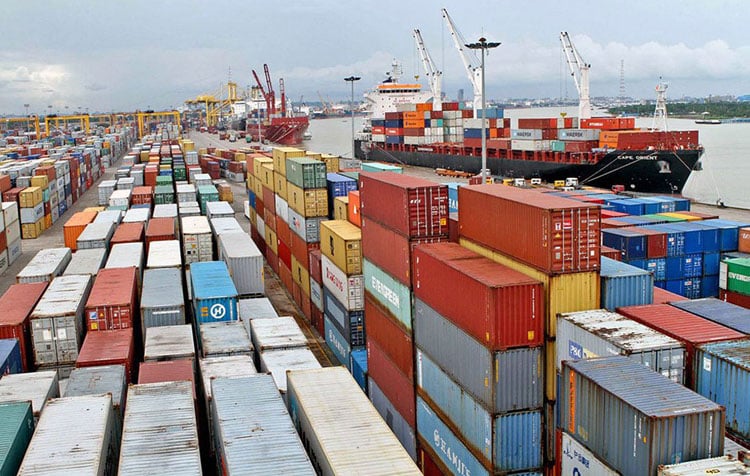
The government’s decision to bring in a foreign operator to manage the New Mooring Container Terminal (NCT) at Chattogram Port has led to a standoff between the port authority and those opposed to the move.
Labour unions, political intermediaries, and other groups have raised concerns, claiming that the move goes against national interests. They have staged fierce protests in recent days in Dhaka and Chattogram, demanding that the government backtrack on the decision.

In response, authorities have accused the opponents of being paid protesters, arguing that they are the beneficiaries of the port’s inefficiencies and illicit practices.

Authorities have raised questions about the unusual alignment of political rivals, including BNP, Jamaat, and several leftist groups, who, despite disagreeing on almost every other issue, have issued nearly identical objections to the matter.
Shipping Adviser M Sakhawat Hossain has accused opposition groups of resisting the reform to protect nearly Tk200 crore in illicit transactions linked to the port annually.
He told TIMES of Bangladesh that the protests have little to do with national interest. “This is about money circulating illegally around the port,” he said.
“There are many silent partners – political actors, labour leaders, and others – who fear losing control over the flow of money,” he added.
However, Hasan Maruf Rumi, convener of the Port Protection Parishad, one of the protesting groups, insists that their resistance is driven by patriotism, not financial gain. “The public must know if the DP World agreement contains anything harmful to the country,” he said.
Other groups, including the Sramik Karmachari Oikya Parishad (SKOP), the labour wings of BNP and Jamaat, left-wing parties, and various professional associations, have been staging continuous protests, claiming they are defending the nation’s interests.
The Chittagong Port Authority (CPA) argues that bringing in DP World, a global operator, to manage the NCT – the port’s most advanced and highest-capacity terminal – is essential for Bangladesh to remain competitive against regional hubs like Colombo, Singapore, and Port Klang.
CPA Chairman Rear Admiral Mohammad Moniruzzaman described the backlash as “predictable” from those who have benefited for years from inefficiencies, adding that “automation, transparency, and performance benchmarks are essential if Chattogram is to handle future trade volumes.”
With rising container volumes and fluctuating vessel wait times, DCCI and BGMEA officials warn that without automated systems, modern crane operations, and streamlined berthing, Bangladesh’s competitiveness will inevitably decline.
Some business voices argue that the opposition comes largely from groups with no stake in port operations. “Actual port users strongly support appointing a global operator like DP World,” said Nasir Uddin Chowdhury, former BGMEA vice-president.
He added, “NCT must be modernised, or the national economy will pay the price.”
A 2004 study by Transparency International Bangladesh (TIB) uncovered systemic malpractice at Chattogram Port, revealing that officials allegedly extracted Tk783 crore in illicit payments that year – Tk451 crore to customs staff and Tk332 crore to port employees.
A more recent 2025 TIB study shows that illegal transactions at the port still exceed Tk64 lakh per day, amounting to over Tk230 crore annually, in line with long-standing estimates of the NCT’s shadow economy.
Many allege that those opposing the appointment of a foreign operator are involved in these illicit activities.
Denying the allegations, opposition voices, such as Nurula Bahar of the BNP-backed Sramik Front Nationalist Workers’ Party, are demanding an independent investigation to identify those involved in illicit transactions.


