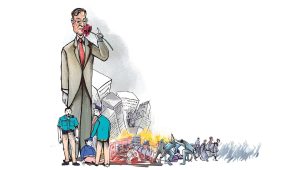
The law and order in Chattogram has deteriorated sharply in recent months, with at least 50 people—mostly political activists—killed over the past year. Most of the killings are linked to turf wars for political dominance, financial control, and illegal business interests.
Rampant sand mining, extortion, and unauthorised financial transactions have emboldened local crime syndicates, creating a parallel economy that sustains organised violence. Officials at a meeting of the District Law and Order Committee, held at the Chattogram Circuit House on Sunday, acknowledged that illicit money flows are directly driving the escalation of armed conflicts across the district.
The meeting, chaired by Deputy Commissioner (DC) Saiful Islam, observed that both political will and strong administrative measures are essential to curb the crisis.
“Illegal transactions are at the root of the recent deterioration in Chattogram’s law and order,” DC Saiful told TIMES of Bangladesh. “We must work collectively to dismantle these networks. Politicians cannot stand aside—they are part of the governance system and must take responsibility to ensure public safety.”
He said the underground economy run by local crime syndicates has become large enough to fund the purchase of significant quantities of illegal firearms now being used in criminal operations.

Raozan: The deadliest flashpoint
Raozan has emerged as the most violent hotspot, with at least 17 people—mostly political activists—killed in the past year. Much of the bloodshed stems from turf wars between armed groups vying for control of extortion rackets and lucrative sand extraction routes.
Committee member Barrister Tarek Akbar Khondaker, who was recently injured in a gun attack in Raozan along with his father, senior BNP leader Golam Akbar Khondaker, expressed frustration at the official response.
“The meeting was largely procedural,” he told The Times of Bangladesh. “That’s not enough to control the situation. Terrorists now have too many weapons in Raozan—people are being killed like birds.”



He alleged that many of the weapons are being supplied from Fatikchhari and Rangunia, while illegal sand extraction continues to bankroll these armed groups.
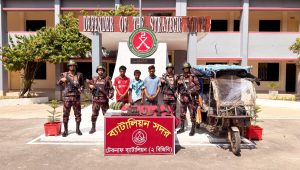
Police say they recovered around 300 illegal firearms—including locally made guns and smuggled foreign weapons—across Chattogram in the past year. However, security agencies are still searching for 155 firearms looted from police stations during the July uprising in 2024, which remain unaccounted for.
“Many of these missing guns have likely entered the criminal network,” a senior police official admitted. “They are now being used for killings, extortion, and intimidation.”
Illegal money, Illegal arms
Investigators have traced a clear link between illicit financial flows and the rise in arms trafficking. Money generated from illegal sand mining in the Karnaphuli and Halda rivers, extortion from businesses, and kickbacks from construction projects is being laundered through underground banking channels (hundi).
Deputy Inspector General Ahsan Habib Palash confirmed the nexus. “Illegal money is bringing in illegal arms,” he said. “Unless we cut off the financing, we cannot control the illegal weapons.”
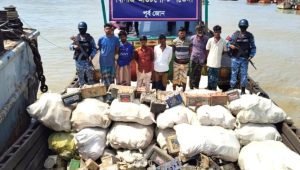
He added that firearms are being smuggled through both coastal and hill routes from neighbouring countries and distributed through local criminal networks.
Sand syndicates, business extortion
Officials of the Bangladesh Army’s 34 Engineering Brigade under the 24th Infantry Division recently reported that powerful syndicates are operating illegal sand extraction hubs along the Karnaphuli and Halda rivers, as well as in adjacent Raozan and Rangunia areas, using forged permits and political protection.
The profits—worth several hundred million taka annually—are being funnelled into arms purchases and organized crime. Industrial zones and construction firms across Chattogram are also frequent targets of extortion gangs, with businesses forced to pay regular “tolls” to avoid attacks, fuelling violent turf battles.
“Chattogram’s underground economy must be dismantled with full political backing,” said one official. “If illegal money keeps flowing, weapons will keep coming.”
Recent incidents—including the attack on BNP candidate Ershad Ullah’s campaign in Chattogram-8 and the killing of listed criminal Sarwar Hossain Babla—underscore the deepening crisis in the port city.
For now, the prospect of peace in Chattogram remains distant—trapped in a vicious cycle of illegal money, illegal arms, and institutional silence.