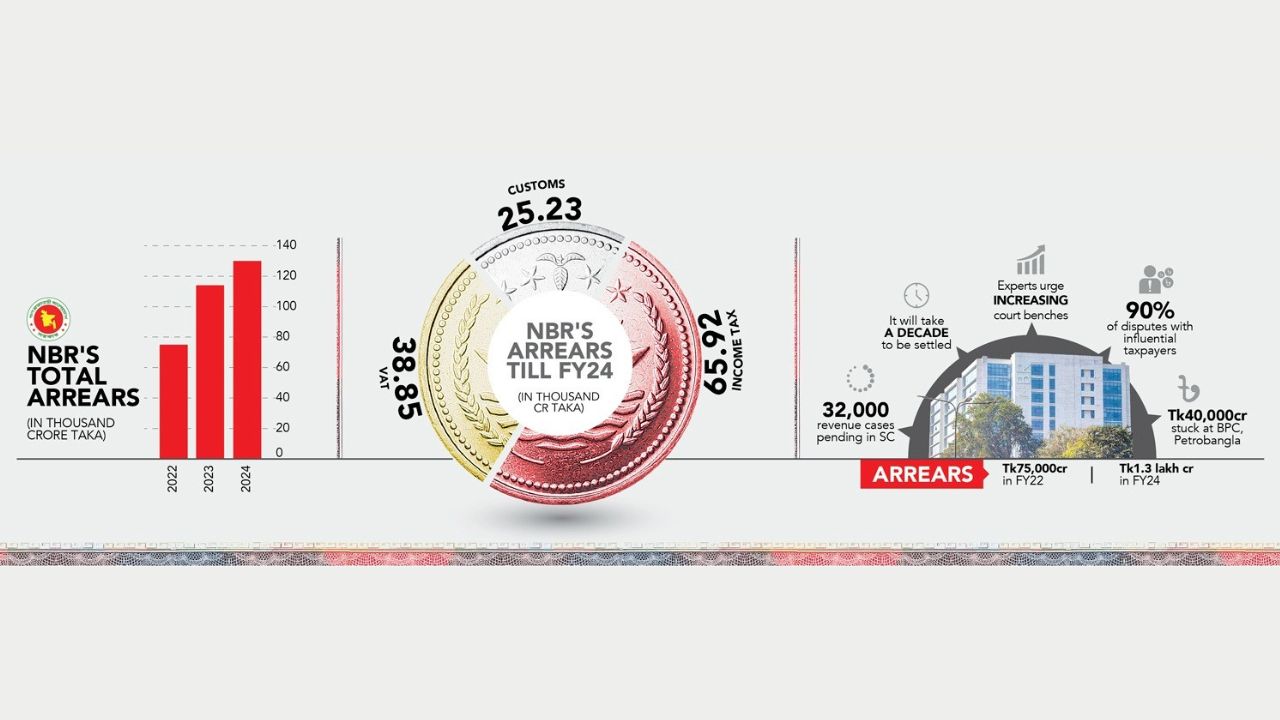



The National Board of Revenue’s (NBR) outstanding revenue has exceeded a staggering Tk1.30 lakh crore, weighed down by administrative bottlenecks and thousands of unresolved tax disputes – an amount equivalent to more than one-third of the country’s annual tax receipts.
Of the total arrears, nearly Tk50,000 crore is stuck in some 32,000 cases pending before the Supreme Court, while around Tk80,000 crore remains tied up in various administrative processes.
The list of NBR’s outstanding defaulters includes both private corporations and government entities.
Experts warned that the mounting backlog of unpaid revenue is squeezing fiscal space and compelling the government to depend increasingly on high-conditional loans from the International Monetary Fund (IMF) and other global lenders to bridge its budget deficit and finance development spending.
They noted that the IMF has attached stringent conditions to its support package, including the withdrawal of all tax exemptions, the imposition of a uniform 15% value-added tax on all goods and services, and a minimum 2% turnover tax across sectors – measures that business leaders have described as a “death warrant” for private enterprises.
The government must implement comprehensive and pragmatic reforms to achieve a mid-term recovery of these arrears, Bangladesh Chamber of Industries President Anwar-ul Alam Chowdhury told TIMES of Bangladesh.
NBR officials said every VAT and tax evasion case identified through audit is recorded as outstanding, which explains the rising figure.
“Reducing arrears is now a top priority,” said NBR Member (Tax Policy) Muttasim Billah Faruqui.

He added that all circle offices have been directed to update arrear data and press state law officers for faster disposal of major revenue cases in court.
Former NBR chairman Badiur Rahman told TIMES, “The NBR must become more proactive and, where necessary, freeze accounts or pursue criminal action alongside revenue cases.”
90% owed by influential individuals, corporations
According to NBR officials, 90% of the outstanding revenue is owed by influential individuals and corporations. Of them, around 55% challenge audit findings and tax demands in court instead of paying dues. If they fail within NBR’s internal tribunals, they move to higher courts, delaying recovery for years – with some disputes dating back to 2003.
The remaining 45% often make partial payments and delay settlements year after year.
One major example is a Tk2,437 crore VAT and supplementary duty case against British American Tobacco Bangladesh from FY18. The High Court initially ruled against the company, but the verdict was later stayed by the Appellate Division and remains unresolved.
Other large VAT disputes exceeding Tk500 crore include two cases against Grameenphone from 2011 and 2017 involving a combined Tk1,750 crore, Dhaka Tobacco’s Tk536 crore case pending since 2009, Premier Bank’s Tk822 crore since 2018, Bangladesh Gas Fields Company’s Tk753 crore since 2018, and Banglalink’s Tk532 crore since 2017.



Under existing rules, a taxpayer can initiate a case by paying only 10% of the disputed amount and withhold the rest until final settlement. If they directly file a writ with the High Court, even that 10% is not required.
VAT law expert Bindu Saha told TIMES that this mechanism effectively turns tax litigation into a profitable strategy. “Until the final verdict, companies keep 90% of the money, earning profits elsewhere,” Saha said.
He explained that under the old law, interest accrues at 2% per month for up to 60 months, while under the new law it is 1% per month for up to 24 months. In practice, a Tk1,000 crore dispute delayed for 15 years can earn a firm more from reinvestment than it would pay in accumulated interest.
Defaulting govt entities
State-owned entities are also major defaulters. The Bangladesh Petroleum Corporation (BPC) and Petrobangla together owe around Tk40,000 crore in unpaid VAT and customs duties to the NBR.
An NBR senior official said the agency hesitates to take strict action against BPC, given its strategic role in importing petroleum. “Holding consignments at ports could trigger a national fuel crisis,” he said.
BPC Director (Finance) Najneen Parveen said, “As a state entity, we depend on ministry-level fund releases to clear large payments. Since it is public money, there is no question of evasion, and we are trying to clear dues.”
Jamuna Group General Manager Md Shamsher Ali said tariff value assessments that often impose excessive tax burdens have been prompting many businesses to seek relief through disputes or underpayment.
Soaring arrears and poor data upkeep
NBR records show that total outstanding revenue stood at Tk74,539 crore in FY22, rising to Tk1.14 lakh crore in FY23 and further to Tk1.30 lakh crore in FY24.
According to NBR data, the backlog swelled byTk56,000 crore over the last two fiscal years of the ousted Awami League government, adding significant strain to the government’s cash flow.
However, the Research and Statistics Wing of the NBR has not updated its official data since FY23. The department, which operates with only four officers including the director general, continues to rely on figures that are more than two years old.
TIMES of Bangladesh determined the total outstanding revenue for FY24 through separate discussions with officials from the income tax, VAT, and customs wings.
According to the officials, Tk65,917 crore remained unpaid under income tax, Tk38,851 crore under VAT, and Tk25,232 crore under customs duties during the fiscal year.
In FY25, the NBR managed to collect Tk3.70 lakh crore in total revenue.
Slow judicial process
More than 32,000 revenue-related cases are currently pending in the Supreme Court involving Tk49,696 crore in unpaid dues.
Taxes Appellate Tribunal President Syed Mohammad Abu Dawood said the tribunal currently operates eight benches across the country. Each bench holds hearings at least three working days a week and spends the remaining days writing verdicts.
The benches collectively dispose of around 850 cases every month, he added.
In contrast, the High Court’s three benches – two virtual and one physical – dispose of 14 to 15 cases a day, but frequent adjournments and around four and a half months of annual recess make progress slow.
Experts believe the three benches are insufficient. Barrister Syed Afzal Hasan Uddin said that in the United Kingdom, senior lawyers are appointed as temporary judges to expedite tax cases – a system Bangladesh could adopt.
Deputy Attorney General Muha Ershadul Bari Khondker said, “At the current pace, it would take at least a decade to clear the backlog, and new cases are being added faster than they are resolved.”
The NBR’s Alternative Dispute Resolution (ADR) system, which once settled about 400 cases a year, now handles around 300.
Former NBR Member (Tax Policy) Syed Aminul Karim said ADR benefits both taxpayers and the government by resolving disputes faster. “But officials are now reluctant to take risks or compromise on dues,” he said.