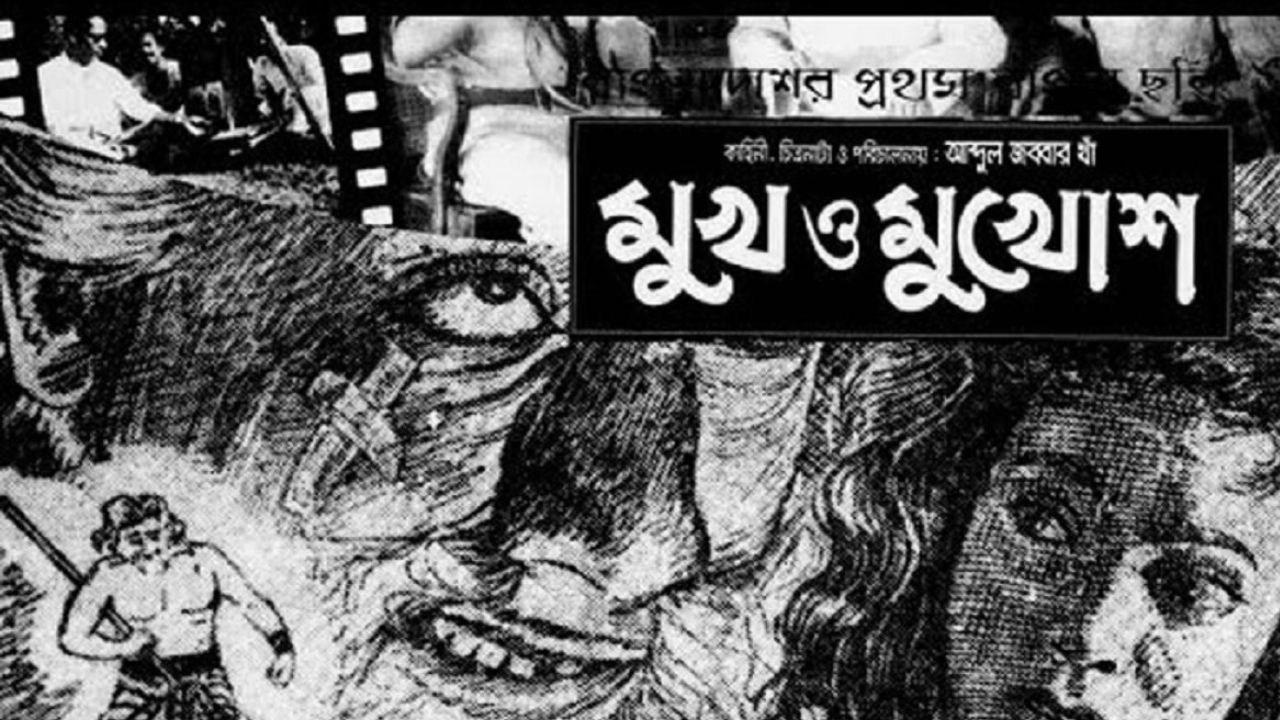

Seventy years ago, on 3 August, 1956, a black-and-white film premiered at Rupmahal Cinema Hall in Dhaka and forever changed the course of Bangla cinema.
As Mukh O Mukhosh celebrates its 70th anniversary, it remains more than just the first full-length Bengali-language feature made in what is now Bangladesh—it stands as the foundation upon which the country’s film industry was built.
At a time when cinema halls in East Pakistan primarily screened films from Kolkata and Lahore, few believed the region had the resources to produce its own feature films.
That perception changed because of one man’s determination.
Playwright, actor and filmmaker Abdul Jabbar Khan reportedly took offence when Pakistani producer F. Dossani claimed that East Pakistan’s humid climate made filmmaking impossible.
Rather than accept the criticism, Jabbar Khan set out to prove him wrong.
Production began in 1953 under extremely modest conditions.

Armed with a single Eyemo camera, a basic tape recorder and a generator, the crew filmed across Kaliganj in Gazipur, Rajarbagh, Kamalapur, Lalmatia, Mirpur, Tejgaon, Zinzira and Tongi. Shooting was completed on 30 October, 1955.
As there was no film processing laboratory in East Pakistan, the negatives had to be sent to Lahore’s Shahnoor Studios for processing.
The story itself was inspired by a robbery in Faridpur that Jabbar Khan had originally adapted into a stage play titled Dakat.
Poet Fazal Shahabuddin later suggested the title Mukh O Mukhosh (“Face and Mask”), reflecting the contrast between people’s public identities and hidden realities.



Casting presented another major challenge, particularly in finding women willing to act on screen.
A newspaper advertisement in Chitrali eventually brought Pyari Begum, an Eden College student, and Zahrat Ara, a student of the University of Dhaka, into the project.
Purnima Sengupta from Chattogram played the female lead, while Inam Ahmed and Abdul Jabbar Khan portrayed the principal male characters.
None of the actors received payment.
The film was financed by Nuruzzaman of Iqbal Films.
Music was composed by Samar Das, songs were written by M.A. Gafur, vocals were provided by Abdul Alim and Mahbuba Hasnat, and editing was handled by Abdul Latif.
Although Jabbar Khan initially faced obstacles returning to Dhaka, he attended the film’s first screening in Lahore before Mukh O Mukhosh was released simultaneously in Dhaka, Narayanganj, Chattogram and Khulna on 3 August, 1956.
Produced on a budget of around Rs64,000, the film reportedly earned Rs48,000, falling short commercially.
Yet its historical significance far outweighed its box-office performance.
Mukh O Mukhosh proved that a full-length sound film could be produced in East Pakistan, inspiring confidence in a local film industry that had previously seemed impossible.
Its success also helped pave the way for the establishment of the East Pakistan Film Development Corporation (EPFDC) in 1957, which later became the Bangladesh Film Development Corporation (BFDC) after independence.
Seven decades later, Bangladesh’s film industry continues to grapple with challenges ranging from declining cinema halls to sustainable investment and global recognition.
Yet every milestone achieved by the country’s filmmakers can be traced back to one pioneering production.
Seventy years on, Mukh O Mukhosh remains not only a cinematic landmark but also a reminder that Bangladesh’s journey in filmmaking began with a dream, a challenge—and the determination to prove that local stories deserved their own screen.