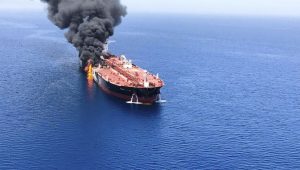
Thousands of US Marines are expected to arrive in the Middle East, coinciding with the expiry of a deadline set by President Donald Trump for Iran to reopen the Strait of Hormuz.
The deployment comes amid reports that the Trump administration is considering a plan to seize and occupy Kharg Island, Iran’s primary oil export hub, in an attempt to force a decisive end to the ongoing conflict and secure leverage in future negotiations, reports FDD.
Before the conflict began, Kharg Island handled approximately 90 per cent of Iran’s crude oil exports. However, strategic analysts warn that such a move could become a significant liability, potentially expanding and extending the war rather than delivering a swift victory.
The military build-up involves two US Navy Amphibious Ready Groups and their embarked Marine Expeditionary Units, comprising at least 3,000 Marines, which are currently moving toward the region.

Additionally, the Pentagon has ordered elements of the US Army’s 82nd Airborne Division to deploy. While a combined force of Marines, airborne troops, and special operations units could likely seize the island quickly, maintaining an occupation poses severe operational challenges. Located 20 miles off the Iranian coast and more than 350 miles from the Strait of Hormuz, the island sits within range of Iranian multiple launch rocket systems and coastal artillery.
Experts highlight an underappreciated threat from Iranian first-person view (FPV) drones, similar to those used extensively in Ukraine, which can be un-jammable if using fibre-optic technology.


If Tehran employs these with sufficient range, the Iranian military could target individual US service members in real time for propaganda purposes. Furthermore, ongoing Russian intelligence-sharing, including satellite imagery, would likely improve the lethality of Iranian strikes against US forces on the island.
The US Navy would also face immense pressure to provide continuous air and missile defence, requiring destroyers to linger near the Iranian coastline to protect troops and sustainment craft.
This mission would likely delay the Navy’s ability to conduct convoy operations for merchant tankers through the Strait of Hormuz, as vital naval assets would be diverted to protect the occupation.
Additionally, air assets such as helicopters and V-22 Osprey tiltrotor aircraft would be tasked with logistical support, leaving them vulnerable to surface-to-air threats.
Critics of the proposed seizure argue that halting Iranian oil revenue can be achieved more safely through sanctions or seizing tankers rather than a high-risk ground occupation. They further suggest that placing troops on the island would actually enhance Tehran’s ability to inflict costs on Washington by allowing Iran to employ a wider range of its arsenal against concentrated forces.
There is also an immense risk of mission creep; if US troops take heavy casualties from mainland fire, the administration might feel compelled to seize Iranian coastal areas, drawing the United States into a protracted ground war of attrition on Iranian soil. As the conflict enters its fourth week, the shift toward a ground operation on Kharg Island is increasingly viewed as a high-risk gamble that may yield little strategic return.