
At coaching seminars run by the Norwegian Football Federation, a short clip is often shown of a 16 year old taking part in a shooting drill. The footage, filmed from behind the goal, shows most of his 20 attempts sailing wide or high. Aspiring coaches watching are then asked a simple question: does this boy have what it takes to play for Norway.
“Everyone says no because in the video it looks like a poor striker,” said Hakon Grottland, long serving head of player development at Norway’s football association. The boy spraying shots in every direction has since become the nation’s talisman and arguably the finest centre forward on the planet: Erling Haaland.
“Maybe that’s also why he has become the best. He missed the most and trained and trained,” Grottland added. “The other thing you can clearly see in the video is that it is just Erling, a coach and the goalkeeper. The rest of the team is on the bus back to the hotel but Erling wanted to keep getting better.”
Haaland now stands as the single biggest obstacle between England and a place in the World Cup semi finals. His match winning double against Brazil in the last 16 delivered Norway’s finest result in their history, and his tally of seven goals leaves him trailing only Lionel Messi and Kylian Mbappe in the race for the Golden Boot.
A breakout month unlike any other
For all his goalscoring exploits in the Premier League, Champions League and Bundesliga over recent seasons, this World Cup, Norway’s first since 1998, has catapulted Haaland to an entirely new level of global recognition. Beyond the finishing, it is his personality that has captured attention. He has emerged as arguably the tournament’s most engaging figure, a grinning, self deprecating presence who has rarely looked happier than during this run with Norway, leading the post match drum celebrations after beating Brazil and cheerfully needling former England striker Wayne Rooney over a promise to row down Liverpool’s River Mersey should Norway reach the last eight. “I’m looking forward to seeing you, Wayney boy,” Haaland said in a video posted to his own channel. “That’s all I want to see now.”

The psychology behind the smile
Geir Jordet, professor of psychology at the Norwegian School of Sport Science, believes Haaland’s appeal lies in a rare combination of traits. “He has this ability to blend. On one side this professionalism, this single mindedness, machine like orientation to prepare, develop and score goals. That’s part of the fascination for everyone that sees him in games,” Jordet said. “The other side is this player that is so relaxed, so fun and a team player. His joy is real. He seems genuinely more happy when his teammates score than when he scores himself. To have that blend is very unique.”
Grottland described a similar impression from within the Norway camp. “Norway is very proud of him. He’s a guy with a big smile, a lot of positive energy. He would make his teammates feel very comfortable. There’s something about the togetherness that you see in Erling and the other players. It’s quite unique for our national teams,” he said.
Viking imagery, ordinary beginnings
Norway’s 2026 squad has leaned heavily into Viking symbolism, with a pre tournament photoshoot depicting the players as warriors and supporters performing a rowing celebration after victories. At 6ft 5in and known for a diet exceeding 6,000 calories a day, including raw milk and organ meat, Haaland fits that imagery on the surface. Yet his path to stardom was anything but predetermined.
At a talent camp in Stavanger in June 2014, Haaland, then still with hometown club Bryne, was among the 30 best players born in 2000, but not a single coach present marked him down as a future full international. It was shortly after that camp he began a dramatic growth spurt. His older brother Astor recalled him growing 20 centimetres and adding 20 kilograms within a year. “Suddenly we were the same size,” Astor said in the Viaplay documentary Haaland: The Big Decision.
Despite his physical development lagging behind, Haaland never lacked self belief. Former Norway captain Brede Hangeland, now the side’s assistant coach, remembered a young Haaland outlining his ambition to become the best forward in the world during a training camp. “Most of the 14 year old boys there could barely look me in the eye, not Haaland,” he said. Martin Odegaard, Haaland’s long time friend and current Norway captain, has joked about that same self assurance. “You have changed a bit,” he told Haaland in the same documentary. “You were more like a little bastard earlier. You have grown up more in the last couple of years.”
Numbers that speak for themselves
Across spells at Molde, Red Bull Salzburg, Borussia Dortmund and Manchester City, Haaland has scored 297 goals in 364 appearances. For Norway, he has now scored in each of his last 14 matches, taking his international tally to 62 goals in 54 caps. Grottland pointed to Haaland’s late physical development as central to his success. “There were other strikers we thought were more promising at the age of 14 but a few years later he’s the best striker in the world,” he said. “If he had the physics from the start, then I don’t think he would have become this great.”
Building a brand, and an audience
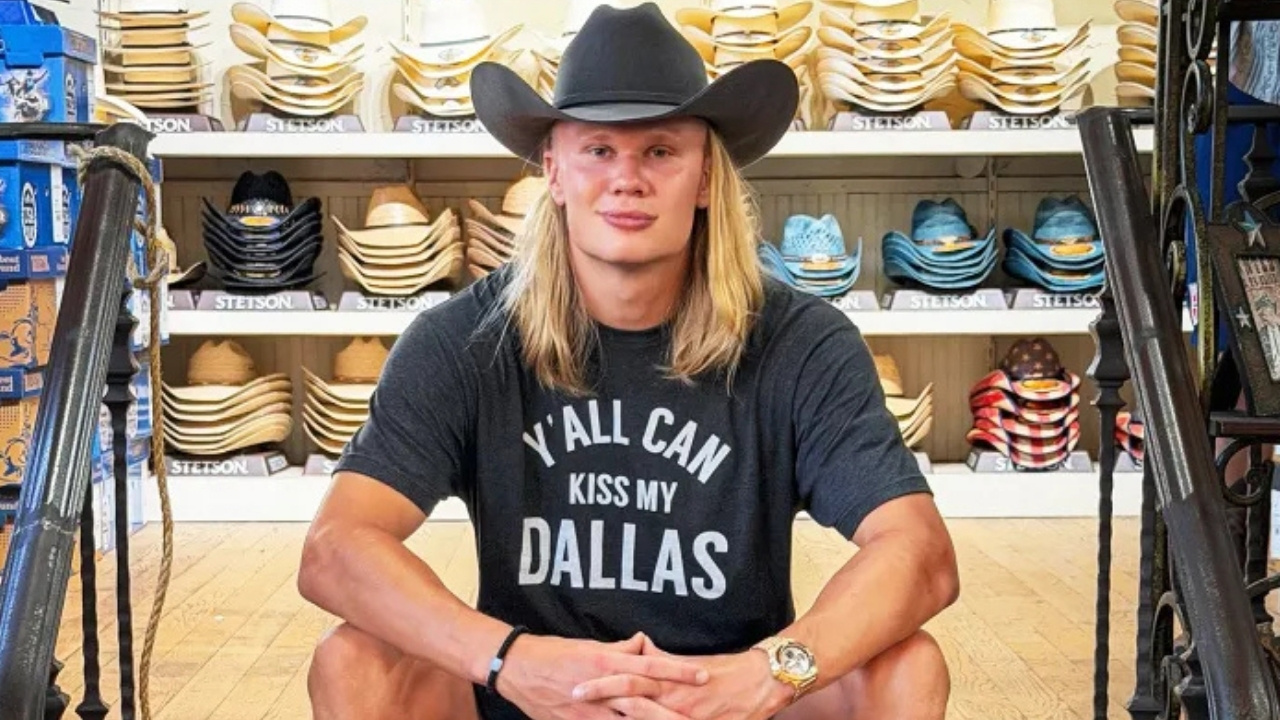
Haaland’s popularity has been amplified by a carefully curated but disarmingly playful online presence. He launched a YouTube channel last September, and recent episodes have leaned into American audiences directly, including a visit to a western wear shop after his winner against Ivory Coast, where he wore a Stetson branded with his initials and a T shirt reading “Y’all can kiss my Dallas.” On Instagram and Snapchat, he has compared his own appearance to Shrek and the anime character Majin Buu. His Instagram following grew by almost 18 million in the past month alone, with roughly five million of those arriving in the 24 hours after his brace against Brazil.
Speaking to reporters after training, Haaland reflected on his enjoyment of the tournament. “To play in the World Cup, play on the biggest stage, against best teams in world, it’s very special,” he said. “But I try to play the game like it’s a training session. It’s important to joke around. Everyone knows me that I like to joke, have fun, that’s the key to daily life to joke around. But also train good, focus well, train well. But joke around and enjoy the moment. You just have to enjoy it.” Asked about his growing following in the United States, he added simply, “It’s a good thing. I like Americans. They’re hilarious. I like the way they are.”
A team man despite the spotlight
Despite his rising global profile, those close to the Norway squad insist Haaland has no interest in standing apart from his teammates. Norway’s football association promotes what staff describe as a “no assholes culture” through its national team development pathway, and Hangeland said the emphasis extends well beyond technical coaching. “You don’t just teach them football, you try and teach them the value of contributing to a team,” he said. Teammate Kristian Thorstvedt echoed that sentiment ahead of the England match. “He’s amazing on the pitch but outside the pitch too, young players look up to him. We all learn bits from each other, but Erling has his own methods, and it’s inspirational to see what he’s doing,” he said.
A more vulnerable side
Behind the swagger often on display for Manchester City, Jordet said Haaland had opened up about a more anxious side to his personality during research for his book on the psychology of penalty taking. After months of no response, Haaland’s team eventually relayed one quote he specifically wanted shared. “When I’m taking penalties, I’m shit nervous. It’s strange if there are players who are not nervous,” Jordet recalled him saying. “That’s the other side of him. He’s genuine and honest.”
Now, Norway stand 90 minutes from a first ever World Cup semi final, a run head coach Stale Solbakken has already described as the greatest achievement in the nation’s footballing history. Thousands filled the streets of Oslo after the win over Brazil, and many are expected to do so again as Norway face England for a place in the last four. Grottland believes the country has never seen anything quite like it. “He’s a legend already. There’s never been a more popular guy in Norway,” he said. And, increasingly, perhaps not just in Norway either.