



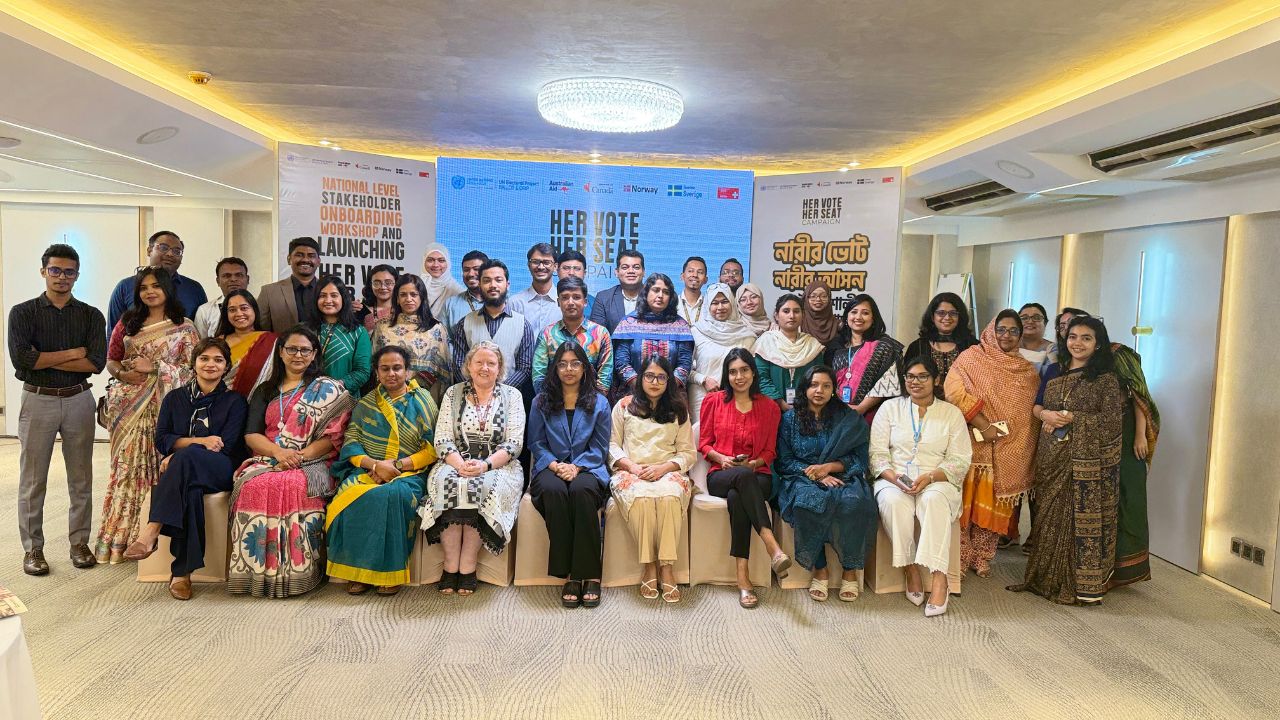
JAAGO Foundation Trust and the Welfare Association of Development Alternative launched a national campaign in Dhaka on Tuesday aimed at strengthening women’s political participation, leadership and influence in decision-making.
The “Her Vote, Her Seat” campaign was unveiled alongside a national stakeholder engagement workshop at the Platinum Grand Hotel in Banani on 28 July, with support from UN Women and the United Nations electoral assistance programme, the organisers said in a press release.

Development partners, United Nations agencies, women leaders, youth representatives, civil society organisations and journalists attended the event.

Election Commission data presented at the programme showed that women accounted for 49.24 per cent of voters in the 13th parliamentary election, but only seven women were directly elected from the country’s 300 constituencies.
The seven directly elected women represented 2.33 per cent of parliamentary seats, although 85 women contested the election.
The number of women in parliament increased to 57 after nominations were completed for the 50 seats reserved for women, meaning that most female representation came through party nominations rather than direct election.
The campaign identified social norms, family restrictions, safety concerns, online harassment, misinformation and unequal access to resources as continuing barriers to women entering politics.
Its baseline assessment and stakeholder consultations drew on experiences from Kurigram, Bogura, Mymensingh, Jamalpur, Cox’s Bazar, Khulna, Satkhira and Patuakhali.
The campaign focuses on women’s access to political and civic spaces, their active participation in those spaces and their ability to influence decisions.
Its central message is that securing a seat is not the ultimate objective. The ability to speak, make decisions and exercise influence from that position is more important.
A symbolic presentation titled “Seat Story: From Voice to Seat” portrayed a young woman’s journey from ordinary life to leadership.
The presentation concluded with the woman taking a symbolic seat, underlining the campaign’s argument that the power to make decisions matters more than merely reaching a position.
Shararat Islam, communication analyst at UN Women, said women’s political participation becomes meaningful only when they can express their views, influence decisions and lead rather than simply being present at the decision-making table.
“Families, communities and all stakeholders must work together to make that possible,” she said.
Irene Sultana, deputy director for research at the National Institute of Mass Communication, said the media was playing an important role in promoting women’s political participation, although many issues remained outside its field of vision.
“There is room for the media to do more here. Women’s safety also has to improve, particularly online,” she said.
Dr Susan Vize, UNESCO representative to Bangladesh and head of office, said consideration should first be given to how women would enter politics, where they would begin and how communities could support them.
“These questions need answers first,” she said.
Iftikhar Ul Karim, programme head at JAAGO Foundation Trust, said women’s political participation was not solely a women’s issue but a foundation of effective and inclusive democracy.
“A seat is not the final goal; what matters most is the capacity to create change from that seat,” he said.
The organisers described “Her Vote, Her Seat” as an entirely non-partisan initiative that does not support any political party or ideology.
The campaign will conduct dialogues, awareness programmes and evidence-based communication activities.


