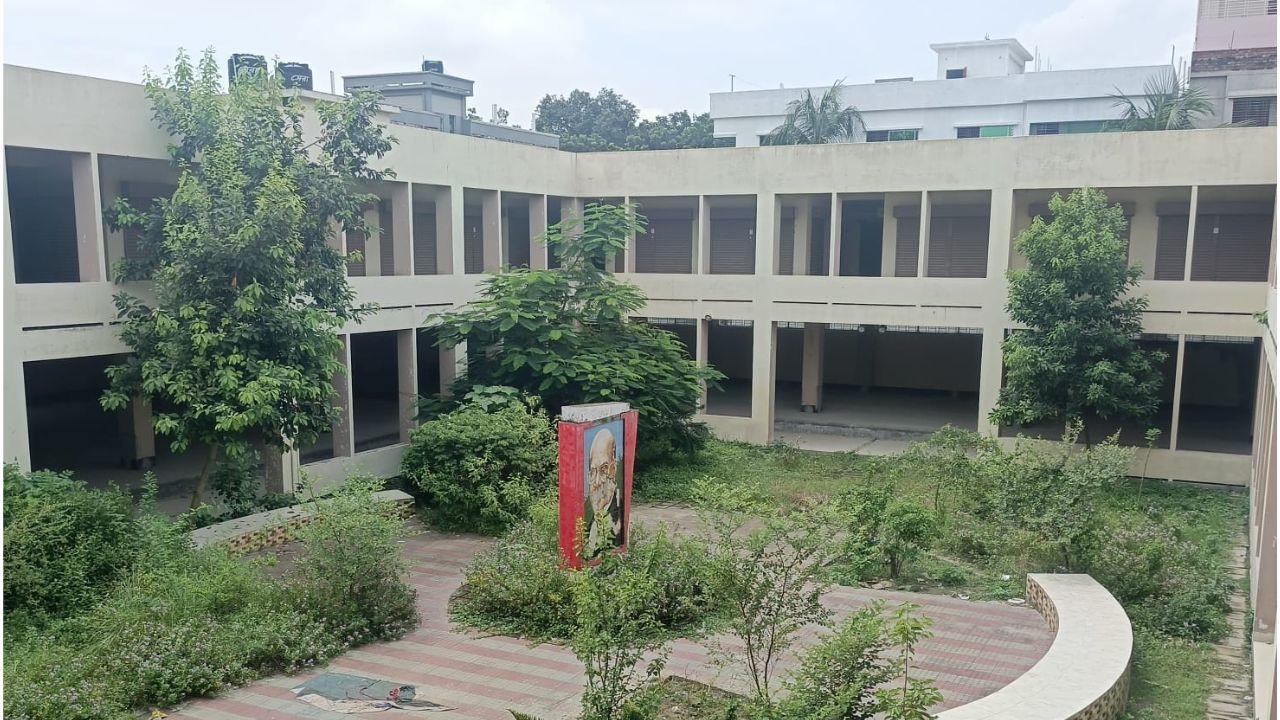



Built at a cost of Tk12.44 crore with modern facilities, planned shop layouts, a slaughterhouse, meat processing areas and fire safety systems, the Sirajganj Municipal Market remains largely deserted nearly five years after construction.
The two-storey facility, built on Fazlul Haque Road in Sirajganj municipality and now known as Sirajganj Municipal Kacha Bazar, was completed in 2021 and officially inaugurated in March 2022. Yet the market has failed to become operational, leaving most of its 200 shops unused.
The empty building, which was intended to ease pressure on the town’s main market by relocating fish, meat, poultry, vegetables and fruit traders to a planned commercial space, has instead become a symbol of poor utilisation of public investment.
With only a handful of traders operating there, the unused sections of the building are gradually deteriorating. Local traders and residents have also alleged that the deserted premises turn into gathering spots for drug users after evening.
According to Sirajganj municipality sources, the project was implemented with financial support from the World Bank at a cost of Tk12.44 crore to modernise the town’s market management system.
Construction began on 21 May 2019 and the building was completed on 30 June 2021. Although designed on a four-storey foundation, only two floors have been completed. The ground floor has 116 shop spaces, while the second floor has 78 shops.

The market includes facilities such as a modern slaughterhouse, separate areas for meat processing and washing, air-conditioned meat sales facilities, an electrical substation, fire safety equipment, toilets, office space and parking facilities.
Despite having almost all the infrastructure required for a modern market, the facility has failed to attract traders and customers, turning the investment into a burden rather than a public service.
Municipality officials said shop allocations were given after collecting security deposits ranging from Tk20,000 to Tk50,000 for open spaces and Tk80,000 to Tk2 lakh for shops. Monthly rents were fixed at Tk500 to Tk800 for spaces and Tk800 to Tk1,500 for shops.
The market was formally inaugurated on 21 March 2022. However, two further attempts were made to make it operational, but neither succeeded.


Traders said they were reluctant to move because there were no customers at the new market. As a result, most allocated traders have not started regular business there.
The absence of a market traders’ association has also hindered coordinated efforts to revive the facility. Several traders, however, said the market could become functional if the municipal authorities take effective measures.
Md Shafiqul Islam Swapan, who runs a temporary shop under the market staircase, said he had taken a shop allocation after paying money but was still forced to operate from the makeshift space.
“I had high hopes when I took the shop. But as the market did not become operational, I am in serious trouble. Customer numbers are extremely low and sales are almost non-existent,” he said.
Market wholesaler Md Shariful Islam Sharif said traders were suffering because the market had not been opened properly.
“Valuable equipment and facilities are also being damaged because the market has remained unused for a long time,” he said, alleging that drug users gather there at night.
Local residents said the building remains mostly empty during the day, but outsiders enter the premises in the evening, creating security concerns among nearby businesses and pedestrians.
Asked why the market had failed to become operational, Sirajganj municipality Secretary Rafiqul Islam said he had no instructions regarding the matter.
However, Sirajganj Additional Deputy Commissioner (Development and Human Resource Management) and Municipal Administrator Shahadat Hossain said the authorities had started a process to open the market soon.
“We have already started the process of opening the building. It is expected to become operational within the next month,” he said.
Regarding allegations of drug use at the premises, he said mobile courts were conducted occasionally by the district administration to prevent misuse of the building.
The market was built with the objectives of reducing congestion in the town, modernising market management and creating a planned trading environment. But years after construction, those goals remain largely unfulfilled.
Local traders and residents said authorities should focus on making the market functional instead of holding another inauguration. They also demanded regular cleaning, security measures and law enforcement monitoring.
Without immediate action, they fear the modern market built with public money could eventually become another example of a failed project.