The sudden arrest of former Speaker Shirin Sharmin Chaudhury has ignited fresh political discussions. Many believe that the BNP government detained her over charges related to a attempted murder case stemming from the 2024 July uprising, viewing it as an act of political vengeance.
However, various sources suggest that her arrest is part of a larger strategy to facilitate the rebuilding of Awami League.
According to multiple sources, including military, civilian, and diplomatic contacts, the entire situation appears to be part of a plan. Given Shirin Sharmin’s involvement in the case from the July uprising, it was not feasible to bring her out or release her publicly through normal means. Therefore, it is believed that she will be released through legal procedure, which may take some time.
The key question remains: Why was she brought into the open after almost 20 months?
Sources indicate that the intention was to utilise her at an appropriate time to help reconstruct Awami League, which currently faces a ban on its activities with most of the party’s leaders either in jail or exile since the ouster of Sheikh Hasina, the party chief.
Neighbouring India and Western nations have been working to reintegrate the Awami League into politics even before the February elections. During the interim government of Muhammad Yunus, similar efforts were made with senior Awami League leader Saber Hossain Chowdhury at its top leadership. In line with the plan, Saber was granted bail in all cases, but Awami League itself did not accept the move.

As part of this initiative, a list of civil society members was prepared to run in the elections as Awami League candidates under Saber’s leadership, but that effort also eventually failed.
Sources suggest that Shirin Sharmin Chaudhury, with her reputation as a dignified and humble politician, is seen as a more acceptable figure to help restructure the Awami League.
Although multiple sources said the new move was taken following a green light from top Awami League leadership, two mid-level party leaders claimed to TIMES that Hasina herself would return to Bangladesh by December this year and lead the party.



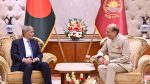
Where had Shirin Sharmin been?
On 5 August, during the student-led protests, Shirin Sharmin was inside the Parliament building. After the fall of Hasina’s government that afternoon, she got trapped inside. As the unruly crowd broke into the building, she and others sought refuge in a room. Along with her husband, Syed Ishtiaque Hossain, State Minister Zunayed Ahmed Palak was also present. Palak himself confirmed this during a court hearing.
After being trapped for nearly 10 hours, army personnel rescued Shirin Sharmin and took her to the Dhaka cantonment for safety. Following the fall of Hasina’s government, hundreds of politicians, ministers, and bureaucrats were sheltered in military barracks for security reasons.
At that time, the military disclosed that 600 people had been sheltered. By the end of August, all had left the cantonment, with several, including former minister Anisul Huq and former prime minister’s adviser Salman F Rahman, being detained at various locations across the country.
However, mysteriously, there was no information about Shirin Sharmin until her sudden arrest. It was speculated that she remained in the cantonment, though the military never confirmed this.
Appearance of Shirin Sharmin
On Tuesday evening, Dhaka Metropolitan Detective Police’s DC Rezaul Karim told TIMES of Bangladesh, “Shirin Sharmin Chaudhury was under surveillance. Two days ago, she visited her cousin Arif Masud Chowdhury’s house in Dhanmondi. She was arrested from there in the early hours of Tuesday.”
A senior journalist and political analyst, who spoke on condition of anonymity, said, “She was treated with respect in the cantonment. Shirin Sharmin is a humble person, and there were no allegations against her. That’s why she was given that respect.”
Two military sources, along with several political observers, suggested that the former speaker’s detention was strategic—she was kept for a specific reason, to be put in play if necessary. They believe that if the president were to resign or the interim government were to be removed, she could have been the only viable option to step in.
Passports and phones
Although Shirin Sharmin had remained out of public view, her phone remained active. When TIMES called her phone on Monday, a day ahead of the arrest, it was found open, but she did not pick up.
After the interim government cancelled her diplomatic passport, Shirin Sharmin and her husband applied for new passports online on 3 October 2024. Their biometric data was taken on 10 October at the cantonment passport office, but it remains unclear whether the passports were ultimately issued.
Legal framework for banning AL
The interim government had issued an executive order banning the activities of the Awami League and its associated organisations, while another order banned the student wing, Chhatra League. The current BNP government aims to bring this process into a legal framework, according to Home Minister Salahuddin Ahmed.
However, Jamaat-e-Islami has opposed this process. In discussions with a parliamentary committee, BNP lawmakers agreed to ratify the amendment relating to the ban on the Awami League, but two members from Jamaat raised objections.
Jamaat MP Gazi Nazrul Islam told TIMES, “The issue of banning a political party by executive order should be thoroughly reviewed to ensure that no questions arise in the future.”
Earlier, Chief Whip Nurul Islam Moni told this newspaper, “Awami League activity is already banned by the interim government. The current government has not banned them. It is not the government’s responsibility to ban any political party. The people will decide on this matter.”