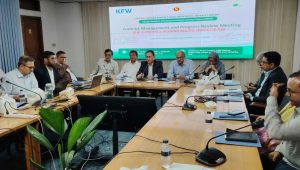
Bangladesh’s renewable energy expansion risks falling short of its employment potential unless skills, job quality and institutional coordination improve, the South Asian Network on Economic Modeling (SANEM) said at a policy dialogue at The Westin Dhaka on Thursday.
A preliminary SANEM survey of 60 Dhaka-based renewable energy firms, conducted in October 2026, found 97 per cent expect employment to grow over the next three to five years, but 82 per cent reported difficulty filling vacancies, particularly for engineers, designers and technical planners. About 90 per cent identified inadequate practical training and laboratory exposure as major weaknesses.
The survey found women make up only 4 per cent of the workforce at surveyed firms, and 68 per cent employ no women in renewable energy roles. Although 97 per cent provide safety training and protective equipment, only 42 per cent enrol employees in social security or pension schemes, and 22 per cent rely on verbal employment agreements.

Md Tuhin Ahmed, SANEM honorary deputy director, presented the findings. Installed renewable capacity reached about 2,185 MW by November, or 6.66 per cent of total generation capacity. The National Renewable Energy Development Strategy 2026–2030 targets 10,450 MW more by 2030, requiring an estimated 155,000 renewable energy workers by 2035, including about 75,000 STEM-qualified professionals.


SANEM proposed a four-pillar roadmap covering workforce planning and labour market intelligence; training and curriculum reform; inclusion, job quality and just transition; and governance, financing and coordination. Recommendations included annual workforce surveys, industry-aligned curricula, competency-based certification, Recognition of Prior Learning, better access for women and an inter-ministerial skills mechanism.
Jahangir Hossain, Director of the National Skills Development Authority, said about 5,000 people had been trained across 100 institutions under the Skills for Sustainable Energy initiative, with nearly 2,700 securing formal employment.
Panellists included Sharmind Neelormi and Selim Raihan of SANEM, A K M Fahim Mashroor of Bdjobs.com, Sakib Bin Amin of North South University, Shahriar Ahmed Chowdhury of United International University and Shafiqul Alam of IEEFA.

Raihan said the transition must move beyond capacity expansion to ensure skilled employment, decent conditions and greater domestic economic value.