


Bangladesh and the United Nations World Food Programme (WFP) have expressed appreciation for rice donation from South Korea to assist the Rohingya population.
The country reaffirmed Seoul’s steadfast commitment to supporting Bangladesh in tackling the prolonged humanitarian crisis.
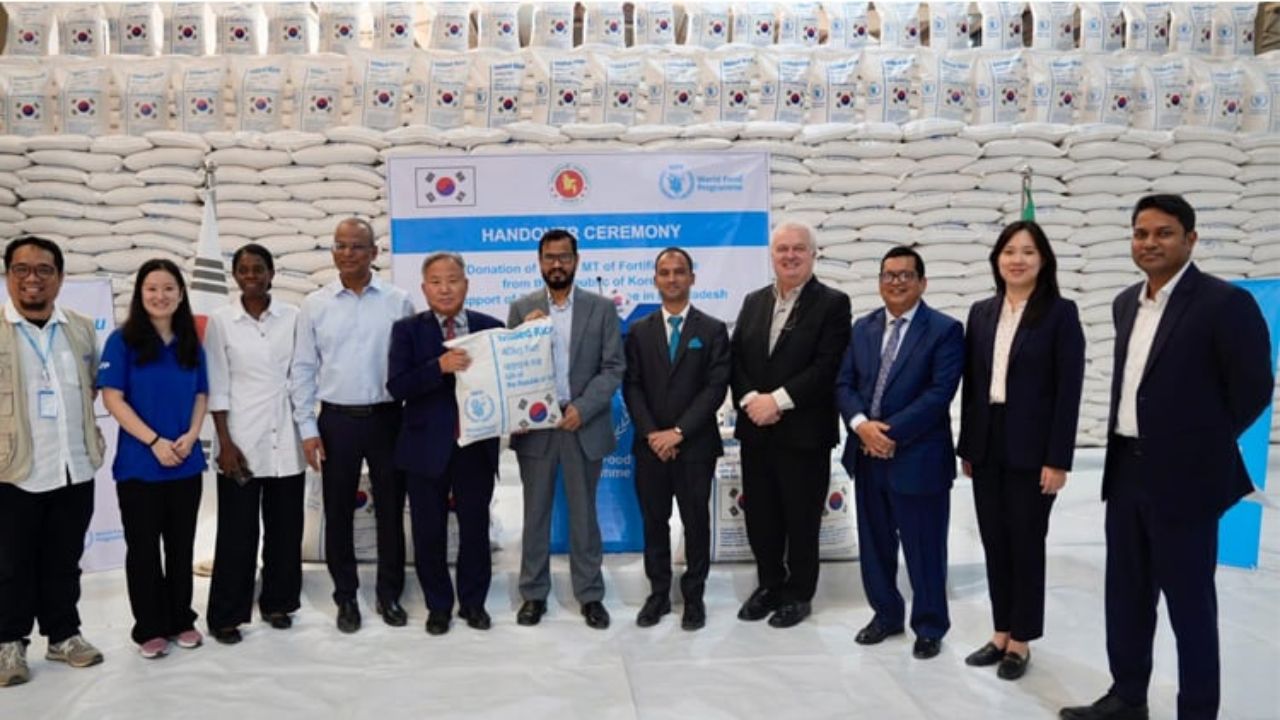
According to a press release, the official handover took place on Wednesday at WFP’s Alongkar Warehouse in Chattogram. Disaster Management and Relief Secretary Md Mostafizur Rahman, South Korean Ambassador Park Young Sik, and WFP Country Director Dom Scalpelli were present at the event.
The ceremony also honoured the contributions of Korean farmers whose dedication made the assistance possible, aligning with Korea’s Farmers’ Day celebrations.

This latest shipment, totaling 20,265 metric tonnes of rice, marks South Korea’s second major donation under its Ministry of Agriculture, Food and Rural Affairs (MAFRA).
In 2024, Seoul had sent 15,000 metric tonnes of rice for the same purpose.




Beyond rice, MAFRA has also supplied fortified rice kernels enriched with vital nutrients- vitamins A, B1, B12, zinc, iron, and folic acid. These kernels will be mixed locally with regular rice at a 1:100 ratio before distribution in Cox’s Bazar camps.
According to WFP, the latest contribution will provide food for the entire Rohingya population of more than 1.1 million people for almost two months. The donation forms part of South Korea’s global aid of 150,000 metric tonnes of rice to WFP operations in 17 countries.
“We remain dedicated to working with the Government of Bangladesh and WFP to respond to the growing needs of the Rohingya community,” said Ambassador Park.
The Rohingya (displaced citizens of Myanmar) crisis, now entering its ninth year, has left over 1.1 million refugees living in camps in Cox’s Bazar. More than 130,000 new arrivals have fled renewed violence in Myanmar’s Rakhine State since early 2024.
The 2025 Integrated Food Security Phase Classification (IPC) report estimates that around 446,000 Rohingya- or 40% of the population- are likely to experience severe food insecurity, with nearly 223,000 facing emergency-level hunger.
WFP has cautioned that without additional funding, critical food assistance may face serious disruptions by April 2026, as global humanitarian support continues to shrink.