Finance and Planning Minister Amir Khosru Mahmud Chowdhury on Wednesday announced a government initiative to take products made by rural artisans, including Shitolpati, pottery, handloom, and silver jewellery, to the global market.
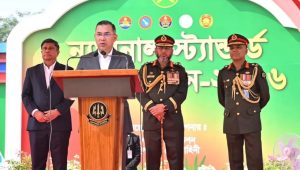
Speaking at a press briefing on “National Conference on Five-Year Strategy and SDG” held at China Friendship Conference Centre in Dhaka, Khosru emphasised that financial aid alone is insufficient.
For improve product quality, the government must provide advanced raw materials, designs, branding, and marketing support, which will increase the income of marginal people and create new employment opportunities, he said.
Khosru said that Sustainable Development Goals (SDGs) are not a charity programme. “Its objective is to improve the standard of living of every person in Bangladesh and ensure their civil, economic, and social rights,” he said.
Khosru added that citizens cannot be made self-reliant in the long term solely through allowances or cash assistance, and opportunities must be created where potential exists.

Highlighting that many rural families have practised the same crafts for generations without receiving fair prices, he cited the example of Shitolpati (cool mat) artisans in Barishal.
Khosru noted that while an artisan sells a Shitolpati for Tk700 to Tk800, the intensive labour and craftsmanship involved mean its value in the international market should be significantly higher.
To address this disparity, the government is prioritising the creative economy. Under this strategy, artisans of Shitolpati, pottery, handloom, blacksmith and potter crafts, and silver jewellery will be granted access to improved raw materials, design assistance, branding, and marketing facilities.



Khosru explained that through better design and quality enhancement, a Shitolpati currently priced at Tk700 could be sold for Tk2,000. Similarly, value addition could increase the price of a Tk10 product to Tk30, thereby boosting artisans’ income and production, and enabling them to create further employment.
To connect these rural products with the international market, the government plans to adapt them for global online marketing platforms such as Alibaba, Amazon, and eBay, aiming to deliver Bangladesh’s rural products worldwide.
Khosru cited Thailand’s “One Village, One Product” initiative as a model, where rural people were provided with skill development, raw materials, designs, and marketing support, transforming the economic landscape of entire villages. The Bangladesh government intends to establish a similar system.
However, Khosru acknowledged that the government cannot execute this plan alone. Partnering with the private sector and non-governmental organisations (NGOs) with field experience is essential to deliver designs, raw materials, credit, and market linkages to remote areas.
Under the creative economy framework, the government also plans to integrate people involved in theatre, music, and sports into mainstream economic activities.
Khosru noted that theatre involves not only artists but also makeup artists and lighting technicians and making these sectors economically viable will create new job opportunities.
He described the initiative as part of “democratisation of the economy”, asserting that every citizen has a right to participate in economic activities and benefit from them, which aligns with the core philosophy of the SDGs.
Khosru said the government is building an effective system involving the public sector, the private sector, NGOs, designers, and other stakeholders, rather than relying on speeches, policies, or budget allocations.
Pilot projects are already being implemented in various areas to identify and correct operational flaws.
The proper implementation of these initiatives will enhance the productivity and income of marginal people, create new jobs, and improve their standard of living, fulfilling the government’s goal of building an inclusive economy by tapping into the latent potential of the people alongside SDG implementation.