






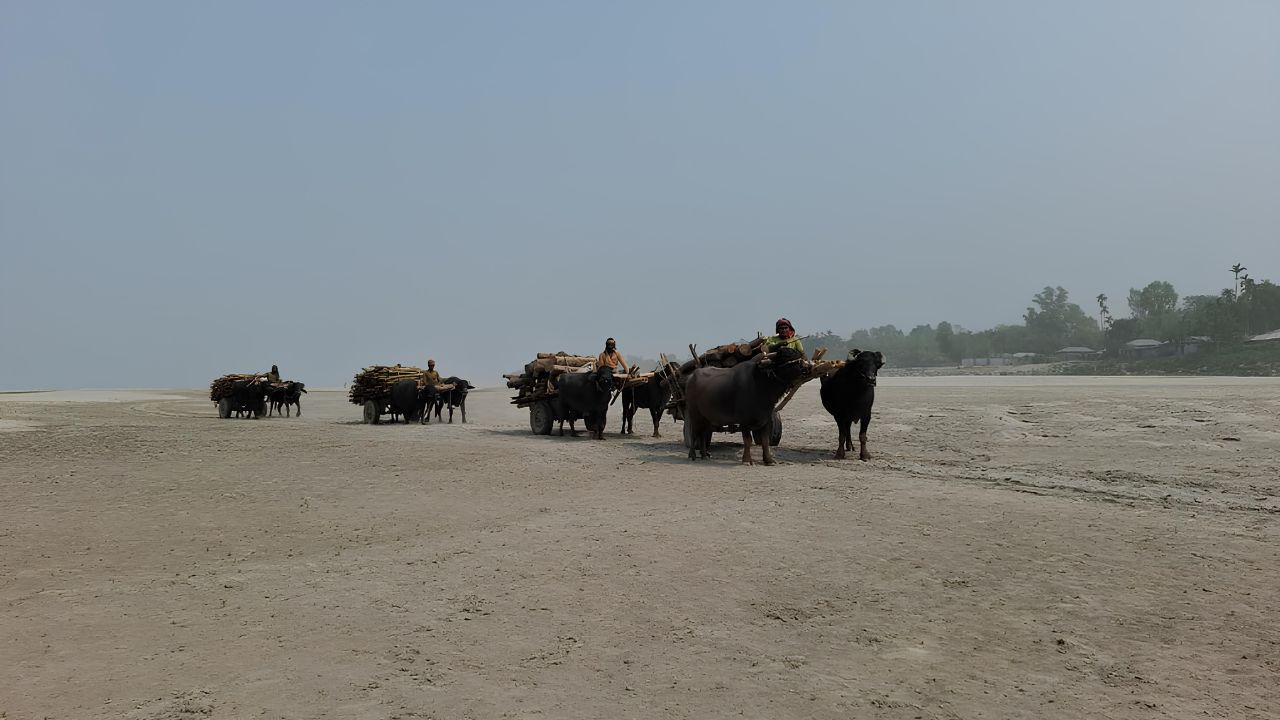
Once, the two-wheeled cart run by cow or buffalo was a familiar sight in almost every household courtyard. Cattle carts are no longer seen as they once were. With the passage of time, buffalo carts followed cattle carts as the next stage, but both are now on the verge of disappearing.
To the new generation today, these are nothing more than mere tales. Transporting cultivated crops from the char lands, moving commercial goods, forming wedding processions, or journeying to the paternal home or in-laws’ house with the cart decorated in a canopy and cloth tied on both sides, these were everyday, ordinary affairs.
In the rural Rowmari, the once-familiar sounds of ox and buffalo carts are slowly disappearing, signaling the decline of a time-honored tradition. These wooden carts, once essential for transporting goods, people, and agricultural produce, are being replaced by modern vehicles that offer greater speed and convenience.
This shift represents the end of an era for the local communities that once relied on these carts as an integral part of daily life.
For generations, ox and buffalo carts were a cornerstone of rural life in Rowmari. They were used to transport crops from fields to markets, carry wedding guests, and even move entire families. Villages like Jandikanda and Bondober were once teeming with these carts, which were as much a part of the landscape as the crops that filled the fields. However, as the region embraces modernisation, the need for these traditional carts has sharply decreased.
Haydar Ali, a farmer from Jandikanda, reflects on the past: “Ox carts were more than just a mode of transportation for us; they were part of our family’s heritage. Today, I have only one left, and it’s used solely for agricultural purposes.”
The carts were once crucial for carrying everything from heavy farm produce to wedding parties. However, the rising cost of livestock and the advent of faster vehicles have led many to abandon this tradition in favor of more efficient alternatives.
Similarly, Bhattu from Bondober village explains the shift: “In the past, our ancestors used ox carts, and later, buffalo carts took over. But due to the increasing cost of cattle and the limited demand, we no longer use them. Now, we rely on farming for our livelihood.”
This transition from traditional carts to mechanical vehicles is not just a change in transportation; it marks the loss of a cultural identity that defined the region for centuries. The creaking wheels of the carts, the lowing of the oxen, and the jingling of bells were once synonymous with village life. Today, such sights and sounds are becoming rare as modern transportation systems take over.
The history of the ox cart dates back thousands of years, originating in the ancient Indus Valley and spreading throughout the Indian subcontinent. In rural Bengal, the cart became an essential means of transport, particularly for agricultural and personal use. However, with the advent of motorized vehicles, these slow-moving carts are no longer a viable option. What was once a symbol of rural life is now fading into the past.
For many in Rowmari, the decline of the ox and buffalo cart serves as a bittersweet reminder of a time when life was simpler, and traditions were more closely connected to the land. While these carts may no longer be seen on the roads, their legacy endures in the stories and songs that continue to celebrate their role in the region’s cultural history. As the world moves forward, the memory of the ox and buffalo cart remains a cherished part of Rowmari’s past.


