


Bangladesh’s apparel export industry has undergone a major structural shift over the past three decades, with knitwear’s share of garment exports rising from 14.2 per cent in FY1992-93 to 53.3 per cent in FY2025-26. However, the segment that now dominates apparel exports recorded a sharper decline than woven garments in the latest fiscal year.
Bangladesh exported $38.70 billion worth of ready-made garments in FY2025-26, down 1.64 per cent from $39.35 billion a year earlier, according to Export Promotion Bureau data compiled by the Bangladesh Garment Manufacturers and Exporters Association (BGMEA).
Despite the decline, garments accounted for 80.62 per cent of Bangladesh’s $48 billion merchandise exports during FY2025-26.
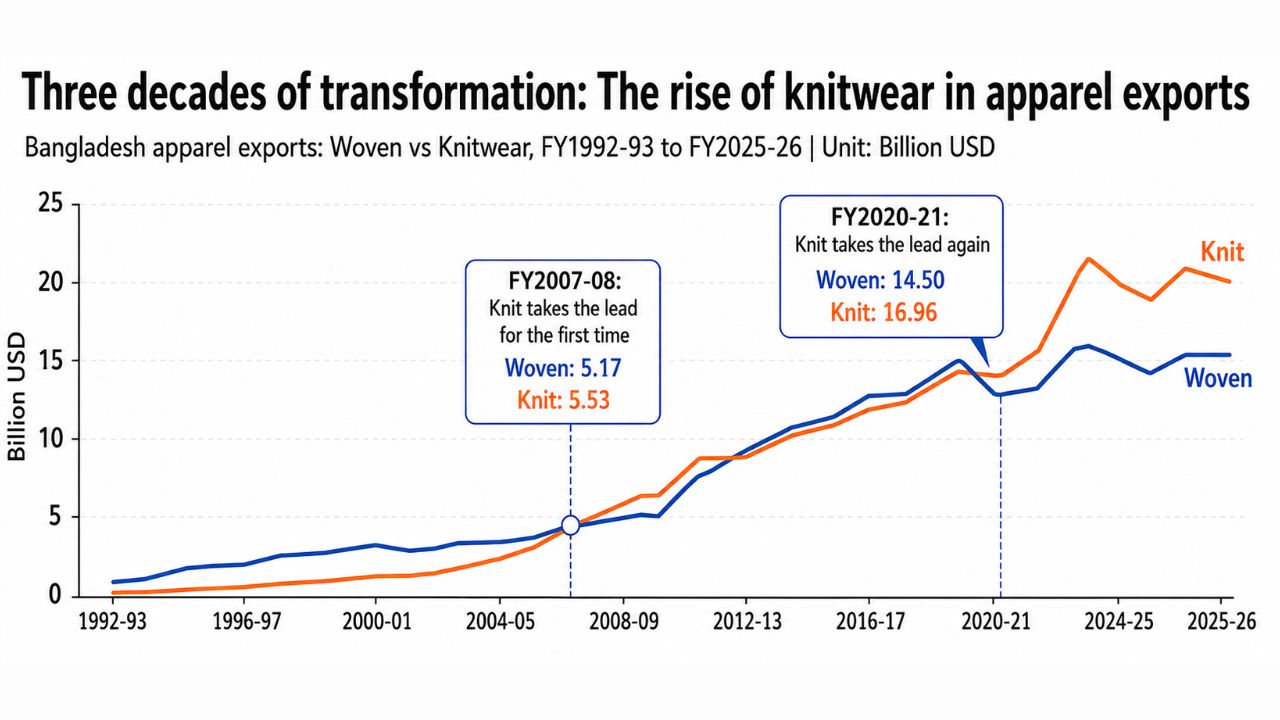
The shift within the apparel sector has been significant. An analysis of BGMEA fiscal-year data from FY1992-93 to FY2025-26 shows that knitwear’s share of apparel exports increased from 14.2 per cent to 53.3 per cent, transforming Bangladesh’s apparel industry from woven-led to knitwear-led.
From woven dominance to knitwear leadership
During the 1990s, woven garments overwhelmingly dominated Bangladesh’s apparel exports. At the beginning of the period, woven export earnings were more than six times higher than knitwear earnings. However, knitwear expanded rapidly during the decade, increasing its share of apparel exports to around 29 per cent by FY1999-2000.

The 2000s marked the rapid rise of knitwear. Knit exports grew faster than woven products and gradually closed the gap between the two segments. In FY2007-08, knitwear exports surpassed woven garments for the first time in BGMEA’s fiscal-year series.
The lead changed again during the 2010s, with woven garments regaining the top position in FY2011-12 and remaining ahead until FY2019-20. However, the gap between the two segments narrowed considerably during the period.
Knitwear regained the lead in FY2020-21, when exports reached $16.96 billion compared with $14.50 billion for woven garments. Knitwear has remained the larger segment in every fiscal year since.




By FY2025-26, knitwear exports stood at $20.62 billion, compared with $18.08 billion for woven garments.
The latest fiscal year, however, shows that the segment now dominating Bangladesh’s apparel exports is facing pressure. Knitwear exports declined 2.53 per cent year-on-year in FY2025-26, while woven exports fell by 0.61 per cent, according to calculations based on BGMEA data.
Backward linkages give knitwear an edge
Bangladesh Knitwear Manufacturers and Exporters Association President Mohammad Hatem told TIMES of Bangladesh that knitwear’s rise over the past three decades was driven largely by strong domestic backward linkages, including local spinning, knitting and dyeing capacity.
He said the sector now accounts for more than 53 per cent of apparel exports and achieves around 80–85 per cent value addition because much of the production process takes place locally.
In contrast, woven garments remain more dependent on imported fabrics, partly because establishing woven textile mills requires much larger investment, Hatem said.
He added that the knitwear sector’s reliance on domestic production has also made it more vulnerable to the ongoing gas shortage, which is disrupting knitting, dyeing and processing operations and contributing to the decline in knitwear exports in FY2025-26.
BGMEA Director Mohiuddin Rubel told TIMES the stronger growth of Bangladesh’s knitwear exports compared with woven garments has largely been supported by the sector’s well-developed domestic backward linkages and easier access to raw materials.
“Bangladesh has built a strong backward-linkage industry for knitwear, with much of the yarn and other inputs produced locally. When raw materials are readily available, production, marketing and overall growth naturally become easier,” he said.
Rubel said the woven segment remains comparatively more dependent on imported fabrics, which can create longer lead times and limit its ability to respond as quickly to market demand.
He also pointed to changes in global consumption patterns after the Covid-19 pandemic, saying the expansion of work-from-home arrangements and more casual lifestyles helped strengthen global demand for knitwear products.
Gas shortages test the leading segment
On the recent slowdown in knitwear exports, Rubel said the ongoing gas shortage has had a greater impact on the segment because a much larger part of its manufacturing and backward-linkage activities takes place locally.
“With a large domestic manufacturing base, the knitwear sector is naturally more exposed when gas supply is disrupted. Production can also face difficulties from occasional shortages of locally available yarn,” he said.