


For Tanima Ferdous, travelling from Badda to Shahbagh, the Pink Bus was supposed to offer a more comfortable journey. Instead, she ended up facing the same old ordeal on a crowded local bus.
Tanima had planned to take the dedicated bus service for women but could not find one. She eventually boarded a local bus, spending the entire journey standing and struggling for space.
“I thought I would take the Pink Bus, but I couldn’t find one. I had to take a local bus. I had to stand the entire way and was almost hanging from the bus. There was so much fanfare yesterday, but I saw no sign of it in practice,” she told TIMES of Bangladesh.
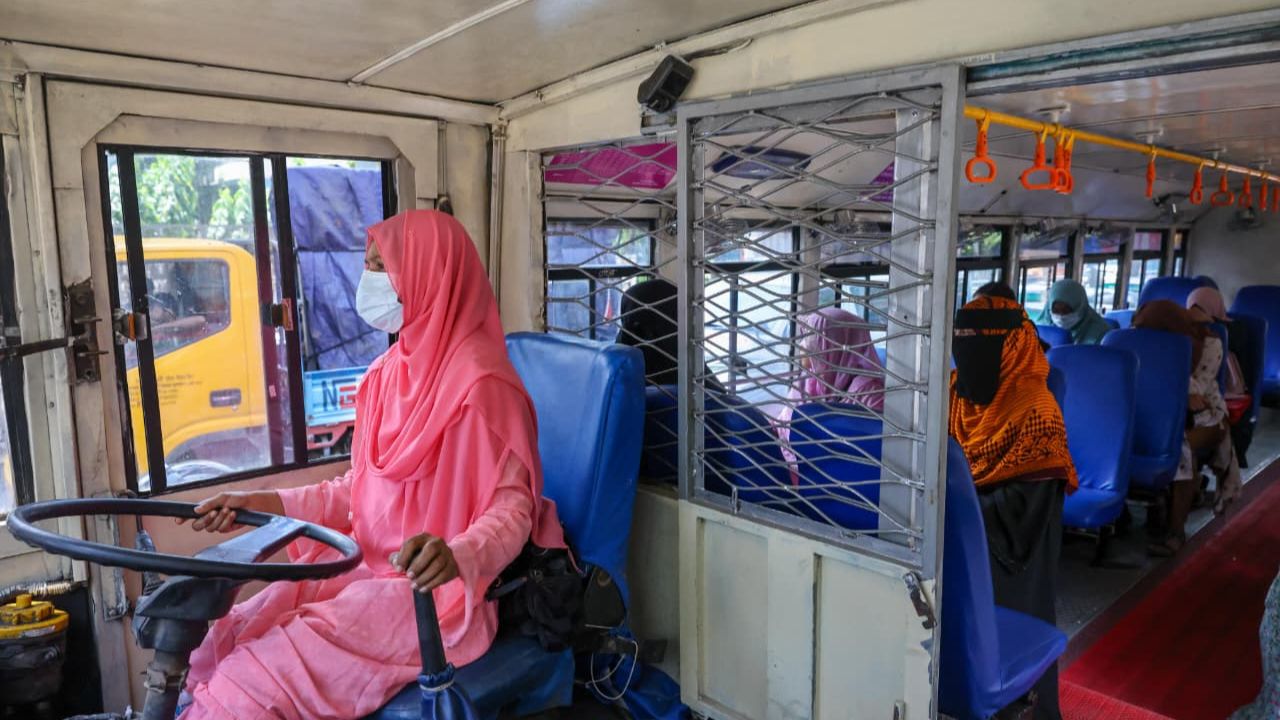
For Sumona Begum, who travels from Mirpur to Motijheel, the experience was quite different. She managed to board a Pink Bus but was surprised to find only a handful of passengers.
“I got on and found that there were only five passengers, including me,” she said.
The low turnout was noticeable on most Pink Buses in Dhaka on the first day of the service, with many of the double-decker buses running with plenty of empty seats.

The latest initiative is the fourth attempt to operate dedicated bus services for women. Previous services also struggled to attract enough passengers and were eventually discontinued amid losses.
One of the key challenges appears to be the long intervals between buses on some routes. Women who cannot afford to wait for hours are likely to turn to regular buses or other modes of transport instead.
Mohammad Shahin, a police officer assigned to traffic duty in Farmgate, said he saw very few Pink Buses throughout the day. “The number of Pink Buses is very low. I saw them operating only two or three times throughout the day,” he said.
The latest initiative has nevertheless generated considerable attention, particularly because women are operating the service. Female drivers and assistants are handling everything from driving the buses to collecting fares, while wearing pink uniforms.




BRTC, however, is not ready to assess the service based on its first day. “Since this is the first day of operations, the drivers also need time to familiarise themselves with the new routes, schedules and actual traffic conditions. Passengers also need time to learn when and where the buses operate,” BRTC Public Relations Officer Mostakim Bhuiyan told TIMES.
“It takes time to understand the strengths and weaknesses of any new initiative. After the service has operated for some time, it will be possible to properly assess the number of trips, passenger turnout and the challenges,” he said.
Routes and fares
The 14 Pink Buses began operating on 13 routes across Dhaka, Chattogram and Bogura on Wednesday.
According to BRTC, the buses will operate from 8am to 6pm every day. The fare is Tk2.23 per kilometre, the same as that charged on regular buses.
In Dhaka, the service covers 10 routes: Notun Bazar (Coca-Cola) to Motijheel, Taltala to Motijheel, Demra Staff Quarter to GPO, Mirpur 10 to Motijheel, Mirpur to Motijheel, Mirpur 12 to Motijheel, Narayanganj to Motijheel, Mohammadpur to Motijheel, Abdullahpur to Motijheel, and Airport to Gazipur.
Outside Dhaka, two routes are covered in Bogura — Sherpur to Matidali and Banani to Mokamtala — while one route runs in Chattogram, from Kalurghat to Patenga.
At the inauguration ceremony, Road Transport and Bridges Minister Sheikh Rabiul Alam said the government was planning to purchase 100 pink electric buses for women. The target is to introduce 50 within three months and roll out the rest in phases within six months.
A history of failed attempts
Dedicated bus services for women are not new in Bangladesh. BRTC first introduced such a service in 1998 and expanded it to Dhaka and surrounding areas in 2001. The service was later discontinued.
It was revived in 2009 but again faltered and was eventually discontinued in 2015. In 2018, BRTC and private organisation Rangs launched another service, “Dolonchapa”, which was also discontinued in 2022.
Mostakim Bhuiyan said the latest initiative differs from previous attempts because women are now involved in operating the service.
“In the previous services, the drivers and assistants were men. So the current initiative is completely new,” he said.
‘Routes and number of buses need to increase’
Syed Mohammad Sheikh Imtiaz, a professor at the University of Dhaka’s Department of Women and Gender Studies, described the dedicated bus service as a form of “positive discrimination” or a specialised intervention.
“Since women face high levels of sexual harassment on public transport, this is a good short-term strategy before a long-term solution is found,” he said.
He said the low passenger turnout could indicate that women’s actual transport needs had not been adequately assessed. “The number of women travelling during office hours is so high that 14 buses are completely inadequate. The routes and number of buses need to be increased for the initiative to succeed,” he said.
Working woman Tazfiha Sikder, however, questioned whether the use of pink was appropriate. “Separating buses by colour itself creates discrimination. If women’s safety cannot be ensured on regular public transport, simply introducing buses of a different colour will not solve the problem,” she said.
Professor Imtiaz agreed that the concern was valid. “The use of pink may reflect stereotypical ideas about women. Another colour could have been used,” he said.