






Three interim government advisers, including Environment Adviser Syeda Rizwana Hasan, launched the ambitious “blue network” plan in February 2025, rolling out a red carpet to inaugurate dredging and restoration work at Baunia Canal in Mirpur to revive Dhaka’s waterways. Despite the fanfare, the initiative has delivered little, with the canals remaining heavily polluted.
More than a year on, the waterways are still choked with waste, while international funding remains tied up in strict conditions set by the World Bank.
Restoring Dhaka’s canals has long been a stated priority for successive governments, but despite spending hundreds of crores of taka on multiple projects, little has changed.
Experts say that despite repeated announcements, high-profile inaugurations and large-scale project plans, the benefits have yet to reach ordinary residents.
Instead, they point to stagnant, foul-smelling water clogged with plastic waste, rising dengue risks and persistent waterlogging across the capital.
The so-called blue network looks impressive on paper, but in reality it has become a collection of stagnant, lifeless and toxic water bodies across Dhaka, several experts said.
Waste-choked canals expose failure
Cleaning and restoration work began on six canals with government funding as part of the blue network initiative.
They are Baunia Canal in Mirpur-13 and 14, Rupnagar Canal in the Rupnagar residential area, Begunbari Canal in Rampura-Begunbari east of Hatirjheel, Manda Canal in the Manda-Mugda-Khilgaon area, Kalunagar Canal in Hazaribagh and Kamrangirchar, and Korail Canal near the Korail slum adjacent to Banani, Gulshan and Mohakhali.
However, after more than a year, the situation of the canals remains unchanged.
The current state of Baunia Canal, a 7.19km waterway flowing through Mirpur-13 and 14, Bhashantek and Manikdi before joining the Turag River, makes it hard to recognise as a canal.
Much of the water has dried up, replaced by layers of plastic waste, while nearby dumping grounds continue to feed garbage into the channel, where it is often burned in the open.
Ayub Ali, owner of Sagar Furniture built on a raised platform beside the canal, said only limited clean-up work had taken place.
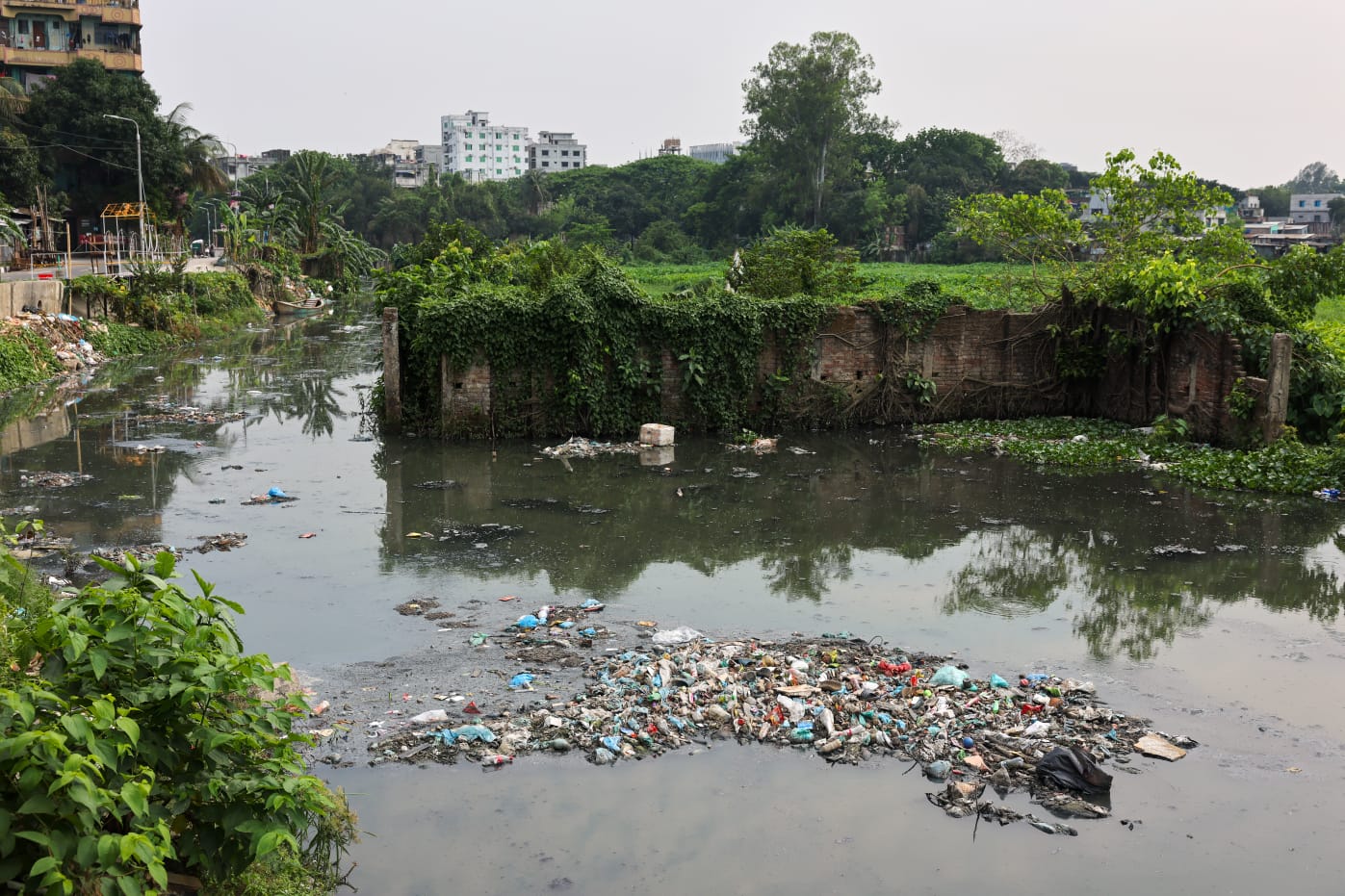
“In 2025, Adviser Rizwana visited, but only the section under the bridge was cleared,” he told TIMES of Bangladesh.
A 20-storey government building stands nearby, and residents say cleaning efforts were largely confined to the visible area in front of it.
Farid, a local grocer, said the canal had only been briefly cleaned ahead of Eid.
“Before that, it was entirely covered in garbage,” he said.
A similar picture emerges at Rupnagar Canal, a 3.5km channel linking Mirpur’s residential areas to the Turag, though DNCC records put its length at around 5km, with a width ranging from five to 15 metres.
Once a flowing waterway, it has now turned into what residents describe as a “living nightmare”.
Barek Mia, who has lived by the canal for four decades, recalled a stark contrast with the past.
“Even during the 1988 floods, the water was clean enough for bathing and fishing,” he said.
“Now it is filled with plastic and rotting waste.”
According to DNCC figures, more than Tk9 crore has been spent on partially cleaning the canal, including Tk5.70 crore for 3.3km in the first phase and Tk3.39 crore for a further 900 metres in the second.
Conditions are no better at Ramchandrapur-Lautola Canal in Mohammadpur, which stretches over 3km and measures between 15 and 25 metres wide.
Hemat Sikdar, a resident of Shyamoli Housing, said the stench from the water made daily life difficult.
“It is hard to live here because of the smell, and during heavy rain the dirty water overflows,” he said.
Rozina Begum, who has lived in a nearby slum for 20 years, said mosquito control efforts were uneven.
“Teams come sometimes, but they spray in the housing area, not in our slum,” she said.
“We have to sit under mosquito nets in the evening.”
The situation under DSCC appears even more severe.
Kalunagar Canal, which runs from Hazaribagh and Kamrangirchar to the Buriganga River, and Manda Canal, linking Manda, Mugda and Khilgaon to the Balu River, have effectively lost their function as waterways.
Years of accumulated solid waste have filled the channels, with some areas now so clogged that people walk directly over them.
Sadikur Rahman, a resident of the Manda area, said the situation had remained unchanged for years.
“For the past three to four years, it has been the same,” he said.
“The water is stagnant, and during the monsoon, the waste from the canal flows into homes in low-lying areas.”
Blue network fails to materialise
The “blue network” plan, expected to attract around $8.5 billion in investment by 2040, has stumbled at an early stage.
The first phase of the project, aimed at improving water security and environmental protection in Dhaka with World Bank support, has yet to receive administrative approval, which had been expected on 10 February 2026.
The project, scheduled for implementation between 2026 and 2032, was estimated to cost $406 million.
Of that, $370 million was to come from the World Bank’s International Development Association (IDA), $26 million from government funds, and the remaining $10 million from the private sector.
M L Saikat, executive engineer of the Dhaka Division at the Bangladesh Water Development Board, said the project remained stuck at the approval stage.
“It is awaiting clearance after revisions following the Project Evaluation Committee meeting and is yet to be placed before the Executive Committee of the National Economic Council,” he told TIMES of Bangladesh.
Parvez Chowdhury, former head of the blue network working group, said the initiative initially had no separate government project or dedicated budget allocation.
Instead, work began using routine maintenance funds and existing manpower from the city corporations, Dhaka Water Supply and Sewerage Authority, and the Department of Environment.

He said his committee had identified 19 canals and prepared an execution plan, with an initial cost estimate of between Tk30 crore and Tk50 crore.
Work had started on six of those canals, he added.
However, Parvez said he had no updated information on progress or actual spending after stepping down from his role seven to eight months ago.
Experts say the main obstacle to implementing the project has been the World Bank’s results-based financing model, under which funds are released only if pre-set targets are met.
Efforts to reach former Environment Adviser Syeda Rizwana Hasan for comment were unsuccessful, as she did not answer repeated phone calls.
City corporations waste crores
A major canal restoration project under DSCC, approved in October 2022 at a meeting of the Executive Committee of the National Economic Council, has yet to see meaningful progress on the ground.
The Tk898 crore project covers four canals – Kalunagar, Zirany, Manda and Shyampur – and received administrative approval in November 2022, with a completion deadline set for June 2026.
However, little effective work has begun so far.
Md Ahsan Habib, executive engineer of DSCC’s waste management division, said progress remained limited despite directives from higher authorities.
“Although there have been instructions to recover the canals, tangible progress has been slow,” he told TIMES.
Data from Dhaka North City Corporation (DNCC) shows that around Tk51.20 crore has been spent over the past 18 months to remove waste and dredge around 15.23 kilometres across five canals.
Over the past five fiscal years, from 2020-21 to 2024-25, the agency’s total spending on canal excavation, boundary demarcation and development has reached about Tk192.87 crore.
Experts warn of structural flaws
Environmental expert M Maksudur Rahman said Dhaka is no longer experiencing typical flooding, but rather prolonged waterlogging caused by blocked canals.
“Encroached canals cannot drain water properly. Even light rain submerges roads, and stagnant, polluted water remains for months, posing serious public health risks,” he told TIMES.
Urban planner Adil Mohammed Khan said successive governments have announced various initiatives, but few have delivered tangible results.
He noted that the blue network project taken up during the interim government period was no exception.
He said structural flaws in the canal restoration process had disrupted natural water flow, leaving the waterways stagnant.
“As a result, even regular cleaning efforts do not produce sustainable outcomes,” he added.
He also pointed to a lack of effective coordination between the city corporations and the Bangladesh Water Development Board, as well as the absence of clear accountability.
Without addressing these issues, he warned, efforts to restore Dhaka’s canals are likely to continue falling short.


