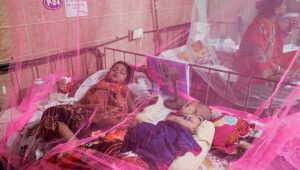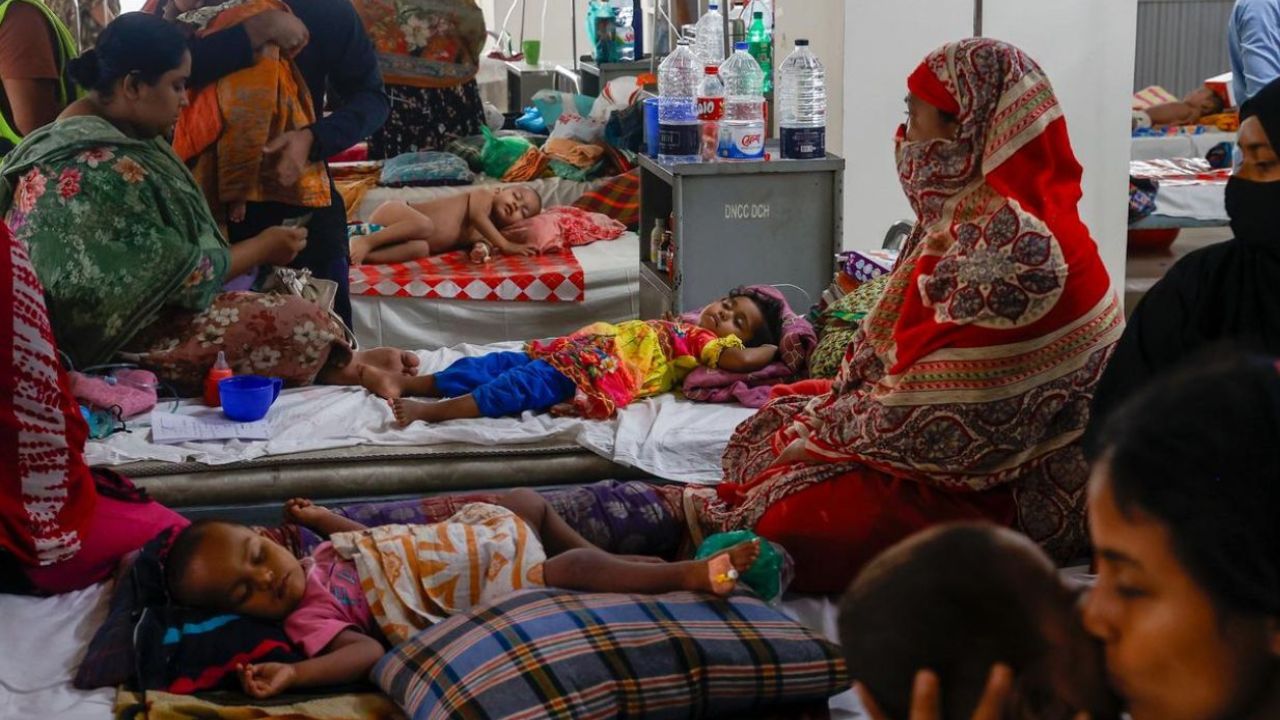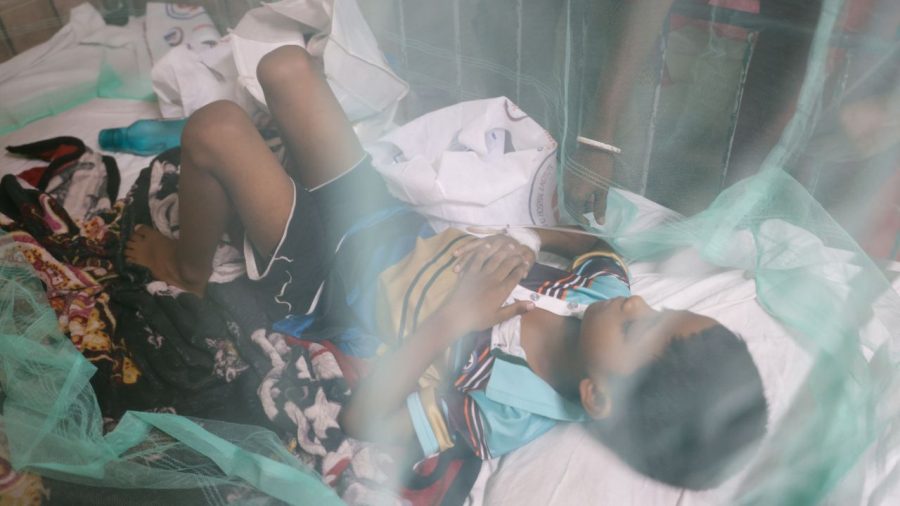



The threat of dengue has flared up across key sectors of the capital, with Dhanmondi, Dhaka Medical College Hospital (DMCH), and Dhaka University recorded as the premier hotspots for Aedes mosquito breeding and high vector density.
A comprehensive 12-day survey conducted by the Dhaka South City Corporation (DSCC) has put 29 wards on high-risk alert, while 28 wards face moderate risk and 18 remain under standard monitoring.
The findings stem from an intensive monsoon larvae survey carried out between 27 September and 8 October, which audited 2,250 households across all 75 DSCC wards. Presenting the results on Wednesday, DSCC Chief Health Officer Dr Jahane Ferdous Binte Rahman confirmed that Aedes larvae and pupae were detected in 322 inspected premises, evaluated through key metrics including the Breteau, House, Container, and Pupa indices.

The data paints a concerning picture for academic, medical, and residential hubs in Zone 1, where Ward 15 (Dhanmondi), Ward 20 (DMCH), and Ward 21 (Dhaka University) registered the highest risk levels, alongside elevated concern in Ward 16 (Bagan), Ward 18, and Ward 19 (Kakrail).
This high-risk designation extends across multiple city sectors, including six wards in Zone 2 encompassing Khilgaon, Basabo-Fakirapul, Shahjahanpur, Malibagh, and Rajarbagh; eight wards in Zone 3 covering Hazaribagh, Ganaktuli, Jagannath Saha Road, Lalbagh, Azimpur, Bakshibazar, Jhaurchar, and West Rasulpur; as well as Moulvibazar, West Jurain, and Alambagh in Zones 4 and 5. Furthermore, heavy larval density was recorded in North Kutubkhali and Adarshabag in Zone 9, alongside Kadamtali, Wasa Colony, South Rayerbagh, and Dolair Par-Dania in Zone 10.




Property types and everyday water storage practices were found to play a major role in vector proliferation across the metropolis.
Detached homes and individual units within multi-storey complexes proved equally vulnerable, accounting for 31.37 per cent and 31.6 per cent of larval discoveries respectively. Semi-pucca homes accounted for 17.39 per cent, construction sites 13.4 per cent, and vacant plots 7.14 per cent.
Everyday household containers emerged as the primary breeding grounds, with plastic buckets responsible for 14.21 per cent of positive sites, plastic drums for 11.22 per cent, stagnant basement water for 9.98 per cent, and plastic mugs accounting for 9.923 per cent.
DSCC Administrator Md Abdus Salam noted that targeted interventions have shifted the epidemiological map, with several previously high-risk wards dropping off the critical list this year due to intensified vector control, expressing confidence that similar focused drives can neutralise the threat in newly flagged areas.

Enforcement measures are already under way, demonstrated on the survey’s opening day when inspectors discovered breeding sites in the basement of a construction site in Bangabazar, resulting in the immediate sealing of the property and heavy fines.
To combat the surge, the DSCC has colour-coded the municipality, marking high-risk areas in red, moderate zones in yellow, and lower-risk sectors in green, while twelve joint teams from the Ministry of Health and City Corporation lead weekly cleaning and fogging operations every Saturday across all 75 wards, complemented by school and mosque awareness drives and mobile court task forces empowered to penalise non-compliant property owners.