






At a quiet courtyard in Sonahar Para, Pabna, an old voice of Bengal’s folk-literary heritage is preparing to return.
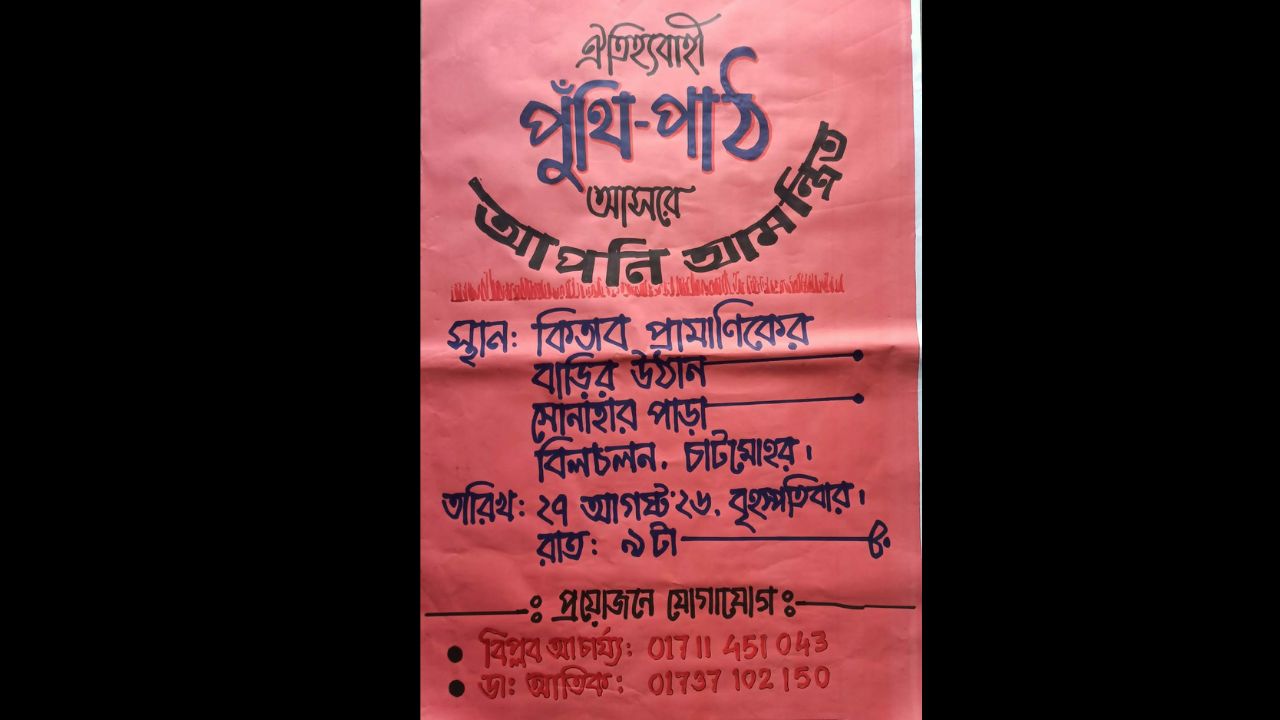
At the residence of Kitab Pramanik in Sonahar Para, Bilchalan Union of Chatmohar Upazila, a traditional Puthi reading gathering will bring together young people and cultural enthusiasts in an effort to reconnect a new generation with one of Bengal’s fading storytelling traditions.
Held under the moonlight, the gathering will recreate the intimate atmosphere of rural Bengal’s traditional Puthi Ashor.
Mats will be spread across the courtyard, with audiences seated in a circle as the Gayen narrates age-old tales through rhythm, melody and dramatic recitation.
Kupis and hurricane lanterns will cast a warm glow over the gathering, evoking a time when such evenings were a cherished form of entertainment in village communities.

For generations, Puthi readings served as an important form of storytelling across rural Bengal.
Stories such as Amir Hamza, Shahnameh, Alif Laila, Hatemtai, Kamala Sundari, Deldar Kumar, Shahzadi Dil Pinjir, Jangnama, Ami Saudagar, Velua Sundari, Gazikalu O Champabati Kanya, Tazkiratul Awliya, Qasas-ul-Anbiya, Bibi Sonavan, Fakir Bilas and Laila-Majnu once echoed through village courtyards.
Characters such as Hanifa, Hamza, Hatemtai, Sohrab-Rustam and Jaigun Bibi also became deeply embedded in the imagination of generations of listeners.
But the tradition has gradually faded under the influence of modern mass media, changing entertainment habits and rapid modernisation.
Once a vibrant part of rural cultural life, Puthi reading now survives largely through the efforts of a small number of dedicated practitioners and enthusiasts.
The Puthi literary tradition of the Indian subcontinent is believed to have emerged around the 18th century.
Poet Fakir Garibullah, from Balia-Hafezpur in Hooghly, is regarded as one of its pioneers. His celebrated Amir Hamza is widely associated with the early development of the tradition.
Linguist Suniti Kumar Chatterji noted that around 32 per cent of the vocabulary used in Puthi literature was of foreign origin.
Its language and stylistic character differed significantly from the Bengali literary tradition that had dominated the medieval period, drawing considerably from the spoken language of regions including Kolkata, Howrah, Hooghly and the 24 Parganas.
Despite the decline in its popularity, the tradition has never disappeared entirely.
Among those continuing to preserve it is Asaduzzaman Dulal, a cultural personality from Chatmohar who remains dedicated to keeping Puthi recitation alive.
At the upcoming gathering, Dulal will perform Bibi Sonavan, while Md Laimuddin Pramanik will present Gazikalu O Champabati.
The event is being promoted through handwritten posters across Chatmohar, adding another layer of nostalgia to an initiative centred on reviving an old form of community storytelling.
The initiative has received support from Sajal Biswas, Biplab Acharya, Niamul Mukta, Lecturer Abdul Mannan, Amlan Bhattacharya, Sourav Kundu, Shubho Karmakar and others who believe cultural traditions survive when communities actively choose to preserve them.
More than a night of recitation, the gathering represents an attempt to restore a forgotten soundscape of Bengal and introduce its stories to a generation growing increasingly distant from traditional forms of folk culture.
For a few hours, beneath the moon and the glow of lanterns, the courtyard may become a bridge between past and present — allowing old stories, memories and a fragment of Bengal’s cultural soul to find their way back into the light.


