Political unrest in Bangladesh has become a chronic crisis that threatens the country’s long-term stability and growth. The upheavals of 2024–2025 mark a decisive break from the past, exposing deep structural failures in governance, political culture, and institutional resilience. Once hailed as a global development success praised for steady GDP growth, poverty reduction, and social indicators, Bangladesh now confronts a dangerous convergence of political paralysis, economic contraction, and social fragmentation. What is at stake is not merely a change of government, but the survival of democratic norms and economic momentum built over decades. Without urgent corrective action, the nation risks losing hard-earned gains and sliding into prolonged instability with consequences that will be borne by ordinary citizens.
Political turbulence has been a recurring feature of Bangladesh since independence in 1971. From the 1990 mass uprising that ended military rule to the caretaker government crisis of 1996, the emergency rule of 2006–2008, and the violent hartal and blockade cycles of 2013–2014, democracy has often been hostage to street confrontation rather than institutional consensus.
Yet the crisis of 2024–2025 is fundamentally different in scale and consequence. Unlike previous confrontations, it resulted in the fall of a sitting prime minister, Sheikh Hasina, ended more than 15 years of uninterrupted Awami League rule, and replaced an elected government with an interim administration led by Nobel laureate Dr. Muhammad Yunus. The subsequent banning of the Awami League has left the political arena dangerously unbalanced. Bangladesh is therefore not reliving history; it is confronting an existential rupture. The familiar cycle of rivalry has escalated into a crisis of state legitimacy.
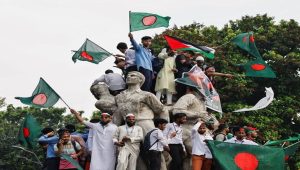
In July 2024, Bangladesh entered uncharted territory. Student-led protests against corruption, authoritarianism, and police brutality rapidly evolved into a nationwide uprising. Within weeks, Dhaka and other major cities descended into chaos as clashes between protesters and security forces intensified. Hundreds were killed and thousands injured. Human rights organisations documented excessive use of force, arbitrary arrests, and enforced disappearances. The streets became symbols of rage and resistance, while fear permeated everyday life. Under mounting domestic and international pressure, Sheikh Hasina resigned and went into exile, creating a power vacuum unprecedented in recent history. Her fall closed one chapter of authoritarian consolidation but opened another fraught with uncertainty.

In the immediate aftermath, the interim authorities banned the Awami League under anti-terror laws, accusing it of orchestrating violence. Party offices were sealed, bank accounts frozen, and thousands of activists detained. For the first time since 1971, a major political force was effectively erased from open political competition. While the government framed the ban as a security necessity, critics warned that excluding a mass-based party undermined pluralism and risked replacing one form of authoritarianism with another. Democracy without competition, they argued, is democracy in name only.
Dr. Muhammad Yunus assumed leadership of the interim government with a mandate to stabilise the country, implement reforms, and prepare for elections. Initially welcomed by civil society and international partners, his administration soon faced criticism for perceived overreach, delays in restoring law and order, and a lack of clear political consensus.
The interim government’s credibility weakened further as violence persisted and economic indicators deteriorated. Instead of acting as a neutral bridge, it became another contested actor in an increasingly polarised landscape.



Dr. Yunus’s announcement of an April 2026 election timeline only deepened the deadlock. Bangladesh thus found itself trapped between an exiled and banned Awami League, an emboldened BNP demanding immediate power, and an interim government struggling to assert legitimacy. The result has been prolonged uncertainty, fueling unrest rather than reconciliation.
Operation Devil Hunt marked a turning point. Over 11,000 Awami League-linked figures were arrested in weeks. While authorities claimed success against ‘violent networks,’ civil society groups described the operation as collective punishment. Human rights organisations warned that the line between justice and political vendetta had blurred beyond recognition. The breakdown of law-and-order exposed minorities to heightened risk. Hindu temples were vandalised, properties attacked, and intimidation of Christian and indigenous communities reported. At least 47 major incidents of communal violence were recorded within a year, tarnishing Bangladesh’s secular image. Journalists, too, came under attack. More than 120 reported harassment or detention, prompting media unions to describe the period as the darkest for press freedom since 1990. Fear replaced trust as the organizing principle of governance.
Political chaos has exacted a devastating economic toll. GDP growth slowed from 5.8% in FY2023 to 4.2% in FY2024, with projections falling to around 3.3% in FY2025. Investor confidence has collapsed; foreign direct investment has dropped by nearly two-thirds compared to pre-2024 levels. The ready-made garment sector, the backbone of exports, has been hit hardest. More than two million workers lost jobs due to factory closures and disrupted supply chains. Inflation surged to 12–14%, with food prices rising fastest, pushing millions closer to poverty.
The May-June 2025 NBR strike alone cost an estimated Tk 2,500 crore per day, paralysing trade and worsening shortages. Banking stress intensified as non-performing loans threatened to reach alarming levels, forcing Bangladesh to seek additional IMF assistance.
Globally, Bangladesh is now viewed as a high-risk destination. Multilateral lenders warn of declining confidence, while Western nations press for credible elections and minority protection. India, balancing strategic interests, has urged dialogue while tightening border vigilance.
The path forward is clear, if politically difficult. Bangladesh needs inclusive, internationally monitored elections within a credible timeframe; impartial law enforcement; economic reforms to restore confidence; and genuine protection for minorities and the press. Above all, political dialogue must replace zero-sum confrontation.
Without urgent reform and inclusive politics, decades of progress risk being undone. For a nation with immense potential and a young population, inaction is not an option. The time to restore stability, trust, and democratic legitimacy is now, before the crisis becomes irreversible.
The views expressed in this article are solely of the author
The writer is a columnist and political analyst