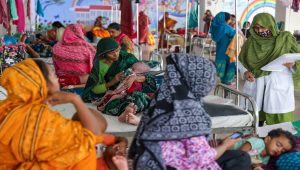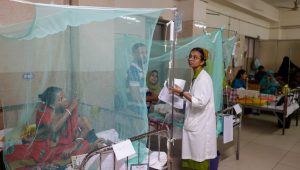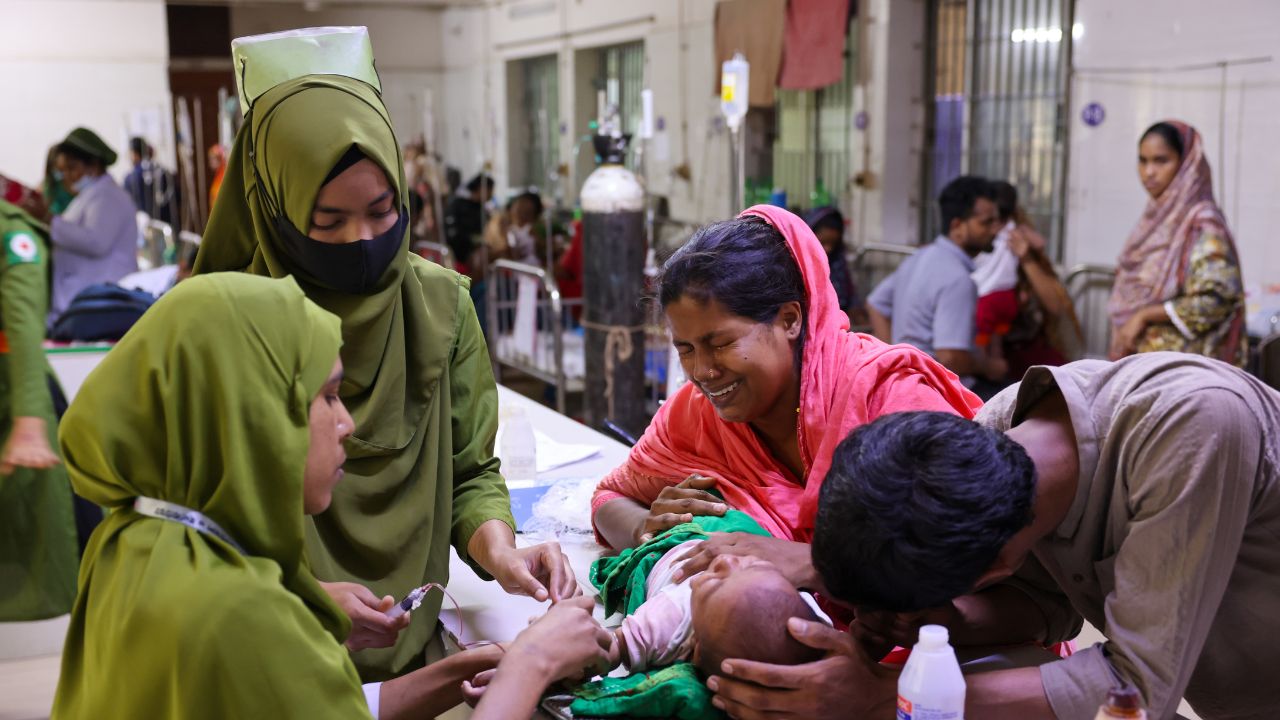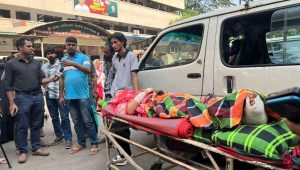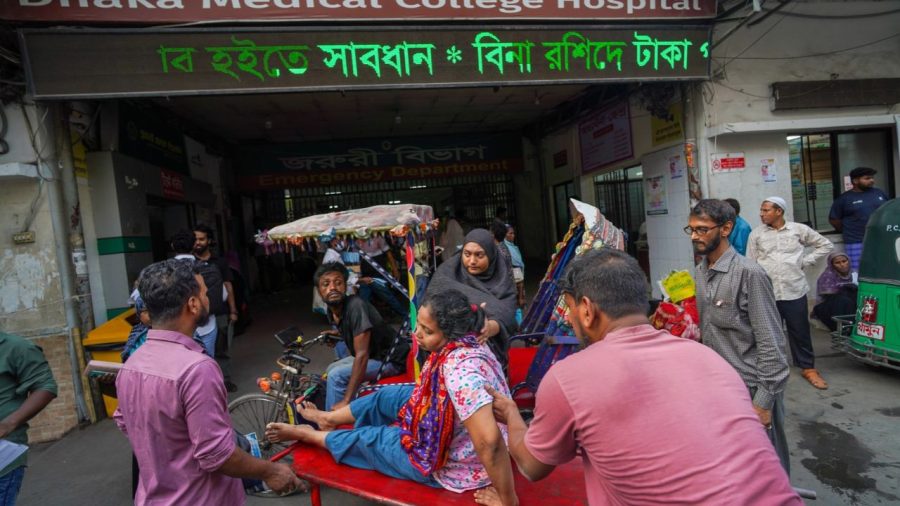



A stroke patient lay helpless on a metal trolley on the emergency room steps, whilst an accident victim’s desperate brother spent three excruciating hours pleading for a vehicle. Both were casualties of a ruthless private ambulance strike that has left vulnerable patients stranded outside Dhaka Medical College Hospital (DMCH).
Since Wednesday morning, distraught families have spilled out onto the pavements outside the emergency and outpatient departments, unable to transfer critically ill relatives as private operators withdrew services over parking rights.
For Rezaul Karim, the strike turned a medical emergency into a nightmare.
His sister, Seema Akter, suffered severe injuries in a road accident in Mawa on Tuesday. Doctors at DMCH urgently advised transferring her to Pangu Hospital, but finding transport proved nearly impossible.
“I searched frantically for nearly three hours and even dialled the national emergency hotline, 999, but no help came,” Rezaul said.

In desperation, he eventually persuaded the driver of a government-owned ambulance to take his sister.
Other families were not as fortunate. Shaheen Gazi, a stroke victim brought from Savar, remained abandoned on a stretcher outside the emergency entrance.
Doctors required an urgent MRI scan at Ibn Sina Hospital in Lalbagh, but without an ambulance, his treatment came to a complete standstill.




“The entire hospital is run by syndicates, and ambulances are no exception,” said Shafique Ahmed, whose relative was caught in the gridlock. “I cannot even bring an outside ambulance to collect a patient because local drivers physically obstruct us. They are holding helpless patients hostage to press their own demands.”
Parking dispute or profiteering racket?
Whilst private operators claim the strike was sparked by a ban on parking inside hospital grounds, insider allegations suggest a far more lucrative motive: control over a high-profit ambulance app.
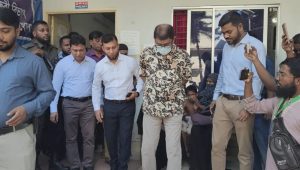
Following daylong sufferings of patients, Bangladesh Ambulance Owners’ Welfare Association in the night said they had suspended their strike for seven days after a meeting with the hospital administration and Shahbagh police.
“We have given the hospital authorities seven days to meet our demands. If they fail to implement them within this period, we will announce further programmes,” said Md Badal Matbar, the association general secretary.
According to a member of the ambulance owners’ association, the strike was triggered after the hospital’s new director scrapped an app-based booking service.
The scheme, originally intended to streamline transport, had allegedly been hijacked by an operator syndicate to gouge vulnerable families – jacking up standard Tk1,000 fares to Tk2,500, and Tk8,000 inter-district runs to a staggering Tk13,000.
Insiders claim the app generated Tk30,000 to Tk40,000 daily in illegal commissions for association leaders, yielding up to Tk15 lakh a month.

“The demand for parking inside the hospital is an eyewash,” another ambulance owner revealed. “The real goal is to force the hospital to reinstate the app. Parking inside gives them the foothold they need.”
Central figures behind the strike include Md Badal Matbar, general secretary of the Bangladesh Ambulance Owners’ Welfare Association, and Md Emon Ali, general secretary of the DMCH Private Ambulance Owners’ Association.
Badal serves as president of the Dhaka Medical unit of Jubo Dal, whilst Emon is actively vying for the position of general secretary. The pair reportedly controlled the collection of Tk12-15 lakh generated every month through the app-based ambulance scheme.
Threatening to escalate the standoff, Emon Ali warned, “If our demands are not met, the Dhaka Metropolitan Ambulance Owners’ Association will enforce a full strike from Thursday.”
As political and commercial interests clash, patients remain trapped in the crossfire.