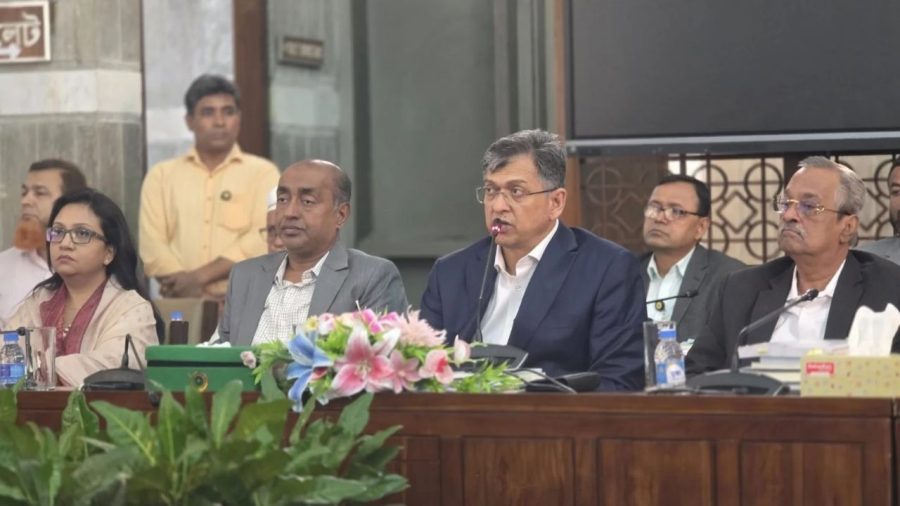



A decision on the formation process, operational scope, and methods to keep the caretaker government system free from controversy will be taken in parliament after the bill is introduced, Home Minister Salahuddin Ahmed said on Wednesday.
Salahuddin, also president of the Special Committee on Constitutional Amendment, added that any nationally acceptable proposal arising from discussions will also be considered.
He informed reporters that there is no alternative to introducing the caretaker government system in Bangladesh, speaking after a meeting of the special committee on constitutional amendment.
Regarding the proposed ranked-choice voting method in the July National Charter, Salahuddin explained that the committee had a note of dissent on the issue. He noted that they favoured discussing and deciding the matter in parliament.
“We must introduce the caretaker government system; there is no alternative to it,” the committee president said.
Salahuddin added that discussions would cover the timeframe for forming the government, its operational scope, and its formation methodology, including examining which search body or selection committee could render the process free from controversy.
He observed that further suggestions and proposals might emerge during parliamentary debates after the bill is introduced, meaning no final decision on constitutional amendment can be reached immediately.

Opposition protests, social proposals
Addressing the opposition party’s street movement over constitutional reform, the home minister expressed criticism, noting that the opposition had the opportunity to present their views if they had approached the special committee on constitutional amendment.
He commented that the opposition appeared to prioritise street protests over dialogue, adding, “The opposition is protesting on the streets. If they came to the constitutional amendment committee with the demands they are raising, we could have listened to their views.
“But I think they are prioritising street movement.”
Salahuddin informed that proposals gathered from various sections of society regarding constitutional amendment will be compiled and discussed in upcoming committee meetings.



He mentioned receiving submissions from constitutional experts, Supreme Court lawyers, bar association representatives, teachers, and editors, clarifying that these proposals remain under review and the committee has not yet reached any decisions.
He also revealed that various proposals concerning the balance of power between the president and the prime minister have been received and will be compiled into the upcoming report.
Enforced disappearance victim testimonies
During the meeting, the committee listened to accounts from family members of individuals subjected to enforced disappearance and torture over the past 17 years.
Salahuddin highlighted that 48 representative individuals were invited with the assistance of the ministry of liberation war affairs, Mayer Daak, and several other organisations.
The participants included relatives of returned victims as well as family members of those who remain missing, attending as wives, children, and fathers.
The victim families demanded measures to prevent future disappearances, justice for perpetrators, legal management of missing persons’ properties, official state recognition, and family rehabilitation.
Expressing empathy as a former victim of enforced disappearance himself, Salahuddin shared that listening to the emotional testimonies was deeply moving, with several speakers unable to finish their accounts.
Legal redress and investigative safeguards
Regarding property management and compensation for victims of enforced disappearance, the home minister explained that provisions have been included in the Enforced Disappearance Prevention and Redress Act, allowing missing persons’ assets to be managed with court permission.

He outlined two legal mechanisms for compensation: confiscating and selling offenders’ assets under court orders, or state-provided compensation if asset liquidation proves insufficient.
Clarifying the investigation process under the Enforced Disappearance Prevention and Redress Act, Salahuddin explained that any law enforcement agency or branch facing allegations would be barred from investigating itself, with investigations assigned to a different force.
Differentiating between departmental indiscipline and criminal offences, he emphasised that criminal matters must be dealt with under criminal law, whereas departmental breaches would trigger internal disciplinary measures.
Crossfire comments and future protections
Responding to queries about recent comments on crossfire by the inspector general of police (IGP), the home minister observed that careless wording might have been used while discussing strict legal enforcement, though he noted that making such comments was inappropriate.
Reviewing the government’s eight-month tenure, he claimed that no incidents of crossfire, extrajudicial killing, custodial death, or enforced disappearance had occurred during this period.
He added that one allegation was investigated and human rights organisations have been invited to conduct independent inquiries.
Concluding his address, Salahuddin underscored the necessity of establishing safeguards so that no citizen falls victim to enforced disappearance, political vengeance, or death in police or prison custody in the future.
He affirmed that necessary constitutional protections would be incorporated into the constitution, while operational rules and laws would be enforced through their respective legal frameworks.