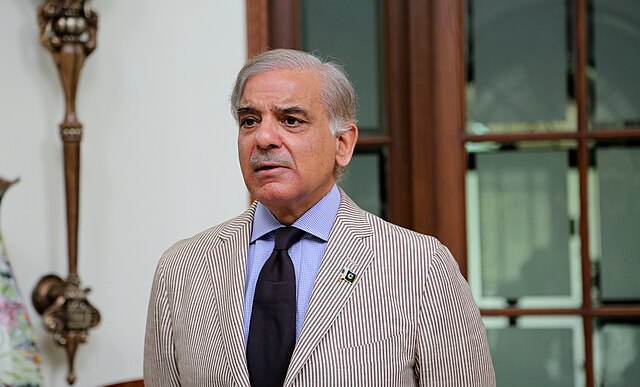



Pakistan Prime Minister Shehbaz Sharif on Friday, rejecting the weaponisation of water, warned that his country would not allow India to cross the red line by holding the Indus Waters Treaty in abeyance and endangering millions of lives for narrow political gains.
Shehbaz Sharif made the remark while addressing a three-day International Conference on Glaciers’ Preservation in Tajikistan’s capital Dushanbe on Friday, reports DAWN.
The event is being hosted by the Tajikistan government in collaboration with the United Nations, UNESCO, WMO, the Asian Development Bank, and other key partners as a historic moment for climate ambition, glacier preservation, and international cooperation.
It is being attended by over 2,500 delegates from 80 UN member states and 70 international organisations, including prime ministers, vice presidents, ministers, and UN assistant secretaries-general.

“India’s unilateral and illegal decision to hold in abeyance the Indus Waters Treaty, which governs the sharing of the Indus Basin’s water, is deeply regrettable,” Shehbaz said while addressing the conference.
“Millions of lives must not be held hostage to narrow political gains, and Pakistan will not allow this. We will never allow the red line to be crossed,” he said.




During his address, Shehbaz touched upon all relevant issues, including glacial preservation, Pakistan’s climate vulnerability, the 2022 floods in Pakistan, global climate action and responsibility, scientific projections on glacial melt, weaponisation of water and call to protect nature and humanity’s shared destiny.
“The world today bears fresh scars from the use of conventional weapons in Gaza that have left deep wounds. As if that were not enough, we are now witnessing an alarming new low—the weaponisation of water,” he observed.
He added that Pakistan, being home to over 13,000 glaciers, was the most concerning as glaciers contributed nearly half of the annual flows in the Indus-river system — “the lifeline of our civilisation, culture and economy”.
“The five great rivers that shape our geographical landscape—Indus, Jhelum, Chenab, Ravi, and Sutlej—all depend on the stability of glacial systems. This makes Pakistan one of the most vulnerable countries to any climatic changes that impact glaciers,” the Pakistan Prime Minister continued.
He told the gathering that Pakistan had faced the peril of glacial melt in the form of devastating floods in 2022 that destroyed millions of acres of standing crops, thousands of houses as well as infrastructure — despite the country contributing only less than half a per cent of the total world’s emissions and yet being one of the 10 most vulnerable countries.
He prayed that no other country faced such devastation, which necessitated a comprehensive plan and immediate implementation.
India suspended its participation in the Indus Waters Treaty (IWT) of 1960, which governs the usage of the Indus-river system, shortly after 26 civilians in India-held Kashmir were killed in what India called an act of terror.
After the April 22 attack, Indian Prime Minister Narendra Modi ordered officials to expedite planning and execution of projects on the Chenab, Jhelum and Indus rivers, three bodies of water in the Indus system that are designated primarily for Pakistan’s use.